

A digital marketing strategy for colleges is the primary way institutions reach, attract, and convert prospective students, especially amid one of the toughest demographic periods in higher education. Enrollment has been declining since its 2010 peak, and the coming demographic cliff, driven by lower birth rates since 2007 will intensify competition for a shrinking pool of traditional students through the 2030s. Institutions that treat digital marketing as a cost center are falling behind those that use a disciplined, integrated strategy to grow enrollment efficiently without matching increases in spend.
Contents
- 1 Key Takeaways
- 2 Channels That Influence Student Enrollment Decisions Today
- 3 Why Declining Enrollment Is Now a Strategic Risk
- 4 9 Strategies to Fix Enrollment Decline Now
- 4.1 Strategy 1: Connect SEO and Paid Search So They Feed Each Other
- 4.2 Strategy 2: Fix Your Landing Pages Before Buying More Traffic
- 4.3 Strategy 3: Stop Optimizing for Clicks, Start Optimizing for Enrollments
- 4.4 Strategy 4: Respond to Inquiries Faster
- 4.5 Strategy 5: Improve Lead Quality at the Source
- 4.6 Build Your Enrollment Strategy
- 4.7 Strategy 6: Align Marketing and Admissions Around the Same Metrics
- 4.8 Strategy 7: Concentrate Budget Around the Academic Calendar
- 4.9 Strategy 8: Measure What Actually Connects to Enrollment
- 4.10 Strategy 9: Build Organic and Automated Capacity So Growth Doesn’t Stop When Spend Does
- 5 Digital Marketing Strategy for Colleges and Its Role in Enrollment Growth
- 6 Where Student Acquisition Breaks Across the Funnel
- 7 Frequently Asked Questions
- 8 Turning Strategy Into Measurable Enrollment Growth
Key Takeaways
- Undergraduate enrollment has fallen 8.43% from its 2010 peak, and private four-year institutions are still losing headcount even as national numbers stabilize.
- 70% of higher education institutions plan to increase digital marketing budgets, recognizing that awareness, consideration, and conversion each require distinct channel strategies.
- Institutions that track cost per inquiry and cost per enrollment alongside traffic metrics can identify exactly which campaigns are driving applications and which are absorbing spend without return.
Channels That Influence Student Enrollment Decisions Today
Based on Sixth City Marketing’s higher education marketing statistics, over 90% of online experiences start with a search engine, 72% of prospective students prefer virtual tours and video content over traditional brochures, and 50% of younger applicants use more than five social media platforms to research colleges. These three data points define the primary channel investments that a digital marketing strategy for colleges must make: search visibility, video content, and multi-platform social presence.
Channel 1: Organic Search: Discovery Layer
Organic search is where most student journeys begin. It captures high-intent prospects actively looking for programs, making it the most valuable long-term traffic source for enrollment growth.
- High search traffic: Organic search generated 46% of traffic to higher education sites in the 2023 to 2024 academic year. This confirms that SEO investment through optimized program pages, targeted blog content, and strong technical performance delivers more qualified traffic per dollar than most paid channels at scale.
- Evolving search behavior: AI-driven search and voice queries are changing how students find information. Content that directly answers specific questions and is structured with schema markup has a stronger chance of appearing in AI summaries and voice results compared to traditional SEO-only pages.
Channel 2: Paid Social & Video: Awareness Channels
Paid social and video platforms introduce your institution to students before they begin actively searching. These channels build familiarity early, positioning your brand in the consideration set.
- Early-stage reach: Platforms like TikTok, Instagram, and YouTube connect with prospective students during passive discovery. Short-form video content featuring student experiences and program highlights builds awareness before search intent develops.
- Retargeting impact: Retargeting strengthens every prior interaction. A student exposed to multiple touchpoints, from video to website to follow-up ads, is far more likely to submit an inquiry, making retargeting one of the highest-return investments in paid media.
Channel 3: Email: Nurture Channel
Once interest is captured, email becomes the primary tool for guiding prospects toward application. It connects intent with action through consistent, relevant communication.
- Personalization matters: Around 80% of students expect personalized communication during the enrollment process. Generic messaging reduces engagement, while segmented communication aligned with program interest and stage improves response and conversion rates.
- Behavior-based automation: Automated emails triggered by student actions outperform scheduled campaigns. Messages sent after key behaviors, such as visiting a financial aid page or starting an application, reach students at the moment of highest relevance and drive stronger conversion outcomes.
Why Declining Enrollment Is Now a Strategic Risk
Declining enrollment is no longer a gradual issue. It is a direct and growing threat to institutional revenue. Colleges must respond strategically to remain sustainable. The institutions that act early will be better positioned to stabilize and grow.
The Demographic Cliff Is Not a Future Event
The decline in student population is already happening. Institutions are operating in this reality now, not preparing for it later. The impact varies across different types of schools. Understanding this shift is critical for planning effective enrollment strategies.
- Shrinking cohorts: High school graduate numbers peaked in 2025 and will decline for at least the next 15 years.
- Regional risk: Less-selective and regional institutions face greater enrollment pressure due to limited geographic reach.
The Revenue Consequences of Declining Enrollment
Enrollment loss directly impacts long-term revenue. Each missed student represents multiple years of lost income. This makes inaction financially costly. Even small declines can compound into significant financial gaps over time.
- Lifetime value loss: Losing one student means losing several years of tuition, fees, and housing revenue.
- Marketing ROI: Investing in digital marketing costs far less than the revenue lost from declining enrollment.
9 Strategies to Fix Enrollment Decline Now
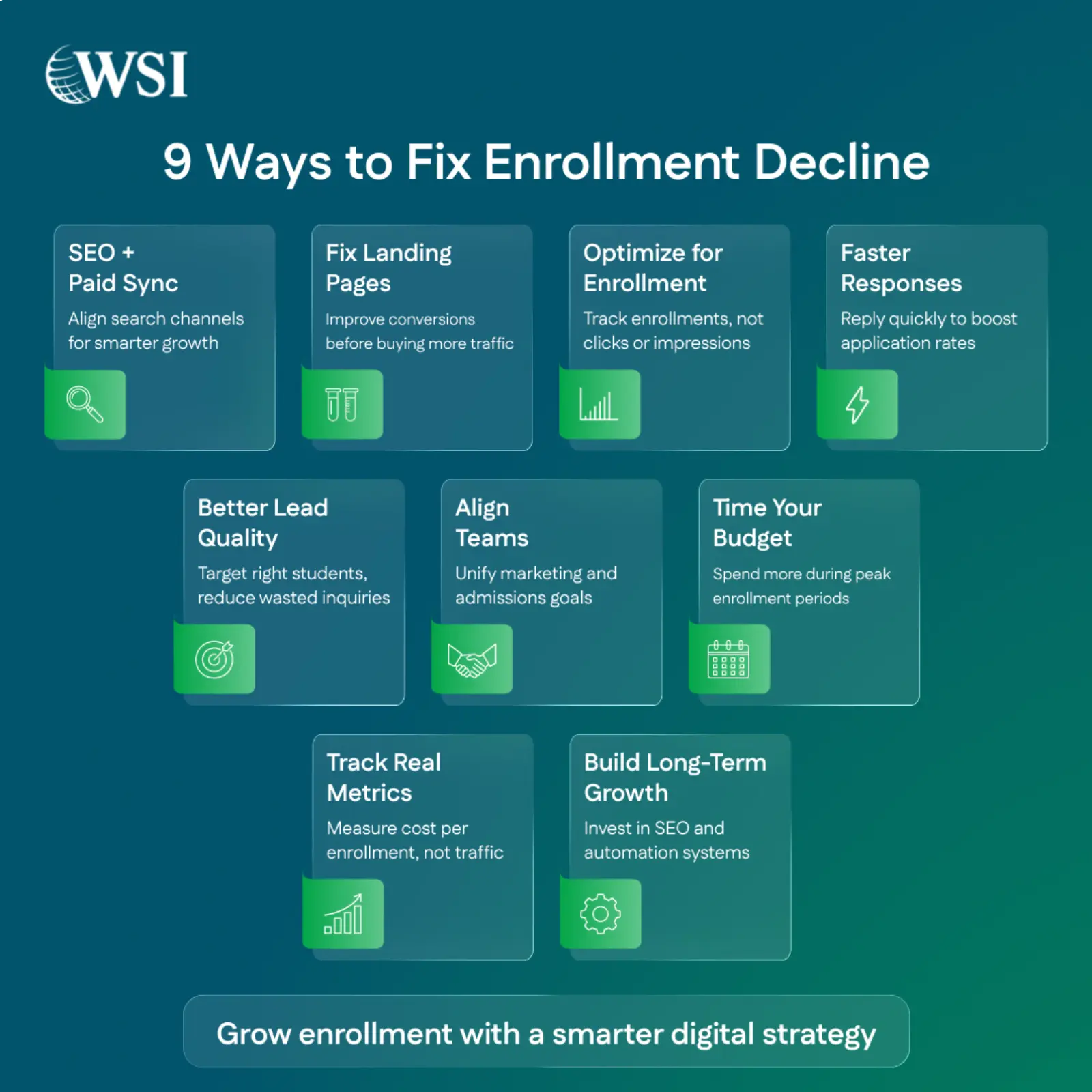
Enrollment decline rarely has a single cause. In most cases, the marketing and admissions infrastructure contributing to it shares a common pattern: channels operating in isolation, budgets tied to visibility rather than outcomes, and follow-up processes too slow to convert interest into applications. The strategies below address each of these gaps directly.
Strategy 1: Connect SEO and Paid Search So They Feed Each Other
Most institutions run SEO and paid search as separate efforts, which means optimizing each one blindly. Paid search tells you within weeks which keywords drive inquiries and at what cost, and that data should directly inform which program pages get organic investment. It works the other way too: when a program page ranks on page one for a high-intent query, you stop bidding aggressively on that term and shift that budget to gaps where organic visibility is absent.
What to do:
- Pull high-performing paid search terms with low cost per inquiry and use them to guide organic content priorities.
- Identify program pages with strong organic rankings and reduce paid spend on those terms.
- Use negative keyword data from paid campaigns to tighten organic targeting.
Strategy 2: Fix Your Landing Pages Before Buying More Traffic
Buying more traffic into a broken conversion system produces more wasted spend, not more enrollments. According to Cropink, marketers who run consistent A/B tests see an average 37% increase in conversions, yet only 17% actively test their pages. Higher education median landing page conversion rates sit at 6.3% against an 8.4% education industry median, meaning most college pages are already underperforming their own sector before any optimization work begins.
What to test first:
- Form length: HubSpot data shows three-field forms convert at over 25% versus five-field forms at just over 21%
- Headline specificity: “Complete your MBA in 18 months” outperforms “Advance Your Career with Our MBA Program.”
- CTA labels: “Request Program Details” outperforms “Submit” or “Learn More”
- Above-the-fold layout: It doesn’t matter if the form appears before or after program information affects completion rates more than most teams expect
Since only 1 in 8 A/B tests produces a statistically significant result, the gains require sustained testing over time, not a single redesign.
Strategy 3: Stop Optimizing for Clicks, Start Optimizing for Enrollments
Campaigns measured on impressions and clicks will optimize for impressions and clicks. That produces strong visibility metrics and weak enrollment results. The fix is changing what the campaign is told to optimize for.
What to do:
- Set inquiry submissions as the primary conversion goal, not clicks.
- Where CRM integration allows, push the optimization target to the application starts.
- Track cost per enrolled student as the primary performance indicator across all channels.
- Reduce spend on channels generating clicks but not inquiries at an acceptable cost, and shift that budget to channels that perform against enrollment metrics.
Strategy 4: Respond to Inquiries Faster
Prospective students evaluating graduate programs are typically comparing multiple institutions at the same time, and the first to respond substantively shapes how that comparison plays out. Inquiries that receive a response within hours convert to applications at significantly higher rates than those followed up on the next day, which means response time functions as an enrollment variable and should be tracked alongside enrollment metrics, not treated as a service standard.
What to do:
- Set a response time standard measured in hours, not days.
- Use automated acknowledgment emails to hold attention while the first human response is prepared.
- Build CRM-based follow-up sequences so that no inquiry goes cold due to admissions capacity constraints.
Strategy 5: Improve Lead Quality at the Source
High inquiry volume with a low inquiry-to-application rate is a targeting problem, not a volume problem. Adding a budget to campaigns producing low-quality leads scales the inefficiency.
Tighten audience targeting:
- Export enrolled student profiles from CRM and upload them as custom audiences so platforms model lookalike audiences based on actual enrollment behavior, not demographic proxies.
- Segment those audiences by program since the profile of a Healthcare Management student differs from a Technology and Entrepreneurship student.
- Pull the geographic distribution of currently enrolled students from CRM data and use that as the basis for geographic targeting. Campaigns running nationally for a regionally enrolled institution waste a large share of the budget on impressions that will never convert.
Fix your inquiry forms:
- Add a program-specific field so admissions teams know exactly what the student is interested in before the first contact.
- Include a work experience range selector and intended start term field so follow-up prioritization is based on context, not guesswork.
- Use multi-step forms: breaking a long form into two or three steps typically increases completion rates while collecting more qualification data per submission.

Build Your Enrollment Strategy
Get a full-funnel digital marketing strategy for colleges today.
Strategy 6: Align Marketing and Admissions Around the Same Metrics
Enrollment growth stalls when marketing optimizes for inquiry volume and admissions optimizes for application quality, with no shared definition of what a qualified lead actually is. Both teams end up measuring different things and holding each other accountable for the wrong outcomes.
What to do:
- Agree on a shared lead definition enforced at the CRM level by identifying a qualified inquiry, a qualified prospect, and an application-ready lead.
- Run weekly or biweekly meetings between campaign managers and admissions staff to review lead quality by channel and source.
- Feed admissions disposition data back into campaign targeting: which sources produced students who enrolled, which produced students who disqualified, and why.
- Ensure ad copy, landing page claims, and admissions call guides communicate consistent program-specific information. Discrepancies between what marketing says and what admissions says during follow-up conversations are a common and overlooked cause of application drop-off.
Strategy 7: Concentrate Budget Around the Academic Calendar
Distributing budget evenly across the year consistently underperforms concentrated spend during high-intent periods. Student inquiry and application behavior follow the academic calendar with enough predictability to build budget allocation around it.
What to do:
- Increase paid spend substantially during peak inquiry windows in the months before application deadlines and term start dates.
- Pull back to retargeting-only campaigns during low-intent periods such as mid-summer and winter holidays, where cost per inquiry is typically higher, and inquiry-to-application rates are lower.
- Run dedicated deadline retargeting campaigns targeting students who have visited the application page or started an application but not completed it, in the three to four weeks before each deadline. This audience has already demonstrated intent and responds to deadline-focused messaging at rates significantly above baseline.
Strategy 8: Measure What Actually Connects to Enrollment
Institutions that track traffic and form fills are measuring activity. Institutions that track cost per enrolled student, inquiry-to-application rate, and channel-level attribution against enrollment outcomes are measuring performance.
The metrics that matter:
- Cost per inquiry by channel: reveals which sources generate demand efficiently and which produce volume at unsustainable cost.
- Inquiry-to-application rate: a low rate across all source points indicates a follow-up problem; a low rate on specific source points indicates a targeting or lead-quality problem in those channels.
- Cost per enrolled student: total marketing spend divided by students who enrolled, which is the appropriate denominator for every budget decision.
- Application completion rate: the ratio of application starts to completed applications, which surfaces friction in the application process itself.
The infrastructure behind the numbers:
- Connect ad platforms to CRM data so tracking reflects actual enrollments, not just form fills.
- Upload enrollment outcomes back to ad platforms as conversion events so campaigns optimize toward real enrollment behavior.
- Standardize UTM tagging across every paid link, email, and campaign so channel-level data is clean enough to make decisions from.
- Use time-decay or linear attribution rather than last-touch, since graduate students typically research programs across multiple channels over weeks before submitting an inquiry.
Strategy 9: Build Organic and Automated Capacity So Growth Doesn’t Stop When Spend Does
A marketing infrastructure that produces enrollment only when paid campaigns are active is a dependency, not a strategy. When budgets are cut, enrollment falls in proportion. Sustainable growth requires building capacity that generates inquiries regardless of paid activity levels.
Build the SEO foundation:
- Give each program a dedicated, fully optimized page built around the queries prospective students actually use, not institutional naming conventions.
- Publish content that addresses questions students have at each stage of their research: awareness-stage content for category-level questions, consideration-stage content for program comparisons, and decision-stage content covering application deadlines, financial aid, and scholarship details.
- Maintain program pages as living documents. Pages that are published and not updated lose organic ground to competitors who treat their pages as ongoing assets.
Build automation that scales follow-up:
- Use behavior-triggered email sequences so that a student who downloads a program brochure enters a relevant follow-up sequence automatically, without manual triage.
- Implement CRM-based lead scoring to surface high-intent prospects for personal outreach, based on behavioral signals like program page visits, email opens, virtual information session attendance, and application page visits.
- Use dynamic email content that changes based on CRM fields, so follow-up messaging reflects the specific program, location, and start term the student indicated at inquiry.
Digital Marketing Strategy for Colleges and Its Role in Enrollment Growth
Digital marketing drives enrollment by shaping visibility and trust. Most students complete much of their decision journey online. A strong strategy influences every stage of that process. Institutions that build this presence gain a measurable competitive advantage.
What does an Integrated Digital Marketing Strategy for Colleges Cover
An effective strategy spans the full enrollment funnel. Each channel plays a specific role in moving students forward. Integration ensures consistent performance. When aligned, these channels compound results rather than compete for budget.
- Organic search: SEO captures high-intent students actively searching for programs and drives sustainable application traffic.
- Paid media: Paid campaigns reach new audiences and re-engage interested prospects who did not convert.
- Email nurturing: CRM-driven email sequences move interested students toward application at a lower cost.
Why Disconnected Channels Produce Weak Enrollment Results
Disconnected efforts reduce marketing effectiveness. Without coordination, opportunities are lost. Integration ensures consistent engagement. A fragmented approach often leads to wasted budget and missed conversions.
- Missed retargeting: Without follow-up ads, interested students leave and do not return, wasting initial awareness spend.
- Unsegmented email: Generic messaging across programs reduces relevance, engagement, and conversion rates.
Where Student Acquisition Breaks Across the Funnel
Student acquisition breaks down at predictable points in the enrollment funnel, and identifying those breaks is the prerequisite to fixing them. Most institutions invest heavily in awareness campaigns without maintaining the downstream infrastructure that converts that awareness into applications, which produces high impressions and low enrollment conversion rates that look like a channel problem but are actually a funnel architecture problem.
Top-of-Funnel: Visibility and Brand Recognition Gaps
At the top of the funnel, the challenge is simple: students cannot engage with what they never see. Visibility gaps limit discovery, and even strong programs remain invisible when digital foundations are misaligned with real student behavior.
- Unoptimized pages: Program pages that do not reflect real student search terms fail to appear in discovery-stage queries. A page titled “Bachelor of Applied Business Administration” will struggle to rank for what students actually search, such as “business degree programs” or “business administration college,” unless it is built around keyword-informed content.
- Broad targeting: Awareness campaigns focused on reach and impressions often prioritize volume over relevance. Without demographic and interest targeting aligned to your ideal applicant profile, much of that reach goes to audiences with no intent to enroll.
Mid-Funnel: Consideration and Lead Quality Failures
Once visibility is established, the next challenge is capturing and nurturing interest. Many institutions generate traffic, yet fail to convert that attention into qualified leads due to missing or inefficient systems.
- No lead capture: Paid traffic without a clear inquiry form or lead magnet results in lost opportunities. When a prospective student clicks an ad and finds no structured way to engage, that visit rarely converts into a future application.
- Slow response: Response time directly impacts conversion. Institutions that take more than 24 hours to reply to inquiries lose a significant share of high-intent prospects to faster competitors.
Bottom-of-Funnel: Application and Yield Conversion Gaps
At the bottom of the funnel, the focus shifts from interest to commitment. Small breakdowns at this stage carry the highest cost, as they impact prospects who are closest to enrolling.
- No follow-up system: Many applications are started and never completed. Without automated follow-up sequences triggered by incomplete applications, these high-intent prospects are left unattended.
- Weak re-engagement: Admitted students who have not confirmed represent the highest-value opportunity. Without targeted digital re-engagement during this decision window, institutions miss a critical chance to improve yield rates.
Frequently Asked Questions
How long does it take to see enrollment results?
Paid media can generate inquiries within 2-4 weeks, making it the fastest short-term driver. SEO typically takes 3-6 months to impact organic traffic. Email automation and CRM follow-ups start improving conversions within 60-90 days.
What is the biggest mistake colleges make?
The biggest mistake is running awareness campaigns without proper conversion systems like landing pages and follow-up workflows. This leads to wasted spend with little enrollment impact. Many also focus on impressions and clicks instead of cost per inquiry or enrollment.
Can this strategy work for both traditional and mature students?
Yes, but each audience needs separate targeting, messaging, and campaigns. Traditional students respond more to social content and campus experience, while mature learners prioritize flexibility and career outcomes. A single generic approach is ineffective for both.
Turning Strategy Into Measurable Enrollment Growth
A digital marketing strategy for colleges that reverses declining enrollment is not built on a single tactic or a single channel; it is built on the integration of SEO, paid media, conversion systems, email nurture, and analytics infrastructure into a coordinated enrollment machine where each component feeds the next.
If your institution is experiencing declining enrollment and needs a digital marketing strategy for colleges built on data-driven performance rather than generic campaigns, WSI Leap Digital’s team of digital marketing specialists brings the full-funnel expertise, measurement infrastructure, and proven methodology needed to build an enrollment strategy that produces results you can measure every month.
Book a strategy consultation to get a customized enrollment marketing assessment that identifies your most significant acquisition gaps and the fastest opportunities to increase student enrollment.

Grow Your Enrollment Now
Get a custom digital marketing strategy for colleges that plans to drive applications.