


A landmark 2025 MIT report, The GenAI Divide: State of AI in Business, found that 95 percent of enterprise generative AI pilots fail to deliver measurable business value, a figure that should give every business leader pause before committing budget to the next AI tool a vendor pitches them. For small and medium-sized businesses, however, that statistic is less a warning than an opportunity: the reasons large enterprises fail at AI are structural, cultural, and organizational, and SMEs are naturally better positioned to avoid every one of them. By starting narrow, moving fast, and tying AI directly to daily operational pain points, SMEs can consistently become part of the 5 percent that deliver real results.
Key Takeaways
- 95% of enterprise AI pilots fail, but SMEs have structural advantages that reduce that risk: Large companies fail because of organizational complexity, misaligned incentives, and pilots disconnected from business outcomes. SMEs can avoid all three by staying focused and moving quickly from test to production.
- The gap between experimenting with AI and generating ROI from it is wide and deliberate: Using ChatGPT for occasional tasks is exploration. Deploying a vendor solution integrated into a specific, measurable workflow is production. Only the latter delivers P&L impact.
- The highest AI ROI for SMEs typically comes from back-office automation, not front-end tools: MIT’s research found that most AI investment targets sales and marketing, but the strongest return on investment consistently comes from automating repetitive back-office processes like invoicing, scheduling, and data reconciliation.
Contents
- 1 What the MIT Report Actually Found
- 2 Why AI Pilots Fail and What SMEs Can Learn from Each Failure
- 3 Understanding the Gap Between Exploring AI and Producing Value from It
- 4 The SME Playbook for Crossing the GenAI Divide
- 5 Where AI Delivers Real Returns for SMEs
- 6 Governance and Risk Management: Keeping AI Safe for SMEs
- 7 Addressing the Three Most Common SME Fears About AI
- 8 Frequently Asked Questions
What the MIT Report Actually Found
The GenAI Divide study is one of the most rigorous examinations of AI adoption outcomes published to date, drawing on reviews of over 300 AI initiatives, surveys of 153 senior leaders, and 52 in-depth interviews across industries. Its core finding, that virtually all enterprise AI pilots fail to reach production and generate measurable financial impact, is not a critique of AI’s potential. It is a detailed account of the specific organizational and execution failures that prevent that potential from being realized.
The Three Root Causes MIT Identified
- Brittle workflows: AI tools deployed into real business environments break down when they encounter the complexity, exceptions, and variability that live operations involve. A system that performs well in a controlled pilot often fails when it meets actual customer data, legacy processes, or staff behavior that the pilot did not anticipate.
- Lack of contextual learning: AI systems that do not adapt as the people and processes around them change become less useful over time, not more. A tool calibrated to a business’s workflows in January may be misaligned with how those workflows actually operate by June, and most deployments do not account for that drift.
- Misalignment with daily operations: The most common failure mode MIT identified is AI being deployed as a standalone capability rather than as an integrated component of existing workflows. When staff have to step outside their normal tools and processes to use an AI system, adoption fails regardless of the tool’s technical quality.
For SMEs, the message is direct: do not run AI pilots to ‘explore AI.’ Run them to solve a specific, named operational problem, measure the result in weeks, and integrate the solution into the workflow your team uses every day.
Why AI Pilots Fail and What SMEs Can Learn from Each Failure
The failure patterns MIT documented are not random. They follow consistent structural logic, and each one has a specific SME-relevant corrective that is practically achievable without enterprise-scale resources or dedicated technology teams. Understanding the failure mode is what makes the corrective actionable rather than generic.
Chasing Hype Instead of a Defined Problem
Large enterprises frequently launch AI pilots to demonstrate innovation readiness or satisfy board-level pressure to ‘do something with AI.’ The pilot is the goal, not the business outcome, which means there is no clear standard for what success looks like and no mechanism for holding the program accountable to one.
- SME approach: Define the problem before selecting the tool. A specific problem has a measurable solution: if customer service calls are consuming 15 hours a week, an AI-assisted intake system that reduces that to 8 hours is a testable outcome. A goal to ‘improve customer experience with AI’ is not.
Scaling Too Broadly Too Soon
Enterprise AI programs frequently attempt to transform entire business units or functions simultaneously. Complexity multiplies faster than capability, integration requirements accumulate, and the program stalls under its own weight before proving a single clear result.
- SME approach: Start with one process, one team, one outcome. Ask ‘How can AI help with our invoice approval process?’ not ‘How can AI transform our finance function?’ Proving a narrow result fast creates the organizational confidence and practical knowledge that scaling later requires.
Neglecting Employee Buy-In
AI adoption that is designed and deployed without the involvement of the people who will use it consistently fails. Staff who do not understand the tool, distrust its outputs, or feel threatened by its presence will find ways to work around it rather than with it, and a tool that is actively avoided does not deliver ROI regardless of its technical capabilities.
- SME approach: Involve your team from the design stage, not the deployment stage. Position AI explicitly as a tool that removes the frustrating, repetitive parts of their work so they can focus on the parts that require judgment and skill. Early involvement creates ownership rather than resistance.
Shadow AI Creating Compliance Risk
MIT’s report identified a growing ‘shadow AI’ problem: employees using personal AI accounts at work because officially sanctioned tools are not meeting their needs. This creates data privacy exposure, inconsistent outputs, and compliance risks that the organization cannot manage because it cannot see them.
- SME approach: Provide approved, secure AI tools before your team resorts to personal accounts. Cloud-based enterprise subscriptions for tools like ChatGPT, Copilot, or sector-specific AI platforms start at under $50 per month per user and include the data protection controls that consumer accounts do not provide.
Understanding the Gap Between Exploring AI and Producing Value from It
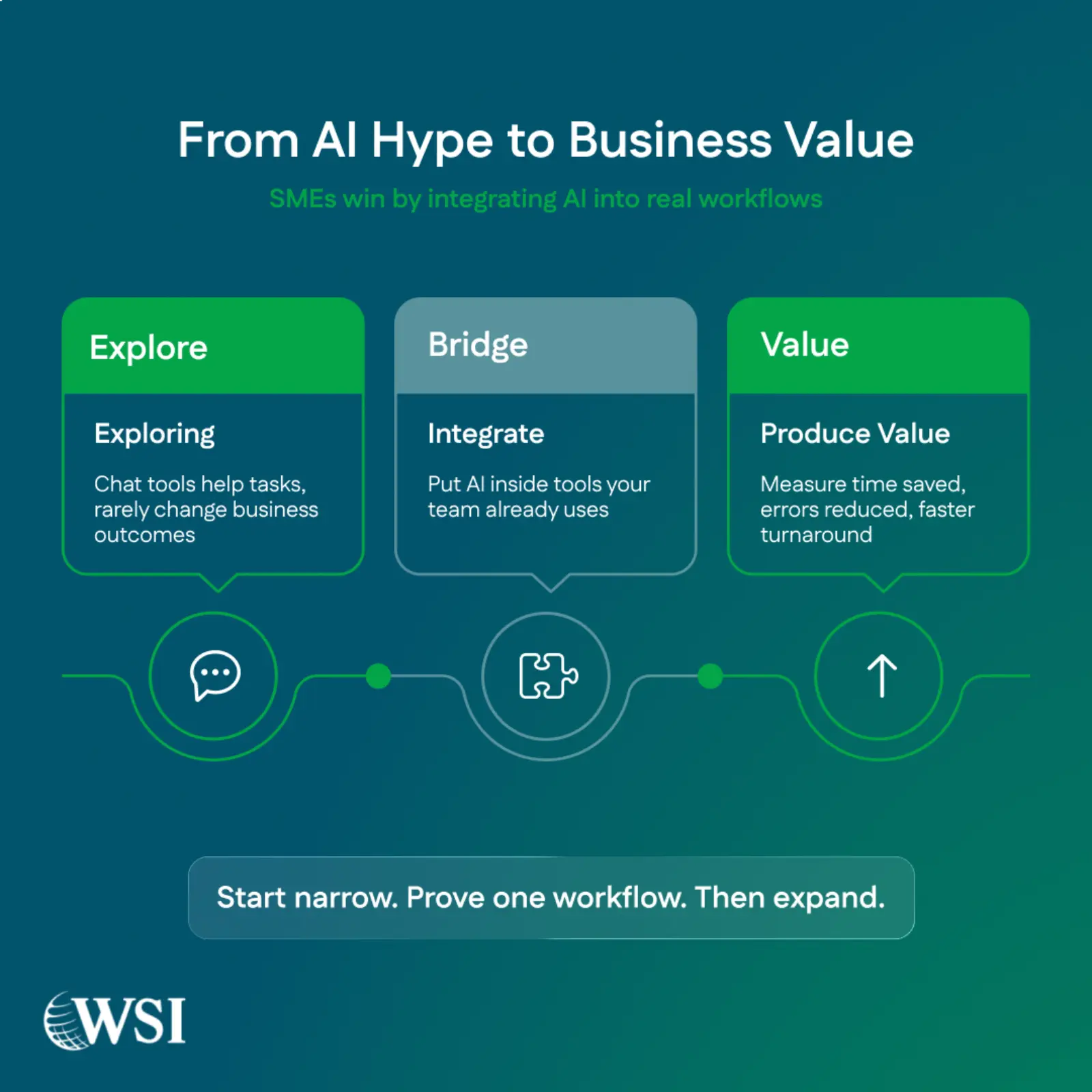
One of MIT’s most practically important findings is the distinction between organizations that have explored or piloted AI and those that have reached production, meaning AI is integrated into operations at a level that generates measurable financial impact. The gap between those two categories is substantial, and it does not close on its own. It closes through deliberate decisions about tool selection, workflow integration, and measurement that most organizations, large and small, consistently underinvest in.
What the Adoption Data Shows
- General-purpose tools: Over 80 percent of organizations have explored tools like ChatGPT or Microsoft Copilot, and around 40 percent report deployment. These tools improve individual productivity but rarely generate enterprise-level financial performance on their own.
- Enterprise and vendor solutions: 60 percent of organizations evaluate purpose-built or vendor AI tools, 20 percent reach the pilot stage, and only 5 percent achieve production. MIT found that vendor solutions succeed at twice the rate of internal builds, making off-the-shelf tools the practical starting point for most SMEs.
- The SME implication: Experimenting with AI tools in your browser is not the same as deploying AI in your business. For measurable ROI, you need a tool integrated into a specific workflow, with defined inputs and outputs, used consistently by the people responsible for that workflow every day.
The distinction matters because many SMEs overestimate how close they are to production based on how much they have experimented. Measuring what AI actually delivers for your business requires moving beyond qualitative impressions of usefulness to specific, tracked metrics tied to the process the AI tool is being applied to.
The SME Playbook for Crossing the GenAI Divide
The five-step framework below is designed specifically for SMEs that want to move from exploration to production without the organizational overhead that makes enterprise AI programs so slow and failure-prone. Each step is narrow enough to be actionable in a business with a small team and limited technical resources, and the sequence is designed so that each step builds the foundation the next one requires. The goal is not a comprehensive AI transformation program. It is a single, measurable result that proves the model and creates the confidence to replicate it.
Step 1: Define a Specific Problem with a Measurable Outcome
Identify one high-friction, repetitive process that costs your team meaningful time or produces avoidable errors. The problem should be specific enough that you can describe the current state in numbers: how many hours per week, how many errors per month, how many calls per day. That specificity is what allows you to define what success looks like before you begin.
Step 2: Run a Lightweight Pilot with a Short Measurement Window
Select a single tool, apply it to the problem you have defined, and set a four to eight-week measurement window. Measure the specific metric you identified in Step 1 before and after deployment. A pilot that cannot demonstrate a directional result in eight weeks is either solving the wrong problem or using the wrong tool, and both are useful findings that cost you weeks rather than months to discover.
Step 3: Choose Tools Built for Your Use Case
Off-the-shelf SaaS platforms with built-in AI capabilities, including HubSpot for sales and marketing, QuickBooks or Xero for financial operations, and Zoho for customer management, are the practical starting point for most SMEs because they integrate AI into tools your team already uses. For more specific use cases, purpose-built vendor solutions outperform internal builds at twice the rate, according to MIT’s data, because they come with the workflow integration and support infrastructure that makes production deployment achievable without a dedicated technical team.
Step 4: Build Team Involvement into the Process from Day One
Share the problem you are solving, the tool you are testing, and the outcome you are measuring with the team members who will use the system. Gather their feedback during the pilot period, specifically on friction points and workflow integration issues, and use that feedback to adjust before full deployment. A team that helped design the deployment is significantly more likely to use it consistently than one that had it installed for them.
Step 5: Measure, Document, and Expand
Once the pilot proves a measurable result, document exactly what was done: the problem, the tool, the integration approach, the training provided, and the outcome achieved. That documentation becomes the template for the next AI deployment in an adjacent process, and it gives you the evidence you need to justify further investment to stakeholders or ownership. Expansion should be sequential rather than simultaneous, applying the same narrow, measurable approach to each new use case rather than attempting to scale multiple deployments at once.
Where AI Delivers Real Returns for SMEs
MIT’s research found that most AI investment is concentrated in sales and marketing, but the highest ROI consistently comes from back-office processes where the work is repetitive, rule-based, and time-consuming. For SMEs, the practical implication is that the first AI deployment should usually target operations, not marketing, because operational automation delivers results that are immediately measurable in time and cost rather than in attribution-dependent revenue metrics. A broader understanding of how AI works in everyday business operations can help SMEs identify where in their specific workflows the clearest opportunities sit.
Customer Service Automation
- FAQ and intake chatbots: Chatbots configured to handle common inquiries, appointment scheduling, and initial triage reduce staff time on repetitive contact without reducing service quality for routine requests. A dental clinic that automated appointment-related calls reduced admin workload by 40 percent without additional staff.
Marketing Content Generation
- AI-assisted content production: AI tools can generate first drafts of blog posts, email campaigns, and ad copy at a fraction of the time manual drafting requires. A boutique retailer using AI-assisted content creation produced ten times more content per quarter with the same team, allowing them to maintain an active content calendar that had previously been inconsistent.
For SMEs investing in organic search visibility, content volume and freshness are increasingly important signals to AI-powered search engines. Feeding the AI tools that now influence search visibility requires a consistent content output that most small teams cannot sustain without AI assistance.
Back-Office Efficiency
- Invoice and reconciliation automation: AI-assisted accounts payable and receivable tools can categorize expenses, match invoices to purchase orders, and flag discrepancies without manual review for routine transactions. An accounting firm that deployed AI-assisted reconciliation recovered 15 hours per week of staff time previously spent on manual data entry.
Sales Enablement
- Lead scoring and personalized outreach: AI tools integrated into a CRM can score incoming leads based on behavioral and demographic signals, prioritize follow-up for the highest-probability prospects, and generate personalized outreach messages that reduce the time sales staff spend on preparation. A B2B consultancy that implemented AI-assisted lead scoring improved lead-to-meeting conversion by 20 percent within the first quarter of deployment.
Data and Business Intelligence
- Churn prediction and trend analysis: AI tools that analyze customer behavior data can identify at-risk accounts before cancellation occurs, giving service or success teams a window to intervene. A subscription business that deployed a churn prediction model reduced cancellations by identifying and re-engaging high-risk clients before their subscription lapsed.

Build Your AI Strategy
Get a practical AI roadmap tailored to your SME.
Governance and Risk Management: Keeping AI Safe for SMEs
AI adoption without basic governance creates risks that can undermine the value it delivers. Data privacy compliance, output accuracy, and security controls are the three areas where SMEs are most exposed, and addressing all three does not require enterprise-scale policy infrastructure. Simple, clearly communicated guardrails applied from the first deployment prevent the most common problems from developing into serious liabilities.
- Data privacy compliance: Confirm that any AI tool handling customer, employee, or financial data complies with the privacy regulations applicable to your jurisdiction and sector, including GDPR for businesses operating in or selling to the EU and CCPA for California-based customers. Most established cloud-based AI platforms publish their compliance certifications publicly, and reviewing them before deployment takes less time than managing a breach after one.
- Output accuracy review: AI outputs, including drafted content, generated summaries, and automated decisions, should be reviewed by a qualified staff member before being used in client-facing communications or consequential internal decisions. The review does not need to be exhaustive, but it should be deliberate: a final check that confirms the output is accurate, appropriate, and consistent with your business standards.
- Approved tools and shadow AI prevention: Providing your team with approved, enterprise-grade AI subscriptions eliminates the incentive for staff to use personal accounts for work tasks. Enterprise subscriptions include data protection controls, audit logs, and usage policies that consumer accounts do not, and they give your organization visibility into how AI is being used across the business.
Addressing the Three Most Common SME Fears About AI
Most SME hesitation about AI adoption comes down to three concerns that appear frequently in conversations with business owners and managers who have not yet made a deployment decision. Each concern is understandable, and each one is either based on a misconception about how modern AI tools work or on an outdated picture of the cost and complexity of AI implementation. Addressing them directly is what makes a practical first step feel achievable rather than risky.
- AI will replace my team: AI tools replace tasks, not roles. They eliminate the most repetitive, lowest-value parts of a job so that the person doing that job can spend more time on the work that requires human judgment, relationship management, and creative problem-solving.
- AI is too expensive: Enterprise-grade AI tools on cloud-based SaaS platforms typically start at under $50 per month per user, and the time savings from even a single well-chosen deployment will outpace that cost within weeks for most SME applications. The cost of not deploying, measured in staff hours spent on tasks that AI could handle, is almost always higher.
- AI is only for tech companies: AI is industry-agnostic and is being deployed in bakeries, law firms, dental clinics, logistics companies, and every other business category where repetitive, rule-based work exists. The specific tools and use cases differ by sector, but the underlying value proposition, trading manual effort on low-value tasks for capacity on high-value ones, is universal.
Frequently Asked Questions
How do we know which AI tool is right for our specific business?
Begin by defining the exact operational problem you want to solve, including its time cost and error impact. Evaluate AI tools against that specific workflow using trials or pilot access before making a commitment. For specialized or regulated industries, prioritize vendor platforms with proven industry deployments and compliance credentials, since established solutions consistently outperform internal builds for small teams.
What does a realistic AI deployment timeline look like for an SME?
A focused AI deployment can typically move from problem definition to full rollout within four to eight weeks. The first phase covers tool selection and configuration, followed by a short pilot period to test performance and gather team feedback. Final refinement and broader rollout occur once measurable improvements are confirmed, assuming the solution is vendor-based rather than custom-built.
How do we measure if an AI deployment is actually working?
Define the success metric before launch by establishing a clear baseline tied to time savings, cost reduction, error rates, or revenue impact. Reassess the same metric at four and eight weeks to determine directional improvement. If measurable gains are not visible within that window, reassess the problem definition or tool selection, then continue tracking validated improvements monthly to capture long-term business impact.
Start With One Workflow and Make AI Earn Its Budget
The widely cited enterprise AI failure rate reflects organizational barriers more than technological limitations, as large companies often struggle with slow decision-making, stakeholder misalignment, and rigid workflows that resist integration. Smaller and mid-sized businesses operate with far greater agility, which positions them to implement AI successfully when they focus on a specific problem, select the right tool, involve their team in deployment, and measure outcomes against clear business objectives. The organizations that gain real advantage are not those with the largest budgets, but those that apply AI precisely to high-friction, low-value manual work and commit to disciplined execution and accountability.
Start Your AI Journey
We help SMEs find and deploy AI that actually works.