
How to increase student enrollment without increasing the budget depends on improving conversion within existing systems. Many schools spend more and enroll fewer students each year. The issue is rarely awareness and often relates to weak conversion steps. Students are finding you, but the process loses them before enrollment.
Contents
- 1 Key Takeaways
- 2 Why More Spending Does Not Fix Enrollment Problems
- 3 How to Increase Student Enrollment Through a 4-Stage Funnel Efficiency
- 4 Improving Conversion Without Increasing Traffic
- 5 Aligning Marketing Strategies to Increase Student Enrollment
- 6 Optimizing Existing Channels for Better Outcomes
- 7 Frequently Asked Questions
- 8 The Fastest Path to Enrollment Increase Starts With What You Already Have
Key Takeaways
- Organic search is your strongest enrollment channel: Research from RNL’s enrollment marketing study shows that organic search converts at three times the rate of any other lead source. Reducing paid ad spend while strengthening SEO produces better results at lower cost.
- Most institutions have weak SEO despite knowing it matters: According to Sixth City Marketing’s higher ed statistics report, 84% of higher education marketing departments view SEO as a key enrollment strategy. Yet 51% of those same departments have no established SEO plan in place.
- Funnel efficiency matters more than traffic volume: Most schools lose prospective students between the first click and the application page. Fixing page content, speed, and program pages produces enrollment increases without adding budget.
Why More Spending Does Not Fix Enrollment Problems
Adding budget to a leaking enrollment funnel produces the same result every time. More traffic enters, but the same proportion exits without applying. Schools that consistently improve enrollment focus on conversion, not volume. The root cause of most enrollment problems sits inside the funnel, not outside it.
Where Most Enrollment Budgets Go
Paid search and social advertising consume the largest share of most enrollment budgets. These channels generate clicks, but clicks alone do not produce applications. When page experience, speed, and content are poor, paid traffic wastes budget. The school pays for the visit but loses the student on the landing page.
The Difference Between Traffic and Enrollment
Traffic measures how many people reach your site. Enrollment measures how many of those people complete an application. These two numbers are related but not the same. A school can have rising traffic and falling enrollment simultaneously. The gap between them is where the conversion strategy lives. That gap is where budget-neutral enrollment improvement always begins.
What Prospective Students Actually Do Online
Prospective students search with specific questions before they ever visit a program page. They search for program comparisons, outcomes, cost, and career paths. If your content does not answer those questions, they go elsewhere. Schools that answer those questions organically generate inquiries at much lower cost. This is not a paid media problem; it is a content and SEO problem. Solving it does not require an expanded budget.
- Awareness gap: Spending more on ads reaches students who would have found you anyway.
- Content mismatch: Program pages that describe courses instead of outcomes do not convert.
- Slow page load: Every second of additional load time reduces application completion rates.
- Friction in forms: Long or confusing inquiry forms are among the most common dropout points.
- No follow-up systems: Inquiries that receive no timely response represent budget that was already spent and lost.
How to Increase Student Enrollment Through a 4-Stage Funnel Efficiency
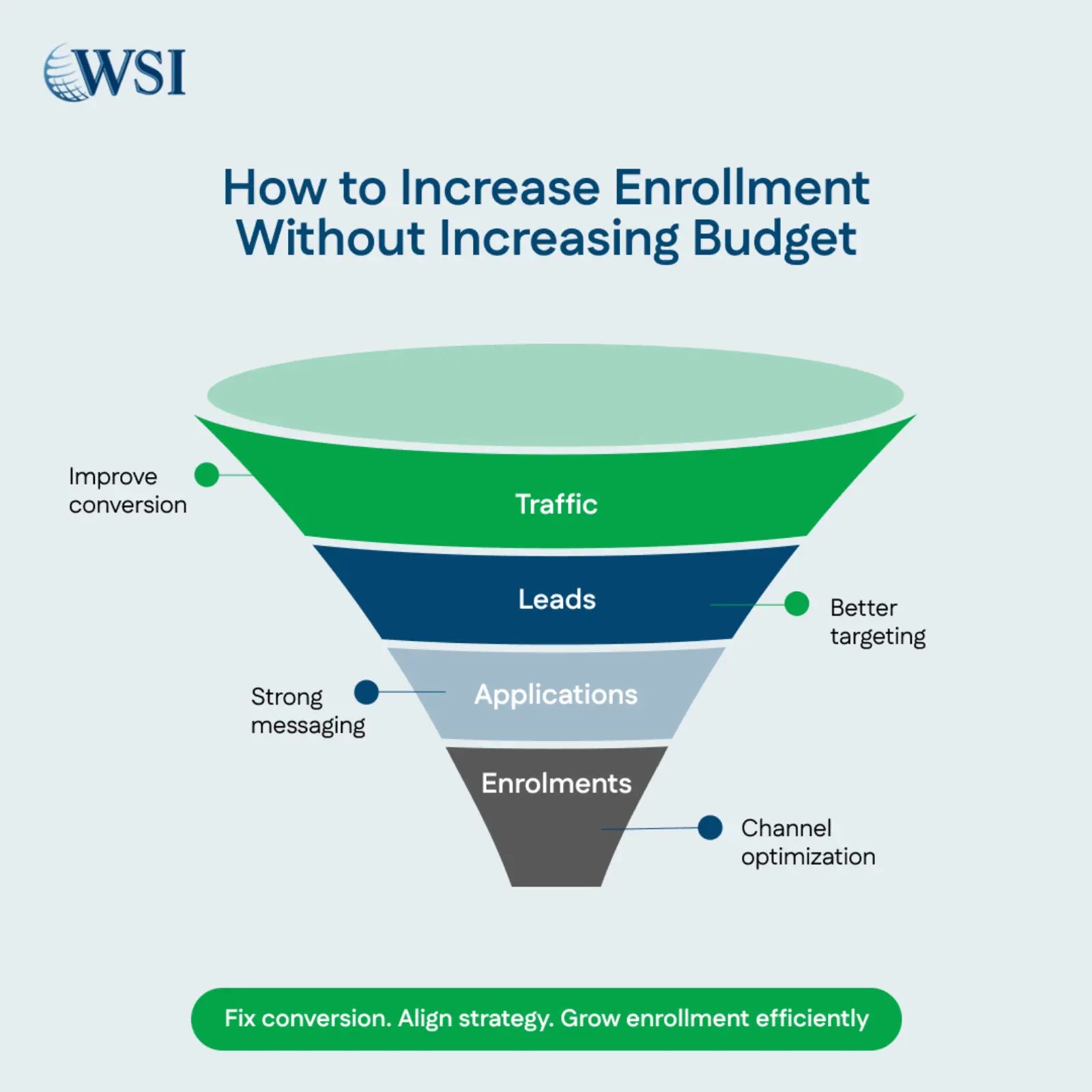
Each stage of a marketing funnel must move students to the next without friction or confusion. The WSI framework for how to increase student enrollment addresses each stage directly. The image below shows how this funnel works and what drives each layer.
Stage #1: Search and Keyword Visibility
Students start with a search engine, not your homepage. They type questions like “best business program in Ontario” or “online MBA Canada.” If your pages do not appear for those searches, you have no funnel entry. Keyword research identifies the exact phrases your prospective students use. Building content around those phrases is how you enter the funnel. This is the stage where WSI LeapDigital’s SEO strategy for higher education begins.
Stage #2: Click-Through from Search Results
Ranking on page one is not enough if no one clicks on your result. Title tags and meta descriptions must answer the search intent directly. A vague title loses clicks to competitors with more specific ones. Click-through rate improvements increase traffic without any additional ad spend. This is one of the fastest, lowest-cost methods for enrollment increase. It requires only copy adjustments to existing pages.
Stage #3: Page Experience After the Click
Students make judgments about credibility within seconds of landing. Slow pages, confusing navigation, and outdated content push them away. Technical SEO improvements, load speed, mobile performance, structure, keep them. A student who stays longer is significantly more likely to inquire. Page quality is a direct enrollment lever that requires no paid media at all.
Stage #4: Program Page Conversion
Program pages are where enrollment is won or lost most often. Students arrive with a specific program in mind and look for proof. Proof means graduate outcomes, career paths, faculty credentials, and program structure. Most program pages describe features when students need to see benefits. Rewriting program pages around student outcomes is one of the highest-ROI moves available. It costs time, not budget, and it directly drives the enrollment increase.

Fix Your Enrollment Funnel
WSI audits and optimizes your full student acquisition path.
Improving Conversion Without Increasing Traffic
Conversion improvement is the fastest path to an enrollment increase. It works on the students already in your pipeline rather than chasing new ones. Even a 10% improvement in application completion rates produces significant enrollment gains.
1. Inquiry Form Optimization
A student who reaches your inquiry form is close to converting. Long forms with unnecessary fields are the most common abandonment trigger. Reducing a form from ten fields to four typically raises submission rates significantly. Progress indicators, mobile-friendly layouts, and clear labels also improve completion. This is one of the most direct ways to improve enrollment without adding traffic. It requires no budget, only a willingness to remove friction.
2. Response Time and Follow-Up Sequences
Inquiries that receive a response within an hour convert at far higher rates. Prospective students contact multiple schools at the same time. The school that responds first and most clearly tends to win the enrollment. Automated email sequences can maintain contact without adding staff hours. A structured follow-up system is a budget-neutral way to improve enrollment outcomes. It recovers students who inquired but were lost to slow or absent responses.
3. Social Proof Placement on Key Pages
Graduate testimonials and employment outcomes are among the most persuasive page elements. Most schools bury this content in separate testimonial sections that no one visits. Placing proof directly on program pages reduces doubt at the decision point. A short quote near the application button has more impact than a testimonial page. Placement matters more than volume when it comes to social proof. This change costs no budget, and it directly supports the enrollment increase.
4. Mobile Conversion Gaps
Over 90% of online experiences begin with a search engine. A large proportion of those searches happen on mobile devices. Pages that render poorly on mobile break the funnel before students ever see the program. Mobile optimization is technical, not financial, and it yields direct enrollment gains. Testing every key page on a phone should be a monthly, not annual, task.
Aligning Marketing Strategies to Increase Student Enrollment
Marketing alignment means every channel supports the same enrollment goal. When SEO, paid media, content, and email pull in different directions, efficiency drops. Aligning them around a clear funnel model is one of the cleanest ways to improve enrollment. This requires strategy coordination, not a new budget.
Content Strategy That Supports SEO and Enrollment
Content written for prospective students and optimized for search serves two purposes. It attracts organic traffic, and it converts that traffic into inquiries. Articles that answer legitimate student questions, cost, career outcomes, and program length perform best. According to Carnegie Higher Ed’s 2024 SEO Benchmarks report, organic search generated 46% of total website traffic across higher education institutions in the 2023 to 2024 academic year. That share of traffic costs nothing per click, making content the highest-efficiency channel available.
Paid Media Used to Fill Gaps, Not Replace Organic
Paid search works best when it targets terms your organic content does not yet rank for. Using paid media to duplicate organic visibility wastes spend without adding reach. A well-structured higher education lead generation strategy from WSI maps paid and organic efforts against specific funnel gaps. This prevents duplication and directs every dollar toward genuine enrollment increase.
Email as a Conversion Tool, Not Just a Newsletter
Emails sent to inquiries should move students toward an application, not just inform them. Each message should answer a common objection or provide a specific next step. Sequences timed to typical decision windows perform far better than batch sends. A student who inquires in January and receives a generic newsletter in February will not apply. A student who receives three specific, well-timed messages in January often will.
Optimizing Existing Channels for Better Outcomes
Every school already has channels producing traffic and inquiries. The question is if those channels are performing at their full potential. Optimization is the process of extracting more enrollment from existing effort and spending.
Website SEO Audits and Technical Fixes
A technical SEO audit identifies issues that suppress your organic rankings. Broken links, missing meta descriptions, duplicate content, and slow pages all hurt visibility. Fixing these issues typically produces a rankings improvement within weeks. Higher rankings produce more organic clicks without any paid media increase. WSI’s SEO services for higher education include full technical audits as a standard starting point.
Google Business Profile and Local Search
Many schools neglect their Google Business Profile despite its direct impact on local enrollment. Students searching for programs in their city often see the profile before the website. An updated, accurate, and review-rich profile builds credibility before the first click. This is a free channel that most institutions underuse significantly. Optimizing it takes time, not budget, and it supports enrollment increase in local markets.
Existing Content That Can Be Improved
Most higher education websites have content that ranks on page two or three. These pages need small improvements to move into page one positions. Updating statistics, adding supporting sections, and improving internal linking often achieve this. Moving a page from position 15 to position 5 can triple its organic traffic. This is a high-leverage, budget-neutral tactic that directly supports enrollment increase.
Retargeting Students Who Already Visited
Students who visited a program page but did not apply are warm prospects. Retargeting campaigns re-engage them at a fraction of the cost of new traffic. These campaigns spend less per conversion because the awareness barrier is already cleared. Using existing budget differently, not adding to it, is the approach here. Retargeting is one of the clearest examples of how to improve enrollment within current spend.
- Brand awareness: WSI’s brand awareness servicesbuild long-term visibility across the channels prospective students use most.
- Search visibility: Organic search rankings generate traffic that compounds over time without per-click cost.
- Landing page CRO: Conversion rate optimization on key pages extracts more applications from existing traffic.
- Email nurture: Structured sequences move warm inquiries toward application without paid touchpoints.
- Program page depth: Detailed, outcome-focused program pages produce higher application rates per visit.
Frequently Asked Questions
Can we increase enrollment without adding to our paid media budget?
Yes, and many schools achieve their strongest enrollment gains this way. Organic search, conversion rate improvements, and funnel optimization all produce enrollment increases without additional ad spend. Working with a team like WSI LeapDigital to audit your current funnel typically identifies specific, high-impact improvements that cost far less than the paid campaigns most schools default to first.
How long does SEO take to produce enrollment results?
Technical fixes and content improvements can produce ranking changes within four to eight weeks. The stronger impact, sustained organic traffic, and inquiry volume typically build over three to six months. Unlike paid media, which stops producing results when the budget stops, SEO compounds over time and continues supporting enrollment increase long after the initial work is done.
What is the first thing to fix when trying to improve enrollment?
Start with your program pages, because that is where most enrollment decisions are made or lost. Review if each page answers the questions a prospective student would have before applying. If the page describes program features without addressing outcomes, costs, and next steps, rewriting it is the single highest-return move available, and it requires no additional budget at all.
The Fastest Path to Enrollment Increase Starts With What You Already Have
How to increase student enrollment is not a budget question for most schools. It is a funnel question, and the funnel already exists.
The students are searching, clicking, and landing on your pages. The gap is what happens after they arrive. Fixing that gap through SEO, content, conversion optimization, and aligned channel strategy produces a consistent enrollment increase without requiring a single dollar of additional spend.

Grow Enrollment Smarter
WSI turns existing traffic into more qualified student applications.