

Marketing reports create value only when context turns data into clear decisions. Charts and percentage lifts may look impressive, yet without interpretation tied to business goals and competitive reality, they can mislead rather than guide. The real gap in reporting is not effort or tools, it is the absence of context that converts numbers into insights and insights into specific actions. This article outlines why contextual interpretation determines reporting value, highlights common pitfalls that strip meaning from data, and provides a practical framework for producing reports that clearly show what is working, what is not, and what to do next.
Key Takeaways
- Vanity metrics celebrated without context can actively mislead strategy: A spike in traffic or impressions that does not connect to leads, pipeline, or revenue is not a performance signal. Reporting it without qualification encourages investment in channels or tactics that look active but are not producing business outcomes.
- The four most common reporting pitfalls all share the same root cause: Siloed channel reporting, ignoring trends over time, measuring activity rather than impact, and omitting an executive summary all strip context from data in different ways, but each produces the same result: stakeholders making decisions with incomplete information.
- Contextual reporting changes the question executives ask from ‘what happened?’ to ‘what should we do?’: When reports include performance versus benchmarks and prior periods, attribution insights across channels, and specific recommended next steps, they function as decision support tools rather than activity logs. That shift in function is what aligns marketing reporting with business strategy.
Contents
- 1 The Distinction Between Vanity Metrics and Valuable Metrics
- 2 The Four Reporting Pitfalls That Strip Context from Data
- 3 What Executives Actually Need from Marketing Reporting
- 3.1 A Top-Down View of Channel Contribution to Goals
- 3.2 Attribution Insights That Reveal Influence Across Channels
- 3.3 Performance Against Benchmarks and Prior Periods
- 3.4 Insights That Lead Directly to Action
- 3.5 Report A vs. Report B: The Difference Context Makes
- 3.6 What Contextual Reporting Looks Like in Practice
- 3.7 Tie Every Reported Metric to a Strategic Goal
- 3.8 Use Plain Language Alongside Charts and Data
- 3.9 Include Specific Next Steps in Every Report
- 3.10 Segment Reports by Funnel Stage, Campaign, or Audience
- 4 Frequently Asked Questions
- 5 From Data to Decisions: Making Your Reporting Work
The Distinction Between Vanity Metrics and Valuable Metrics
Integrating video overviews into blog posts transforms them into multi-channel assets that drive stronger search visibility, longer engagement, broader social reach, and greater brand credibility from a single production effort. With AI tools removing traditional cost and time barriers, video creation can now become a routine part of content workflows rather than a separate initiative. Organizations that consistently pair text with video and measure performance across platforms will build a compounding advantage as search algorithms and audience expectations increasingly reward multimedia depth and accessibility.
The Context Problem with Both Categories
The complication is that even valuable metrics are misleading without context. A cost per lead of $85 is a number. A cost per lead of $85 against a benchmark of $120 for your industry and a target of $100 set at the start of the quarter is a meaningful signal that your program is performing well. A cost per lead of $85 that was $55 four months ago, with no explanation for the increase in the report, is a concern that demands investigation. The metric is the same in all three scenarios. The context changes what it means and what it demands in response.
This is why the instruction to ‘focus on valuable metrics’ is necessary but insufficient for producing useful reporting. The additional requirement is that every metric included in a report be accompanied by the information a reader needs to evaluate what that metric means: the target or benchmark against which it should be assessed, the trend over time that indicates trajectory, the relationship to other metrics that explains causation, and the implication for decisions or next steps. Without those elements, even the most carefully selected metrics function as noise that requires the reader to do the interpretive work that the report should have done for them.
The Four Reporting Pitfalls That Strip Context from Data
Most reporting problems are not the result of insufficient data or inadequate analytical tools. They are the result of structural habits in how reports are assembled and presented. The four pitfalls below account for the majority of context failures in marketing reporting, and each is straightforwardly correctable once identified.
Pitfall One: Reporting in Channel Silos
The most common structural failure in marketing reporting is presenting each channel’s performance in isolation from every other channel. You end up with a report that looks something like this:
- An SEO section
- A PPC section
- A social media section
- An email section
Each comes with its own metrics, its own charts, and its own narrative. This structure reflects how marketing teams are often organized, with specialists or agencies responsible for individual channels reporting independently. But for the executive reading it, this format makes true integrated analysis nearly impossible.
An integrated marketing program is one in which channels share data, feed each other’s audiences, and contribute to outcomes that no single channel produces independently. Reporting that reflects that integration shows how paid search traffic that did not convert on the first visit was added to a retargeting audience, how that retargeting campaign served mid-funnel content, and how the email nurture sequence that followed converted those prospects into qualified leads. Reporting that presents those activities in separate silos shows traffic from PPC, engagement from retargeting, and opens from email, with no connection between them and no way to understand the combined contribution to a single business outcome.
- What to do instead: Build a unified reporting view that traces the customer journey across channels rather than presenting each channel as a self-contained unit. Show how channels contributed to shared outcomes, use multi-touch attribution data to assign credit across touchpoints, and structure the report around the funnel stages the audience moves through rather than the organizational boundaries the marketing team is divided by.
Pitfall Two: Ignoring Trends Over Time
A single month of data, presented without comparison to prior periods or without trend lines showing direction of travel, is almost impossible to interpret correctly. A 12 percent conversion rate in isolation could be excellent or concerning, depending on what the trend looks like. If the rate was 18 percent three months ago and has been declining steadily, 12 percent is a serious problem that demands immediate investigation. If it was 8 percent three months ago and has been increasing consistently, 12 percent is a strong positive signal that validates the optimization work being done.
The failure to contextualize current performance against historical trends is particularly damaging for executive reporting because it forces leaders to make strategic decisions on point-in-time data that may represent either a temporary anomaly or a structural shift. Without the trend, they cannot tell the difference. A board member who sees a bad month without the prior six months of context may draw conclusions that a six-month trend view would immediately contradict.
- What to do instead: Every metric in an executive report should include, at a minimum, a month-over-month comparison and a year-over-year comparison where seasonality is relevant. Trend sparklines or period-over-period percentage changes alongside current figures give readers immediate directional context without requiring them to hold historical numbers in memory or reference a prior report.
Pitfall Three: Measuring Activity Instead of Impact
Activity metrics describe what the marketing team did. Impact metrics describe what those activities produced. ‘We published 12 blog posts this month’ is an activity metric. ‘The 12 blog posts published this month generated 3,400 organic visits, 89 lead form completions, and are estimated to have influenced 14 deals currently in the pipeline based on assisted conversion attribution’ is an impact metric. Both statements are true. Only the second one tells an executive anything useful about the return on the investment in producing those 12 posts.
The prevalence of activity reporting in marketing is partly a reflection of how marketing work is managed internally. Project management systems track tasks. Content calendars track publications. Social media schedules track posts. These are legitimate operational tracking mechanisms. The failure occurs when activity tracking is presented to executives as performance reporting without the conversion and impact data that connects the activity to business outcomes.
- What to do instead: For every activity reported, include the downstream metrics that indicate its impact. Published content should report traffic generated, leads attributed, and assisted conversions. Paid campaigns should report leads, pipeline value, and cost per outcome at the conversion level, not just clicks and impressions. Social media activity should report engagement rates in relation to the specific business outcomes those channels are expected to influence, not raw engagement volume.
Pitfall Four: No Executive Summary
Most marketing reports are built for the people who produced them. Every channel receives detailed coverage. Every tactic is documented. The result is a document that gives a full picture to someone who already understands the marketing program deeply and requires nothing useful from an executive who needs to evaluate performance and make decisions in twenty minutes.
The absence of an executive summary that distills the most important findings into a clear, action-oriented narrative is not a minor formatting oversight. It is a structural failure that forces executives to do their own analysis rather than receiving the analytical output they need from the report. Stakeholders who do not receive a clear ‘so what’ from marketing reporting will either disengage from the reports entirely or draw their own conclusions from the data they do notice, which may not be the conclusions a more complete analysis would support.
What to do instead
Every marketing report should open with a three to five-point executive summary that covers the most significant performance development of the period, performance against the primary goal, one area of concern and the recommended response, and one area of strong performance and the recommended follow-through. This summary should be readable in under five minutes and structured so that an executive who reads nothing else leaves with an accurate picture of marketing program status and a clear sense of what requires their attention.

Upgrade Your Reporting
Get a reporting framework built for executive decision-making.
What Executives Actually Need from Marketing Reporting
Understanding the pitfalls is useful. Understanding what good reporting looks like is what allows you to build a reporting program that consistently produces the decision support executives require. The information executives need from marketing reporting falls into four categories, and a report that addresses all four provides substantially more value than one that addresses any of them in isolation.
A Top-Down View of Channel Contribution to Goals
Executives need reporting structured around business goals, not isolated channel metrics. A channel with strong engagement but weak lead contribution is underperforming if lead generation is the primary objective, while a channel with modest engagement yet high-value lead impact may be strategically overperforming. Reports should therefore be organized by goal, with each channel evaluated based on how effectively it supports that objective. This structure ensures performance is judged by business contribution rather than surface-level metrics.
Attribution Insights That Reveal Influence Across Channels
Multi-touch attribution reveals how channels interact across the buyer journey and which combinations consistently drive conversions. It highlights the influence that last-touch models overlook, especially for channels that shape consideration rather than close deals. For executives allocating budget, this context prevents undervaluing channels that play critical mid-funnel roles. Including attribution insights strengthens strategic investment decisions by showing true cross-channel impact.
Performance Against Benchmarks and Prior Periods
Every reported metric should be compared against its predefined target and a relevant prior period to provide meaningful context. Target comparisons indicate if commitments are being met, while historical comparisons reveal performance direction over time. Both views are necessary to determine the sustainability and repeatability of results. Without this dual reference, performance can appear stronger or weaker than it truly is.
Insights That Lead Directly to Action
An effective marketing insight must lead to a clear recommendation, not simply describe what occurred. Observations become actionable when they identify patterns, explain implications, and specify what should happen next. Each key finding should conclude with a defined action such as reallocating budget, testing a hypothesis, or investigating a variance. Reports built this way position marketing as a strategic decision partner rather than a reporting function.
Report A vs. Report B: The Difference Context Makes
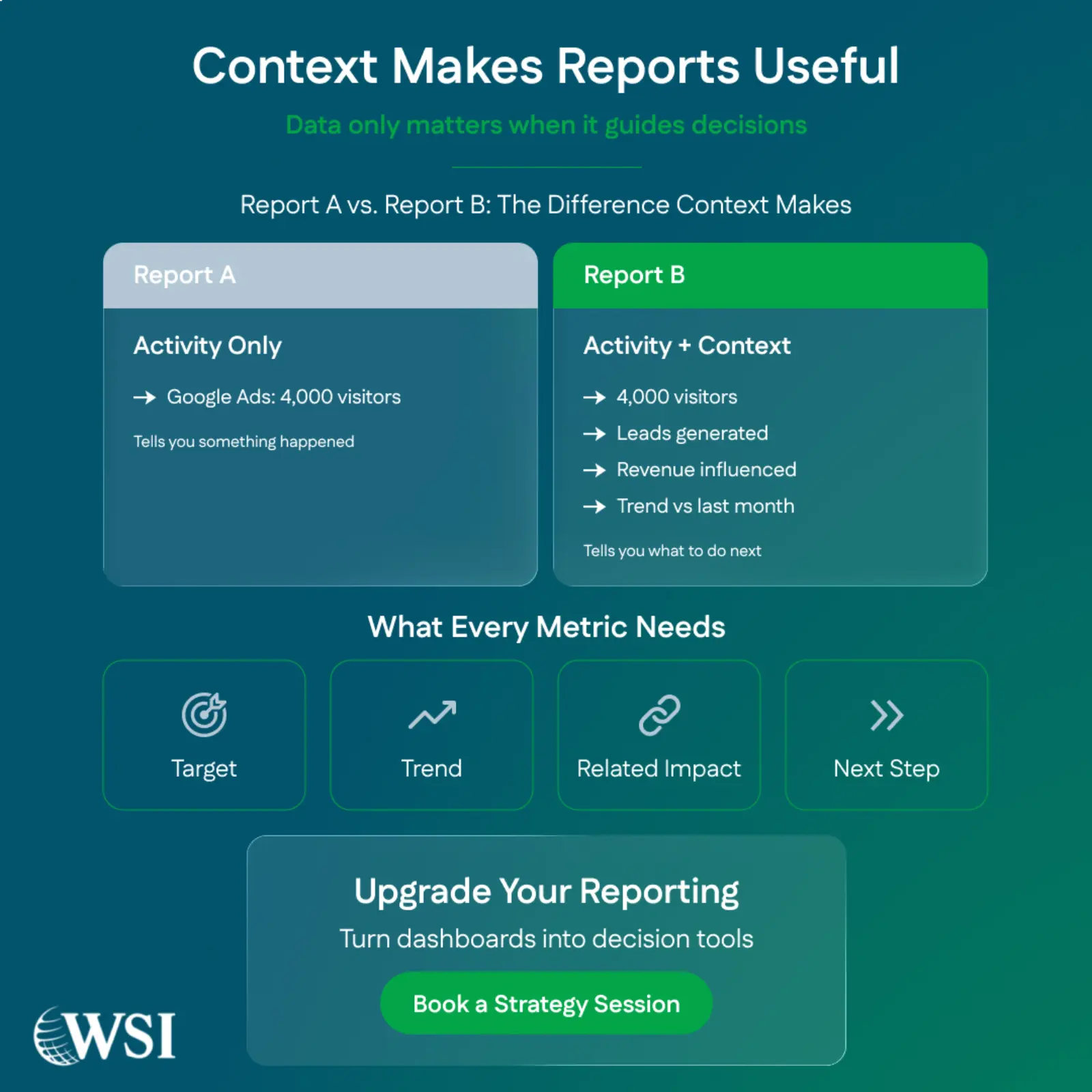
What Contextual Reporting Looks Like in Practice
The comparison between Report A and Report B above illustrates the difference context makes at the individual metric level. But contextual reporting is a structural practice that extends across the entire report, not just individual data points. The following practices, applied consistently, produce reporting that executives can use to make better decisions.
Tie Every Reported Metric to a Strategic Goal
Every metric included in a report should clearly connect to a defined strategic goal and clarify progress toward that objective. If a metric does not directly support a goal, it either requires stronger context or should be removed. Reports built around goal-linked metrics are more concise and more valuable because they eliminate distractions and highlight what truly drives business performance. This structure also forces marketing teams to focus on outcomes rather than vanity metrics, making metric selection a deliberate strategic choice instead of a default dashboard export.
Use Plain Language Alongside Charts and Data
Charts communicate trends efficiently, yet plain language ensures that stakeholders understand what those trends mean. Since executives often review marketing alongside finance, operations, and HR updates, brief written explanations provide necessary clarity and relevance. Each visualization should include a short interpretation that explains what changed, why it matters, and what it signals for the business. This approach allows readers to grasp key insights quickly while still offering detailed visual data for deeper analysis.
Include Specific Next Steps in Every Report
A marketing report should end with clear next steps that transform insights into action. Writing these commitments into each report creates accountability and enables performance tracking in the following cycle. Specific, assigned actions with measurable targets ensure clarity about what will be done and how success will be evaluated. This disciplined follow-through demonstrates that reporting is an active management tool designed to drive continuous improvement rather than simply document past performance.
Segment Reports by Funnel Stage, Campaign, or Audience
Aggregate marketing metrics consistently obscure the performance variance that produces the most valuable insights. Assuming that a blended cost per lead of $95 across all channels tells you very little. A cost per lead of $65 from the organic channel, $88 from paid search, $120 from paid social, and $210 from display advertising tells you a great deal about where your budget is working and where it is not. That segmented view does not require more data. It requires that the data you already have be presented in a structure that reveals the variance rather than averaging it away.
- By funnel stage: Segmenting metrics by awareness, consideration, and conversion reveals where prospects are entering and leaving the funnel and which stages have the highest attrition, focusing optimization effort where it produces the most improvement in overall funnel efficiency.
- By campaign or channel: Segmenting by campaign or channel reveals performance variance that aggregate metrics obscure, enabling budget reallocation from underperforming to outperforming investments with a specific data basis rather than a general impression of channel performance.
- By audience or persona: Segmenting by the audience type or buyer persona being addressed reveals which audiences are responding most effectively to current campaigns, allowing targeting decisions to be based on observed conversion patterns rather than assumed audience characteristics.
The Standard to Hold Your Reports To
Every metric needs a target to be evaluated against, a trend to establish direction, a related metric that explains causation, and a next step that specifies what the data implies for decisions. A metric that cannot answer all four of those requirements is not ready to go into an executive report.
Frequently Asked Questions
How often should marketing reports be produced for executives?
Reporting frequency should align with the frequency with which leadership makes budget and strategy decisions. Monthly reports work well for most organizations, while weekly updates are useful during active launches or periods of sharp performance shifts. Quarterly summaries that consolidate trends and strategic direction are ideal for board-level visibility, where long-term trajectory matters more than short-term fluctuation.
What tools are most useful for building contextual marketing reports?
Effective reporting combines data aggregation with clear visualization and narrative context. Tools such as Google Looker Studio, HubSpot reporting, and data connectors like Supermetrics or Funnel.io can unify multi-channel and CRM data into a single view. The platform matters less than the discipline of adding benchmarks, trends, and next steps that turn dashboards into decision-support documents.
How do we get buy-in from leadership to change our current reporting format?
Present one report in the improved format alongside the existing version and ask leadership which one provides clearer decision guidance. Most executives quickly recognize the difference between a metric summary and a structured decision tool when shown side by side. If comparison is not possible, begin by adding a concise executive summary to the current report, then expand with benchmarks and action steps once leadership sees the added clarity.
From Data to Decisions: Making Your Reporting Work
Marketing data creates value only when it improves decision-making, meaning reports must clarify what is working, what is failing, and what actions should follow rather than simply presenting polished metrics. Most reporting gaps stem from structural habits such as siloed channel views, missing trend context, activity metrics without business impact, and the absence of clear executive summaries, all of which can be corrected through stronger discipline rather than new tools. By prioritizing concise executive summaries, adding trend comparisons, linking activities to outcomes, and defining accountable next steps in every report, organizations significantly improve both strategic clarity and leadership confidence in marketing performance.

Reports That Drive Decisions
We build reporting frameworks that connect marketing to revenue.