

Keyword synergy is the mechanism that makes SEO and PPC genuinely complementary. When both channels share what they know, each one performs better. PPC gets smarter bids and tighter targeting. SEO gets validated content angles and a shorter path to ranking for high-intent terms. Together, the result is a search presence that is harder to dislodge and more cost-efficient to maintain over time.
Key Takeaways
- Integrated campaigns outperform solo efforts: Keyword data from each channel sharpens the strategy of the other, reducing wasted spend and accelerating organic ranking timelines.
- Shared signals create a compounding feedback loop: Exchanging search term reports, conversion data, and audience insights between channels lowers cost-per-click, improves Quality Scores, and identifies content gaps before competitors do.
- The tactics here are immediately actionable: from quarterly keyword exports to joint dashboards and cross-channel landing page tests, teams of any size can execute them without a full restructure.
Contents
- 1 Supercharge Landing Pages with PPC-SEO Testing
- 2 Unlocking Keyword Synergy Between SEO and PPC
- 3 Using Data Insights for Smarter Decisions
- 4 Maximize Budgets: PPC Speeds Up SEO Wins
- 5 Proven Tactics for SEO-PPC Team Alignment
- 6 Frequently Asked Questions
- 6.1 How quickly can I expect to see results from integrating SEO and PPC keyword strategies?
- 6.2 Does integrating SEO and PPC require both to be managed by the same team or agency?
- 6.3 What is the right budget split between SEO and PPC when running an integrated strategy?
- 6.4 How do I measure if the keyword synergy is actually working?
- 6.5 What tools are essential for maintaining a shared keyword pipeline?
- 6.6 Can smaller businesses with limited budgets benefit from SEO-PPC integration?
- 7 Keyword Synergy Is Your Competitive Advantage
Supercharge Landing Pages with PPC-SEO Testing
Landing pages sit at the intersection of both channels. A page that converts paid traffic reliably is also a strong candidate for organic optimization. A page that ranks well organically but fails to convert is a problem that PPC testing can help diagnose and correct faster than any other method available.
Rapid Testing Loops
PPC gives you a fast feedback loop on messaging using real traffic. When a headline or call-to-action pulls better click-through or conversion rates in paid campaigns, you have real evidence that the language is working with live searchers. That data can then feed directly into your SE title tags and on-page headlines, so you’re making changes based on what actually performed rather than assumptions.
Bounce rate data works in the same direction. If paid traffic lands on a page and exits quickly without engaging, the issue is usually content misalignment: the ad promised something the page did not deliver. That signal tells your SEO team where restructuring is needed. Fixing the content improves both paid and organic performance by addressing the actual user expectation rather than just the ad copy.
Unified Page Elements
Several page elements benefit directly from treating paid and organic as a shared system rather than parallel systems:
- Meta descriptions informed by ad copy: High click-through rate ad copy contains the exact language your audience responds to. Adapting that copy into meta descriptions for organic pages applies the same persuasion logic to unpaid search results, raising organic CTR before you even improve rankings.
- Schema markup for rich snippets: Structured data increases SERP visibility for organic listings and signals page quality to Google’s ad systems simultaneously, which can improve Quality Score and lower cost-per-click on related paid terms.
- Consistent page messaging across both channels: When a user sees your paid ad, visits your site, and then later encounters your organic listing for the same topic, messaging consistency builds recognition and trust that neither channel can build on its own.
Covering the Full Marketing Funnel Seamlessly
One of the clearest practical benefits of running both channels together is funnel coverage. SEO and PPC each have natural strengths at different stages of the buyer journey. When coordinated deliberately, they cover the entire funnel without gaps or overlap.
Top-to-Bottom Mapping
Matching each channel to the right funnel stage is what makes integration efficient rather than redundant:
- Awareness stage with SEO long-tail content: A user searching “how to improve website ranking” is early in their research. Organic content that answers that question builds brand familiarity without requiring paid spend. The goal here is presence, not immediate conversion.
- Consideration stage with PPC retargeting: Someone who read your SEO guide and then searches “best SEO tools review” is now comparing options. A paid ad on that mid-funnel modifier, backed by strong organic content on the same topic, keeps your brand visible to a buyer nearing a decision.
- Conversion stage with branded synergy terms: When a prospect searches your brand alongside a pricing or product modifier, they have already made a near-decision. Direct-response PPC on those branded queries captures conversions that might otherwise go to a competitor’s ad if you rely solely on organic results.
Funnel Metrics to Watch
Measuring integrated funnel performance requires a few specific approaches:
- Multi-touch attribution models: Standard last-click attribution undervalues organic touchpoints that precede a paid conversion. A multi-touch model that credits keyword crossovers gives you an accurate picture of how both channels are contributing to revenue, not just which one got the final click.
- Seasonal gap tracking: SEO content takes time to build authority and cannot respond quickly to seasonal spikes in demand. Monitoring which seasonal terms you cover through paid campaigns is a direct signal for which organic content pieces to prioritize before the next peak period arrives.
Unlocking Keyword Synergy Between SEO and PPC
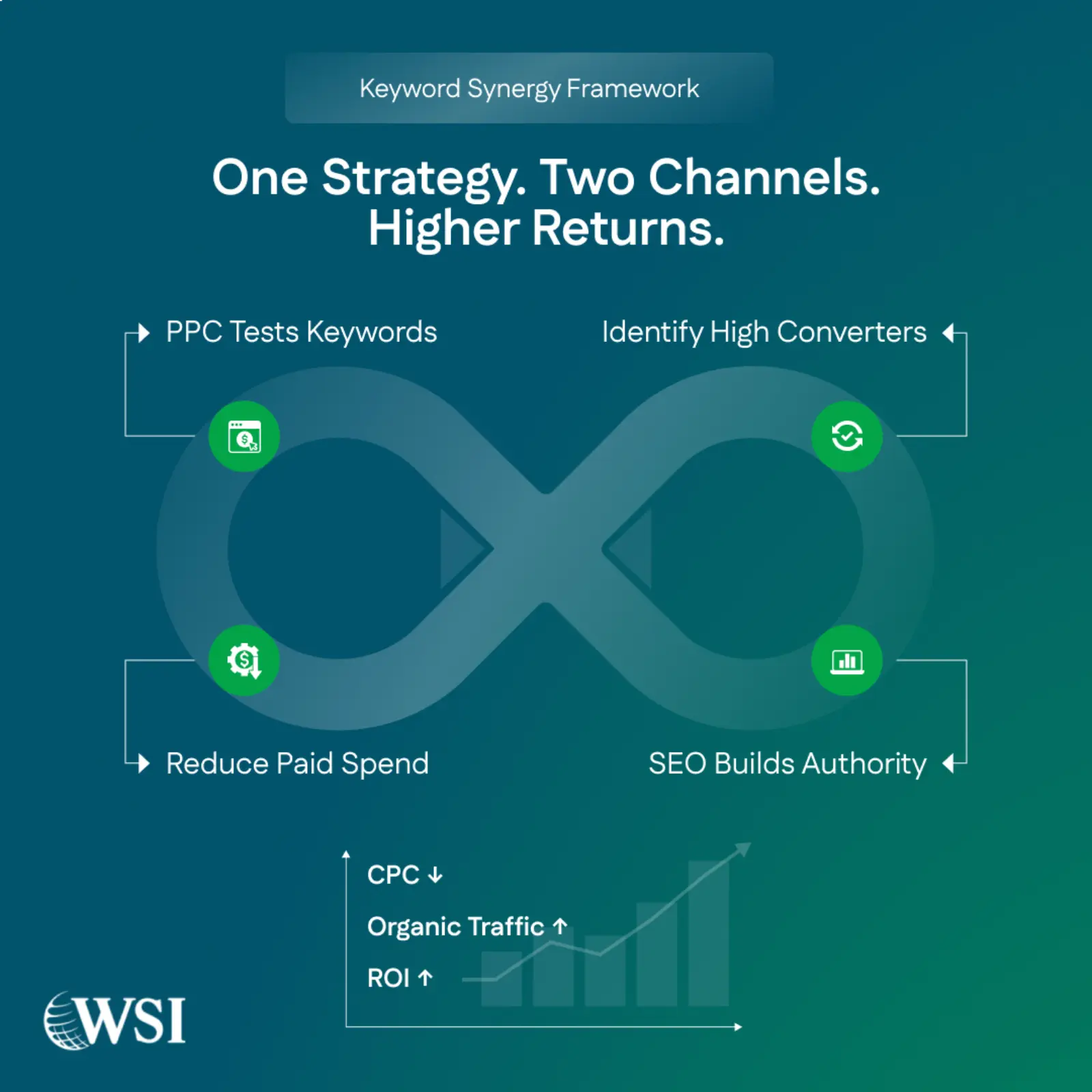
At its simplest, keyword synergy is the practice of letting each channel inform the other’s decisions. PPC gives you fast, clean data on which keywords actually drive conversions. SEO gives you a long-term signal on what people are searching for and how content can earn authority over time. When you combine those two data streams, you stop guessing and start making decisions grounded in real performance.
The cycle works like this: PPC campaigns surface high-intent keywords quickly, often within a few weeks of launching a new ad group. Those proven terms become priority targets for SEO content. As organic rankings grow, the cost of maintaining visibility through paid ads decreases because you no longer need to bid as aggressively on terms where you already rank well. That freed budget then shifts toward testing new keyword territory, and the process repeats.
Why Keywords Unite the Channels
PPC is built for speed, you can launch a campaign, gather statistically meaningful conversion data, and identify your top-performing keywords in a matter of weeks. That timeline is not achievable through organic search alone, where ranking progress typically takes several months. By using PPC as a keyword testing ground, SEO teams can prioritize efforts based on actual performance data rather than search volume estimates alone.
SEO returns the favor by uncovering evergreen, lower-competition terms that paid campaigns can use strategically. When your organic team identifies a keyword cluster where ranking is achievable at moderate difficulty, your PPC team can examine the cost-per-click. If strong organic content already covers those terms, you can reduce or eliminate paid bids on them, reallocating that budget to harder-to-rank, high-intent queries where PPC remains necessary.
The clearest example of a shared keyword win sits at the intersection of brand and transactional queries. A term like “buy SEO tools” serves both channels at once. A paid ad captures users ready to convert today. Organic content targeting the same query builds long-term visibility and trust for users who prefer organic results. Owning both positions for the same query raises the click-through rate and reduces the effective cost per customer acquired.
Actionable Keyword Sharing Tactics
Putting keyword synergy into practice requires a few consistent habits across both teams:
- Export PPC search term reports quarterly: Cross-reference them against your existing SEO keyword list to find high-converting terms that have no dedicated organic content. Those gaps are your immediate content priorities.
- Use rank trackers to time your PPC bids: When an organic keyword is trending toward page one but has not arrived yet, run a targeted paid campaign on that term so you capture traffic now while organic rankings catch up.
- Test competitor keywords through paid search first: When SEO tools identify keywords where a competitor ranks, but you do not, run a small PPC campaign before committing to a full content and link-building effort. Confirmed conversion rates justify the organic investment; poor results save you months of misdirected effort.
Using Data Insights for Smarter Decisions
Each channel generates signals that the other cannot produce independently. PPC gives you precise conversion rate data at the keyword level. SEO gives you organic traffic trends, user engagement patterns, and content performance over time. When those two streams inform each other, decision-making improves across the board.
Cross-Channel Analytics
The most valuable cross-channel data exchanges work in both directions:
- PPC conversion rates guide SEO prioritization: If a keyword carries a 5 percent conversion rate in paid search, it justifies significant organic investment. If a keyword drives high-paid traffic but near-zero conversions, that is a signal to reconsider how much SEO effort you direct toward it before spending months on content and link building.
- SEO traffic trends refine PPC audience segments: When organic traffic to a content cluster grows sharply, it signals rising audience interest in that topic. Your PPC team can build audience segments from visitors to those pages and target similar users through paid campaigns, reaching people who match your growing organic audience before they have searched for your specific keywords.
- Shared performance reviews reduce blind spots: When both teams review the same data together, they spot patterns neither would catch in isolation. A paid keyword that stops converting often correlates with an organic ranking drop or a content gap that only the SEO team would notice.
Tools for Unified Tracking
You do not need an expensive stack to track both channels together. A few tools handle the job well:
- Google Analytics 4 for blended reporting: Setting up channel groupings that separate paid search from organic search, then building custom reports comparing conversion rates and goal completions across both, gives both teams a shared performance view without requiring separate systems.
- Keyword-level ROI dashboards: Combining cost-per-click data from paid campaigns with organic traffic value calculations in a single dashboard provides the clearest business case for continued integration. When you can show that a budget shift away from a keyword cluster has saved a specific dollar amount while organic sessions from those terms have grown, budget decisions become straightforward rather than political.
- Shared Google Sheets pipeline documents: For teams without enterprise analytics tooling, a structured spreadsheet tracking which keywords are in testing, validated, organically owned, or retired is often more effective than purpose-built software and keeps both teams aligned on the same live document.

Audit Your Keywords
Find the gaps your search strategy is missing right now.
Maximize Budgets: PPC Speeds Up SEO Wins
Budget allocation is where the integrated strategy pays off most visibly. PPC and SEO are not competing for the same money. They are doing different jobs at different time horizons. Understanding that distinction is what allows smart teams to use PPC spending to de-risk and accelerate SEO investment rather than treating the two as alternatives fighting for a fixed pool of resources.
Cost-Saving Plays
Several specific tactics reduce cost while improving outcomes across both channels:
- Test competitor keywords cheaply before committing to backlinks: A backlink campaign targeting a competitive keyword can cost thousands of dollars and several months of effort. Running a small PPC campaign on that keyword first tells you within weeks, even if the conversion economics justify that investment. Poor results redirect the budget before it is wasted.
- Reduce PPC reliance as SEO rankings solidify: As organic coverage grows, paid budgets on those same terms can be reduced. A realistic first-year target is approximately a 40 percent shift of PPC spend away from terms where organic coverage now handles primary visibility, with that freed budget moving into testing new keyword territory.
- Use negative keyword lists to stop paying for organic wins: Once a keyword ranks consistently in position one or two organically, adding it as a negative keyword in relevant ad groups ensures you are not paying for clicks you would earn for free. That alone can produce meaningful monthly savings in mature programs.
Timeline Benefits
The time dimension of integrated strategy matters as much as the cost dimension:
- PPC bridges the 3 to 6 month SEO delay: The most common frustration with SEO is the lag between publishing content and seeing meaningful ranking movement. Paid campaigns ensure you are not invisible on high-value keywords during that wait. The cost of that bridging period is predictable and finite. Forgoing that traffic entirely while waiting for organic rankings is far more expensive in aggregate.
- Double down on proven synergy keywords: Once a keyword shows consistent organic ranking and strong conversion rates, it is a confirmed winner. That is the moment to increase content investment around related terms and, where economics support it, maintain a smaller paid presence on the exact keyword to capture incremental traffic that organic results miss. Compounding returns in both channels simultaneously is the goal of a mature integrated program.
Proven Tactics for SEO-PPC Team Alignment
Keyword synergy does not happen by itself. It requires organizational habits that keep both teams exchanging information on a regular cadence. The companies that see the strongest integrated results are not always the ones with the most advanced tools. They are the ones with the most consistent communication processes.
Collaboration Best Practices
A few structural habits create the foundation for sustained alignment:
- Weekly syncs between SEO and PPC leads: A 30-minute standing agenda covering keyword disapprovals from the paid side, new content calendar items from the organic side, and any notable performance shifts from either channel is enough to keep both teams operating from the same information without consuming significant time.
- Shared keyword pipeline documents: A joint Google Sheet with columns for keyword status (testing, validated, organically owned, retired), responsible team member, and performance notes replaces ad-hoc requests between teams and creates accountability for keyword decisions. This document becomes the single source of truth for the integrated program.
- Joint content calendar visibility: When the PPC team knows which organic content pieces are scheduled to publish in the next 30 days, they can plan supporting paid campaigns in advance rather than reacting after the fact. That lead time turns content launches into coordinated SERP events rather than isolated SEO efforts.
Scaling for Growth
As the program scales, a few additional practices maintain the integration quality:
- Agency handoffs require unified briefs: When bringing in an agency or additional team members, briefs that explicitly frame keyword strategy as a shared function prevent the channel-silo problem from re-emerging. An agency managing only PPC with no visibility into SEO performance will optimize for paid metrics in isolation. Shared KPIs and cross-channel reporting requirements in the contract produce fundamentally different work.
- Flexible keyword pools provide algorithm resilience: When a Google core update shifts organic rankings significantly, having active paid campaigns on affected keywords means you do not lose all visibility overnight. You adjust paid spend upward temporarily while the organic situation stabilizes, then pull it back as rankings recover. That kind of agility is only possible when paid and organic keyword lists are maintained together.
Frequently Asked Questions
How quickly can I expect to see results from integrating SEO and PPC keyword strategies?
The initial data-sharing benefits appear within the first few weeks. Once you export your PPC search term report and identify keyword gaps in your organic content calendar, you can start adjusting both channels immediately. The measurable ROI impact, particularly reduced cost-per-click on keywords where organic rankings improve, typically becomes visible within three to six months. The full compounding effect of a mature integrated strategy takes twelve to eighteen months to fully materialize, consistent with the general timeline of SEO authority building.
Does integrating SEO and PPC require both to be managed by the same team or agency?
Not necessarily, but it does require structured communication and shared reporting access regardless of team structure. Many organizations run separate agencies for each channel and still achieve strong synergy by establishing clear processes: shared keyword pipeline documents, regular joint reporting reviews, and consistent briefing standards. The risk of dual-agency arrangements is that each optimizes for its own metrics without accounting for the other channel’s influence. Mitigating that risk requires explicit cross-channel KPIs written into both agency contracts from the start.
What is the right budget split between SEO and PPC when running an integrated strategy?
There is no universal ratio because the right split depends on your current organic authority, competitive landscape, and growth timeline. A general starting framework for businesses with moderate organic presence is to allocate PPC spend more heavily in the first year toward keyword testing and funnel coverage, then shift a meaningful portion toward SEO content investment in year two as validated terms become organic targets. The 40 percent budget shift referenced earlier is a benchmark, not a rule. Monitor keyword-level conversion economics monthly and let performance data drive the allocation rather than fixing a percentage in advance.
How do I measure if the keyword synergy is actually working?
The most direct measurements are cost-per-click trends on keywords where organic rankings have improved, organic traffic growth on terms that PPC testing validated, and overall conversion rate changes on landing pages that went through paid-to-organic testing loops. At the account level, track blended cost-per-acquisition across both channels combined rather than measuring each in isolation. If your integrated cost per acquisition is declining while total conversions grow, the synergy is producing results. If one channel’s metrics improve while the other’s deteriorates, you have a coordination problem rather than a performance problem.
At a minimum, you need access to Google Ads search term reports, a rank tracking tool with historical data (SEMRush, Ahrefs, or Moz are common choices), and Google Analytics 4 with properly configured channel groupings. For the pipeline document itself, a structured Google Sheet with columns for keyword status, responsible team member, and performance metrics is often more practical than purpose-built software, especially for smaller teams. Larger organizations may benefit from tools like Supermetrics or Looker Studio to automate cross-channel data pulls into a single dashboard.
Can smaller businesses with limited budgets benefit from SEO-PPC integration?
Yes, and in some ways, the impact is even more pronounced for businesses with tighter budgets. When every dollar of paid spend needs to justify itself, using PPC data to direct organic investment toward proven keywords eliminates the guesswork that causes small businesses to waste months of SEO effort on terms that will never convert. Starting with a focused set of five to ten high-intent keywords and running small paid tests on each before committing to organic content development is an approach that scales to almost any budget level.
Keyword Synergy Is Your Competitive Advantage
The integration of SEO and PPC leverages keyword data to enhance both strategies. Paid search enables quicker testing, benefiting the organic strategy, while strong organic rankings decrease long-term paid visibility costs. The recommendation is to export PPC search term reports and align them with the organic content plan to identify keywords for mutual investment. This synergy fosters communication, shared analytics, and a collaborative strategy, correcting the competitive disadvantage of operating these channels in isolation.

Let’s Build Together
with a strategy session designed for your business.