


Publishing a well-researched blog post used to be enough to attract search traffic, earn backlinks, and hold a reader’s attention through to the end. Today, the competitive landscape for content has shifted enough that text alone consistently underperforms against pages that pair written content with video, and search engines have updated their quality signals to reflect that change in reader behavior. A short video overview embedded at the top of a blog post, one that gives readers a 60 to 90 second orientation before they decide to read further, is one of the most practical and scalable content improvements a business can make, and AI has made the production cost low enough that it is viable for every post, not just flagship content.
Key Takeaways
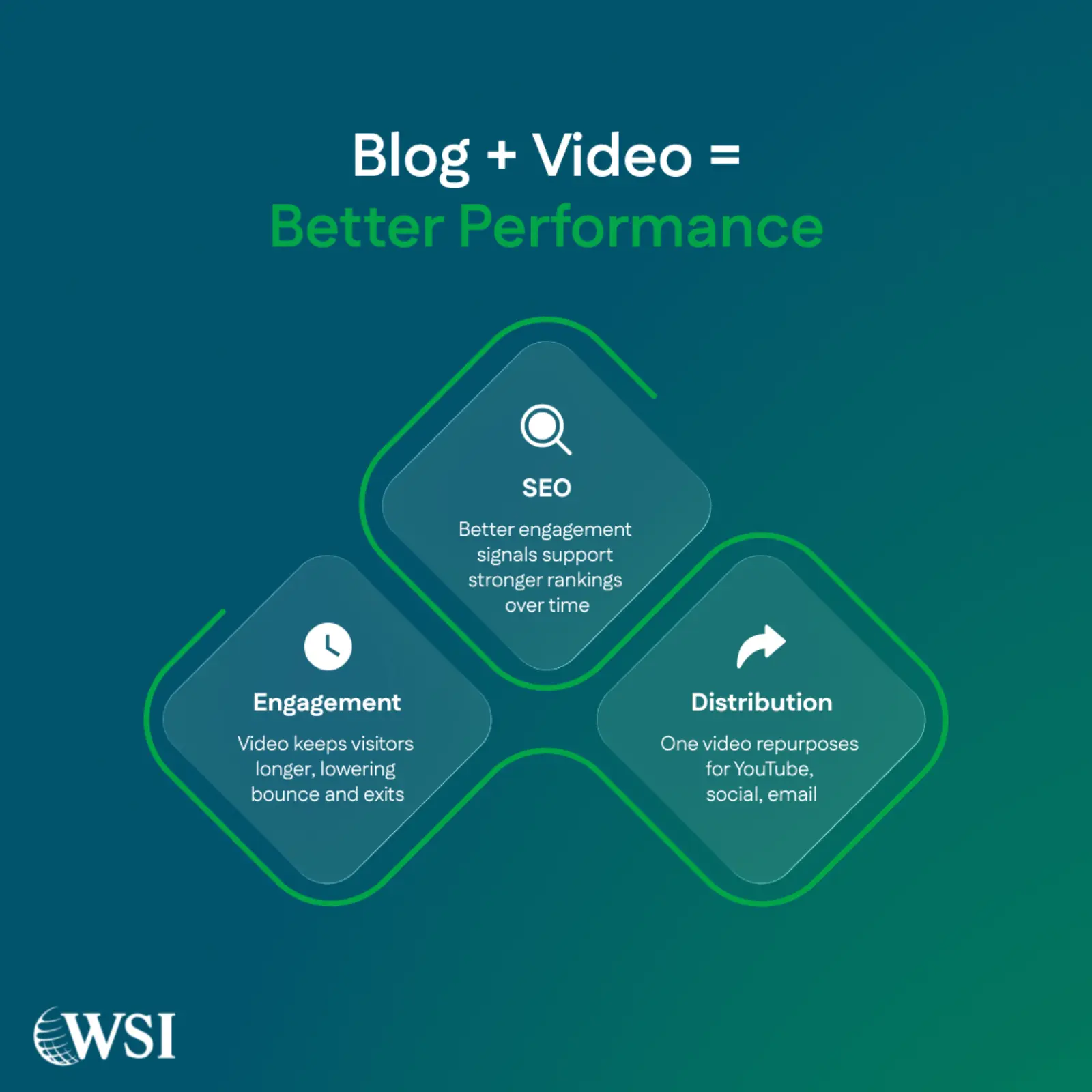
- Video increases time on page and reduces bounce rate, two signals Google uses to evaluate content quality: A visitor who watches a 90-second video before reading an article spends significantly more time on the page than one who skims the headline and leaves, and that behavioral signal carries measurable weight in organic search ranking.
- AI tools like Synthesia have eliminated the production barriers that made per-post video impractical: Script-to-video generation with selectable avatars and voiceovers means a blog video can be produced in under 30 minutes without a camera, studio, or on-screen talent, at a fraction of traditional video production costs.
- A single blog video generates returns across multiple channels simultaneously: The same video embedded in a blog post can be uploaded to YouTube for independent search visibility, clipped into short-form content for LinkedIn, Instagram, or TikTok, and repurposed into email campaign assets, multiplying the return on a single production investment.
Contents
- 1 Why Video Belongs on Blog Pages
- 2 The SEO Benefits of Video in Blog Content
- 3 Engagement and User Experience: What Video Adds Beyond Rankings
- 4 How AI Has Made Per-Post Video Production Practical
- 5 Measuring the Return on Investment of Blog Video Overviews
- 6 Frequently Asked Questions
- 7 Adopt the Hybrid Content Standard to Multiply Reach and Performance
Why Video Belongs on Blog Pages
The case for adding video to blog content is not primarily an aesthetic one. It is grounded in specific, measurable changes in how readers consume content online and how search algorithms evaluate the quality of a page. Understanding both dimensions, the behavioral and the algorithmic, makes it easier to justify the investment and to prioritize it as a content workflow element rather than an optional improvement.
Video Matches How Modern Readers Actually Behave
The modern web reader approaches content pages with a scanning mindset rather than a reading mindset, particularly on the first visit. They are evaluating within the first few seconds if the page is worth their full attention, and that evaluation happens primarily through visual cues before a word of body text is read. A video embedded prominently at the top of a blog post changes that evaluation moment by providing an immediate, low-commitment way to assess the content’s relevance and quality.
Research on information retention consistently shows that video outperforms text for initial comprehension and recall. Viewers retain significantly more of a message they watched than one they read in the same time investment. For content marketers, this has a direct implication: a reader who watches a one-minute video overview of a blog post before reading it arrives at the body text with context, orientation, and higher intent to complete the article than one who navigates directly to paragraph one.
Video Increases Dwell Time, Which Influences Rankings
Dwell time, the duration between a visitor clicking through to a page from search results and returning to the results page, is a behavioral signal that search engines use as a proxy for content quality. A page that consistently holds visitors for longer periods signals to Google that it is delivering on its promise to searchers, which supports higher ranking over time. Video is one of the most reliable tools available for extending dwell time because it adds minutes of engagement to a visit that might otherwise last seconds.
- Bounce rate reduction: Visitors who play an embedded video stay on the page for the duration of the video at a minimum, reducing the immediate exit rate that signals poor content quality to search algorithms. A 90-second video at the top of a post can cut bounce rate even if the visitor does not read the full article.
- Session depth improvement: A visitor who engages with a video is statistically more likely to continue reading and to visit additional pages on the same site during the same session. Extended session depth is a positive engagement signal that supports the domain’s overall search authority.
Video Supports Content Distribution Across Channels
A blog post that includes a video overview is not just better content on the page where it lives. It is also the source asset for a distribution strategy that reaches audiences who would never find the blog through organic search. The video produced for the blog post can be published as a standalone piece of content on every platform where the business maintains a presence, extending the reach of the underlying research and writing investment without requiring additional content production.
- YouTube visibility: Uploading blog overview videos to YouTube creates a secondary search discovery surface for the same content topic. YouTube is the second-largest search engine by query volume, and a well-optimized video can rank for queries that the written blog post does not capture.
- Short-form social content: A 90-second blog overview video can be edited into a 30 to 60-second clip suitable for LinkedIn, Instagram Reels, or TikTok, giving the content organic social reach without the production cost of creating platform-native content separately.
- Email campaign assets: A video thumbnail with a play button embedded in an email campaign achieves higher click-through rates than a text link to the same blog post, making the video a conversion asset for the email channel as well as the organic search and social channels.
The SEO Benefits of Video in Blog Content
Search engine optimization for content has expanded well beyond keyword placement and backlink volume. Google now evaluates a range of on-page behavioral signals, structured data quality, and content format diversity in determining which pages deserve top positions for competitive queries. Building your brand’s authority and trustworthiness across content formats is an increasingly important factor in how Google assesses a page’s long-term ranking quality under its E-E-A-T framework.
Rich Snippets and Video Carousels
Google surfaces video content in search results through two distinct features that are not available to text-only pages: video carousels, which appear as a dedicated row of video thumbnails above or within organic results for relevant queries, and rich snippets, which display a video thumbnail alongside the standard blue link result. Both features give video-enabled pages a visual prominence advantage over text-only competitors on the same results page, increasing click-through rate even when the underlying organic ranking position is the same.
- Video schema markup: Implementing VideoObject schema markup on pages with embedded video provides Google with machine-readable data about the video’s title, description, duration, and thumbnail, which is required for eligibility for video-specific rich results. Without schema markup, an embedded video exists for human visitors but is invisible to the structured data evaluation that determines rich result eligibility.
- Featured snippet potential: Pages that combine high-quality written content with supporting video are well-positioned for featured snippet selection because they demonstrate content depth across multiple formats. Google’s featured snippet selection increasingly favors pages that answer a query comprehensively, and multimedia depth is one signal of comprehensiveness.
Stronger On-Page Engagement Signals
The behavioral signals that video generates, lower bounce rates, higher dwell time, and increased session depth, feed directly into the on-page quality assessments that Google uses in its ranking algorithms. A page that consistently generates strong engagement signals relative to other pages ranking for the same query will tend to maintain or improve its position over time, while a page with weak engagement signals will tend to see its position erode as higher-engagement alternatives emerge.
- Backlink attraction: Video content is perceived as higher production value than text alone, which makes pages with embedded video more likely to attract inbound links from other sites. Backlinks from relevant, authoritative sources remain one of the strongest individual ranking signals in organic search, and any content format improvement that increases backlink acquisition supports ranking performance.
- Social sharing amplification: Pages with embedded video generate more social shares than text-only equivalents for the same topic. Social shares do not directly influence organic ranking, but they extend content reach, drive referral traffic, and increase the visibility that leads to the organic backlinks that do influence ranking.
AI Content and Search Engine Visibility
As search engines increasingly rely on AI to evaluate and surface content, the question of how AI-generated content performs in modern search has become practically important for any organization producing content at scale. AI-generated video content that is accurate, contextually relevant, and properly structured performs well in search evaluations, particularly when it is paired with written content that provides the depth and specificity that the video format cannot accommodate.
The distinction that matters is not the production origin of the content but its quality and relevance to the searcher’s intent. An AI-generated video that accurately summarizes a well-researched blog post and includes proper schema markup is a net positive for that page’s search performance, regardless of the production method. The bar is quality and accuracy, not production modality.

Grow Your Brand Online
Add video to your content strategy and boost visibility.
Engagement and User Experience: What Video Adds Beyond Rankings
SEO performance is the measurable downstream benefit of video, but the more immediate impact is on the visitor’s experience of the page and their relationship with the brand presenting it. Video changes the communication dynamic from one-directional reading to a more active, multi-sensory engagement that builds comprehension, trust, and recall more effectively than text alone. For businesses using content to build relationships with prospective clients or customers, these engagement effects are as commercially important as the ranking improvements.
The Movie Trailer Model for Blog Content
A blog video overview functions in the same way a movie trailer does: it delivers the highlights, sets expectations for what the full piece contains, and creates enough curiosity or value to help the viewer decide to invest further time. This structure respects the reader’s decision-making process rather than demanding commitment upfront, which paradoxically increases the proportion of visitors who do commit to reading the full post because they have been given a fair and compelling preview of its value.
The practical structure that works best is a 60 to 90-second video that covers three to four key points from the blog post without exhausting the full argument of each one. The video should make the case that the blog post answers a specific question the viewer is likely to have, and it should conclude with a verbal prompt that directs the viewer to the written content below for the complete analysis. This structure maximizes both video engagement and article read-through rate.
Accessibility and Inclusive Content Design
Video content with captions significantly extends the reach of a blog post to audiences that text alone does not serve well. Captions make content accessible to viewers in sound-restricted environments, to non-native speakers processing written transcription alongside spoken audio, and to viewers with hearing impairments who would otherwise be excluded from video content entirely. Modern AI video platforms generate captions automatically and synchronize them to speech with high accuracy, making accessibility a zero-effort outcome of the production process rather than a separate post-production task.
- Non-native speaker reach: A captioned video allows readers who find dense written prose challenging to follow the same content in spoken form while reading the transcript, effectively providing two simultaneous content formats for the same audience.
- Auditory learner engagement: A meaningful proportion of any audience comprehends information more effectively when they hear it rather than read it. A video overview serves that audience segment in a format that written content structurally cannot.
- Accessibility compliance: For organizations with accessibility obligations, captioned video supports compliance with Web Content Accessibility Guidelines standards that apply to multimedia content published publicly.
Trust and Brand Authority
A video presence on a blog post signals a level of production investment and communication intentionality that text alone cannot convey. Visitors encountering a brand for the first time through a blog post make rapid assessments of credibility and professionalism, and the presence of a well-produced video, even one featuring an AI avatar rather than on-camera human talent, shifts that assessment positively by demonstrating that the organization takes its content presentation seriously.
- Brand consistency signals: A video that uses the brand’s visual identity, tone of voice, and terminology reinforces brand recognition across every channel where the video appears, building the consistent impression that supports long-term recall and preference.
- Thought leadership positioning: Organizations that consistently produce video content alongside written content are perceived as more authoritative in their field than those that publish text only. Video is a higher-effort content format in the reader’s perception, and that perception transfers to the brand’s standing in the topic area.
How AI Has Made Per-Post Video Production Practical
The traditional barriers to blog video production, equipment, on-screen talent, editing time, and production cost, made per-post video economically unviable for most content programs. A single professionally produced video could cost thousands of dollars and require days of coordination, which made video a flagship content format rather than a routine one. AI video generation platforms have eliminated each of these barriers systematically, making it possible to produce a professional-quality blog overview video in under 30 minutes at a per-video cost measured in dollars rather than thousands.
What AI Video Tools Like Synthesia Actually Do
AI video platforms like Synthesia operate on a script-to-video model: you provide a written script, select an avatar from a library of diverse presenters, select a voiceover language and tone, and the platform generates a presenter-led video in minutes. The avatar lip-syncs to the generated voiceover, and the visual environment, including background, graphics, and branding elements, is configurable through a template interface that does not require design or technical skills.
- Script-to-video generation: Paste a 150 to 200-word summary of your blog post, select visual settings, and the platform renders a complete presenter-led video. The full production process from a finished blog post to an embedded video takes under 30 minutes for an experienced user.
- Avatar and voice diversity: A library of diverse avatar options and multi-language voiceover capabilities means a single content team can produce videos suited to different audience demographics and regional markets from the same production workflow.
- Localization at scale: AI video platforms can generate the same video in multiple languages without re-recording, enabling international content programs that would be prohibitively expensive to run with traditional production methods.
Integrating Video into the Content Production Workflow
The most effective implementation of blog video production treats it as a standard step in the content workflow rather than a separate project. The practical sequence is: write the blog post, draft a 150 to 200-word summary that covers the three to four most important points, generate the video using the AI platform, and embed the video at the top of the post before publication. This sequence adds approximately 30 to 45 minutes to the production time of any post and requires no additional team members or technical skills beyond access to the AI platform.
- Blog summary script: The video script should be a condensed version of the blog’s argument, not a verbatim excerpt. It should cover the core question the post addresses, two to three key findings or recommendations, and a clear invitation to read the full piece for the complete analysis.
- Top-of-post placement: Embedding the video at the top of the post, before the body text begins, maximizes the proportion of visitors who encounter it. Visitors who scroll past the first screen without engaging with any media element are significantly less likely to watch a video placed further down the page.
- YouTube cross-post: Uploading the same video to the brand’s YouTube channel immediately after embedding it in the blog creates a second indexed asset for the same topic without any additional production effort. YouTube and blog search visibility compound each other’s reach for the same investment.
Cost Efficiency Compared to Traditional Production
A professionally produced 90-second video using traditional methods, including videographer, talent, editing, and revisions, typically costs between $1,500 and $5,000 per video, depending on production quality and market. At that cost, video production is reserved for campaigns and flagship content pieces that can justify the expense individually. AI video production on platforms like Synthesia costs approximately $30 to $100 per month for a subscription that covers unlimited video production, reducing the per-video cost to negligible levels and making it economically sensible to produce a video for every post in a content calendar.
Measuring the Return on Investment of Blog Video Overviews
The ROI of adding video to blog posts is measurable through a combination of engagement metrics, search performance metrics, and conversion data that most organizations already collect through Google Analytics, their CRM, and their search console. Establishing a baseline before adding video to a set of posts and comparing post-video performance against that baseline is the most reliable method for quantifying impact specific to your audience and content type. The data consistently points in the same direction across industries: video-enabled pages outperform text-only equivalents on every metric that connects content performance to business outcomes.
Engagement Metrics That Reflect Video Impact
- Time on page: Average session duration on blog posts with video overviews is measurably higher than on equivalent posts without video. Tracking this metric before and after adding video to a post is the clearest direct measure of the behavioral engagement benefit.
- Bounce rate reduction: A reduction in the percentage of single-page sessions on video-enabled posts indicates that video is successfully extending visitor engagement beyond the first page, which is a positive signal for both user experience and search performance.
- Video play rate and completion rate: Tracking the percentage of page visitors who play the embedded video and the percentage who watch it to completion identifies the optimal video length and placement for your specific audience, enabling ongoing optimization of the format.
Search Performance Indicators
- Organic ranking position: Pages with embedded video and proper schema markup are eligible for video-rich results that increase click-through rate at any given ranking position. Monitoring ranking position and click-through rate together after adding a video to a page shows the combined effect on organic traffic volume.
- Featured snippet acquisition: Tracking featured snippet appearances for target queries before and after adding video and schema markup to relevant posts measures the structured data impact on search result format, which is one of the highest-leverage visibility improvements available without changing ranking position.
Conversion and Commercial Impact
The conversion impact of video overviews is most visible on blog posts with explicit calls to action, such as posts that invite readers to download a resource, schedule a consultation, or subscribe to a newsletter. A visitor who has engaged with a 90-second video is meaningfully more likely to complete a conversion action than one who skimmed the headline and scrolled past, because the video has established context, built initial trust, and demonstrated the brand’s communication quality before the conversion ask is made.
Organizations that track lead source data through their CRM can quantify the pipeline contribution of video-enabled blog content by comparing conversion rates on video-enabled posts against text-only equivalents over a comparable traffic volume. This comparison typically demonstrates a conversion rate lift that, when expressed in revenue terms, justifies the subscription cost of AI video production many times over within the first quarter of implementation.
Frequently Asked Questions
Does the video need to feature a real person, or is an AI avatar acceptable for professional audiences?
AI avatars are widely accepted in professional and B2B environments when the content is accurate, well-written, and aligned with brand standards. Audience perception depends more on clarity, insight, and production quality than if the presenter is human or AI-generated. Founder-led or relationship-driven brands may benefit from occasionally pairing AI videos with personal appearances to strengthen relational credibility.
How long should a blog video overview be, and what should it cover?
A 60 to 90 second format is ideal for introducing the topic, highlighting two or three key insights, and encouraging viewers to read the full article. The script should clearly state the problem addressed and summarize the most valuable takeaways without covering every detail. The goal is to provide immediate value while reinforcing that the complete analysis is available in the written post.
What technical steps are required to make a blog video eligible for Google’s rich video results?
The video must be publicly accessible, properly indexed, and supported by VideoObject schema markup that includes essential metadata such as title, description, thumbnail, upload date, and duration. Hosting on crawlable platforms like YouTube or Vimeo, or embedding with structured data on your site, ensures eligibility for indexing. Final validation through Google’s Rich Results Test confirms correct implementation and search visibility readiness.
Adopt the Hybrid Content Standard to Multiply Reach and Performance
Integrating video overviews into blog posts transforms them into multi-channel assets that drive stronger search visibility, longer engagement, broader social reach, and greater brand credibility from a single production effort. With AI tools removing traditional cost and time barriers, video creation can now become a routine part of content workflows rather than a separate initiative. Organizations that consistently pair text with video and measure performance across platforms will build a compounding advantage as search algorithms and audience expectations increasingly reward multimedia depth and accessibility.

Build Brand Awareness Now
Get a content and video strategy built for your brand.