

When marketers talk about ROI, content marketing rarely gets the credit it deserves. Paid ads get the performance dashboards. SEO gets the technical audits. But content sits quietly in the background, doing the work that makes every other channel function. It is the asset that gets indexed, the resource that social posts link to, the substance that email newsletters deliver, and the material your prospects use to decide, even if they trust your brand before they ever speak to anyone on your team.
That quiet consistency is exactly why content marketing is so easy to undervalue. The results are not always immediate, and they are not always easy to attribute to a single campaign. But the leads that content generates tend to be better qualified, more informed, and further along in their decision process than leads from almost any other source. Understanding why that happens, and how to replicate it deliberately, is what separates businesses that use content as a genuine growth lever from those that treat it as an afterthought.
Key Takeaways:
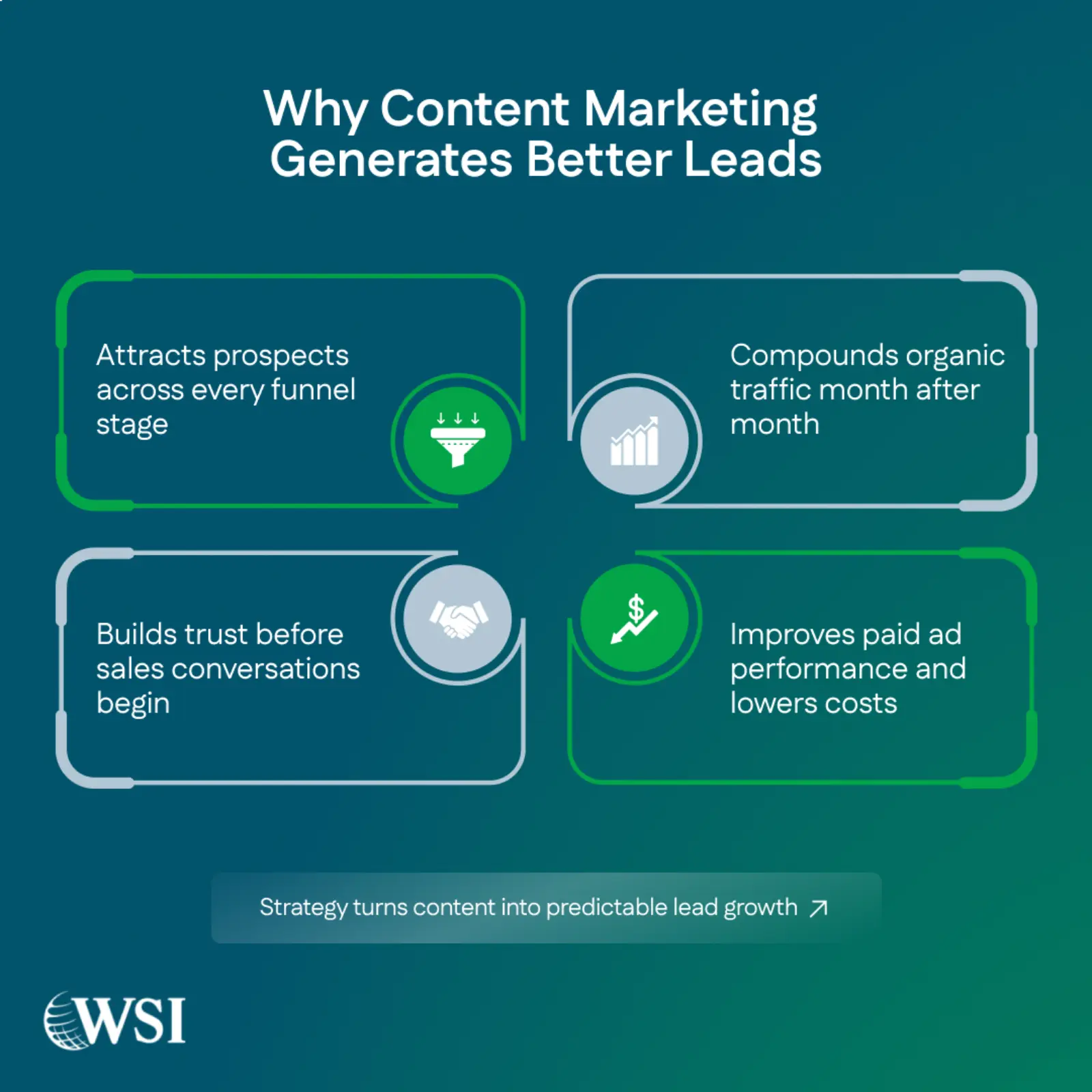
- Content marketing generates leads at every funnel stage: Unlike paid ads that capture only ready-to-buy prospects, well-planned content attracts, educates, and builds trust with audiences at awareness, consideration, and decision stages simultaneously.
- The SEO and content connection compounds over time: Businesses that publish consistently see measurably higher organic traffic and lead volume, and those gains do not disappear the moment a campaign budget runs out.
- Strategy is what separates content that converts from content that just exists: Mapping content to funnel stages, optimizing for search intent, promoting across channels, and measuring consistently are the habits that turn a content program into a reliable lead source.
Contents
- 1 Why Content Works Across the Full Marketing Funnel
- 2 The SEO-Content Connection That Compounds Over Time
- 3 How Content Marketing Improves Paid Ad Performance
- 4 Content Builds Long-Term Trust That Outlasts Any Campaign
- 5 Real-World Examples of Content Marketing Generating Leads
- 6 Why Strategy Is What Separates Content That Converts from Content That Just Exists
- 7 Frequently Asked Questions
- 8 The Compounding Advantage of Content
Why Content Works Across the Full Marketing Funnel
Most lead generation tactics target buyers at one specific point in their decision process. A paid search ad reaches someone already searching for a solution. A cold outreach email targets someone who may not know they have a problem yet. Content marketing is different because it is one of the few channels that can operate effectively at every stage of the funnel without requiring a separate strategy for each one.
The mechanism behind this is straightforward. Different content formats naturally align with different buying stages. When you build a content program that covers all three stages, you create a system where your brand is present regardless of where a prospect currently sits in their research process. That presence builds familiarity over time, and familiarity is one of the strongest predictors of eventual conversion.
Top of Funnel: Attracting the Right Audience
At the awareness stage, the goal is not conversion. It is visibility and relevance. Prospects at this stage are typically searching for answers to broad questions, not for specific vendors. Content that meets them at that point earns initial trust and introduces your brand in a low-pressure context.
The formats that perform best at this stage tend to be discoverable through search and shareable through social channels:
- Blog posts targeting informational search queries: Long-form articles that answer specific questions your target audience is already searching for generate sustained organic traffic without ongoing ad spend, and they continue accumulating visits and backlinks long after publication.
- Explainer videos distributed across social platforms: Short-form video content that breaks down a concept relevant to your industry reaches audiences who are early in their research and introduces your brand as a credible source before they are ready to evaluate vendors.
- Infographics and data-led content: Visual content that presents research, statistics, or process breakdowns earns shares from industry publications and social audiences, extending your reach to prospects who would not have found you through search alone.
Middle of Funnel: Building the Case for Your Solution
Once a prospect is aware of their problem and has started comparing options, the content they seek becomes more specific. They want evidence, comparison, and depth. Generic brand messaging loses effectiveness at this stage. Substantive content that helps them make a more informed decision builds the kind of trust that eventually converts.
- In-depth guides and whitepapers: Comprehensive resources that walk through a decision framework, explain a methodology, or provide a structured comparison give prospects the information they need to feel confident evaluating your offering alongside alternatives.
- Webinars and recorded presentations: Live or on-demand sessions that demonstrate your team’s expertise in a specific area allow prospects to assess not just what your business does, but how it thinks. That qualitative signal is often what moves a prospect from consideration to intent.
- Case studies with specific outcomes: Detailed accounts of how your business solved a specific problem for a client, with named metrics and clear context, are among the highest-converting content types at the middle of the funnel because they make abstract value claims concrete and verifiable.
Bottom of Funnel: Removing the Final Barrier to Conversion
At the decision stage, prospects have already identified you as a viable option. What they need now is the confidence to commit. Content at this stage reduces the perceived risk of choosing your business and makes the path to conversion as clear as possible.
- Client testimonials and reviews presented in context: Social proof is most persuasive when it comes from people who faced the same situation the prospect is currently in. Testimonials that describe the problem, the process, and the outcome are significantly more convincing than generic endorsements.
- ROI calculators and interactive tools: Self-service tools that allow prospects to input their own numbers and see a projected return make the value of your offering tangible rather than theoretical, which directly addresses the hesitation most buyers have before making a purchase decision.
- Product walkthroughs and demo content: Video or written walkthroughs that show exactly how your product or service works in practice answer the practical questions prospects are often reluctant to ask in a sales conversation, reducing friction at the final step before conversion.
The SEO-Content Connection That Compounds Over Time
SEO and content marketing are often discussed as separate disciplines, but in practice, they are inseparable. SEO determines if your content gets discovered. Content determines if discovery translates into engagement, trust, and conversion. Neither works well without the other, and when they are aligned, the results compound in a way that paid channels simply cannot replicate.
The data on this is consistent and has been for years. Websites that publish blog content regularly receive substantially more organic traffic than those that do not. Businesses that reach 16 or more posts per month see 3.5 times more leads than those publishing fewer than four posts in the same period. Those numbers are not explained by volume alone. They reflect the cumulative effect of a content library that covers a wide range of search queries across multiple funnel stages, creating multiple entry points for prospects to discover the brand.
How Content Earns Search Visibility
Google’s ranking systems reward content that answers user queries in depth, demonstrates topical authority, and earns links from other credible sources. Each of those criteria requires content investment. A business that publishes one generic post per month cannot compete with one that publishes multiple well-researched, search-optimized pieces per week, even if both businesses invest the same total hours. Consistency and quality together are what build the topical authority that search engines reward with sustained rankings.
The practical implications for content strategy are specific:
- Target search intent, not just search volume: A keyword with 10,000 monthly searches but high competition and vague intent will generate less qualified traffic than a cluster of specific, long-tail queries with lower volume but clear purchase or research intent. Matching content format and depth to what searchers actually want from a query is what earns rankings and keeps visitors on the page.
- Build topic clusters rather than isolated posts: Search engines evaluate topical authority at the site level, not just the page level. A cluster of ten interlinked articles covering different aspects of the same subject performs better collectively than ten unrelated standalone posts, because the internal link structure signals domain expertise in that subject area.
- Update existing content regularly: Refreshing older posts with new data, expanded sections, and current examples signals to search engines that the content remains accurate and relevant. In competitive niches, regular updates are often what separate a page holding a top-five position from one that gradually declines to page two.
Content That Ranks Also Converts
There is a common misconception that SEO content and conversion content are fundamentally different and require separate approaches. In practice, the best-performing content does both. A well-structured blog post that ranks for a high-intent search query and includes a relevant lead magnet, a clear next step, or an embedded call-to-action converts search traffic into leads without any additional paid amplification.
The key is alignment between what the search query promises and what the content delivers. A prospect who searches a specific question and arrives at a page that answers it thoroughly, provides additional resources, and makes a relevant offer has everything they need to take the next step. The content does the selling before any direct conversation takes place.

Content That Converts
See how a content strategy can grow your qualified leads.
How Content Marketing Improves Paid Ad Performance
One of the most overlooked aspects of content marketing is its direct impact on paid channel performance. Marketers often treat content and paid advertising as separate budget lines with separate goals. In practice, the content your business produces has a direct effect on how well your paid campaigns perform, how much each conversion costs, and how long the value of each paid click lasts after the initial visit.
The connection is most visible on landing pages. Sending paid traffic to a thin, generic page is one of the most common reasons paid campaigns underperform their potential. Users who click a paid ad arrive with a specific expectation shaped by the ad copy. If the landing page fails to meet that expectation with relevant, credible content, they leave. That exit is not a paid media problem. It is a content problem, and it costs real money every time it happens.
Why Content-Rich Landing Pages Convert Better
Landing pages that incorporate substantive content perform better across several measurable dimensions:
- Context and reassurance reduce bounce rates: A page that explains the offer in detail, describes who it is for, and addresses the most common questions a prospect might have gives visitors the information they need to stay and evaluate rather than leaving to search for answers elsewhere.
- Upfront objection handling removes decision friction: Most prospects arrive at a landing page with at least one significant hesitation. Content that anticipates and directly addresses those hesitations, rather than ignoring them in favor of pure promotional copy, moves prospects past the barriers that would otherwise prevent conversion.
- Social proof and credibility signals increase trust: Testimonials, client logos, case study excerpts, and third-party endorsements embedded in landing page content tell visitors that other people like them have made this decision and found value in it. That social validation is one of the strongest conversion drivers available.
- Lead magnets deliver higher quality leads than direct pitches: Promoting a practical resource, such as a buyer’s guide, a checklist, or a decision framework in a paid ad, rather than a direct product offer, delivers more qualified leads because the prospect self-selects based on genuine interest in the subject matter rather than responding to a promotional trigger.
Content Quality Affects Paid Ad Costs
Beyond conversion rates, content quality directly affects the cost of running paid campaigns. Google Ads Quality Score is partially determined by the relevance and quality of the landing page experience. A higher Quality Score lowers cost-per-click and improves ad placement, meaning better content does not just convert more visitors, it costs less to attract them in the first place.
The same dynamic applies to social paid platforms. Facebook and LinkedIn ad systems favor content that generates genuine engagement. Ads that drive traffic to high-quality content resources earn lower CPMs over time as the platform’s algorithm recognizes that users find the content valuable. Content investment, in other words, has a compounding effect on paid media economics that shows up in the numbers over time.
Content Builds Long-Term Trust That Outlasts Any Campaign
There is a fundamental structural difference between paid advertising and content marketing that shapes how each one contributes to business growth. Paid ads produce results for exactly as long as you are willing to fund them. The moment the budget runs out, the traffic stops, the leads stop, and the visibility disappears. Content works on a different model entirely.
A blog post that ranks on page one for a relevant search query generates traffic every day, continuously, for months or years after it was published. A whitepaper downloaded by thousands of prospects through an email campaign continues circulating within organizations long after the campaign itself has ended. A case study linked by an industry publication earns referral traffic indefinitely. The cumulative value of a content library compounds over time in a way that no paid campaign can replicate, because the assets continue working after the investment period ends.
Content as a Sales Enablement Tool
The lead generation function of content marketing is well understood, but its role in the sales process itself is often underappreciated. Content that your marketing team creates to attract and educate prospects is frequently the same content your sales team needs to move those prospects through the pipeline.
- Whitepapers and technical guides support complex sales conversations: When a sales rep shares a detailed resource that addresses a specific concern a prospect raised in a discovery call, it demonstrates depth of expertise and keeps the conversation moving without requiring a separate follow-up meeting for every question.
- Explainer decks and product comparison content reduce sales cycle length: Prospects who have already consumed detailed content about your offering arrive at sales conversations better prepared. They ask more specific questions, they require less basic education, and they move through the evaluation process faster because the content has already done significant preparatory work.
- Onboarding and customer success content reduces churn: Help articles, video tutorials, and structured onboarding guides that explain how to get maximum value from your product or service reduce the support burden on your team and improve customer outcomes, which directly affects retention and referral rates.
Thought Leadership and Reputation Building
Beyond direct lead generation and sales support, consistent content publication builds a brand’s reputation within its industry in ways that advertising cannot replicate. Thought leadership content, if published on your own site, contributed to industry publications, or shared through executive voices on professional networks, creates a perception of expertise that influences how prospects, partners, and potential hires evaluate your business.
- Guest posts and contributed articles extend reach to new audiences: Publishing in industry media introduces your thinking to readers who would not have found your site through search, and the credibility transfer from established publications to your brand is a form of endorsement that paid advertising cannot purchase.
- Interview and podcast content builds individual and organizational authority: When members of your team participate in industry conversations as recognized subject matter contributors, that visibility generates both direct referrals and improved brand recall among prospects who encounter your paid or organic channels separately.
Consistent publishing signals operational credibility: A business that has published 200 well-researched articles about its field communicates something about its stability, expertise, and commitment that a newer or less prolific competitor simply cannot replicate quickly. That signal matters to prospects evaluating vendors for significant or long-term engagements.
Real-World Examples of Content Marketing Generating Leads
Abstract arguments for content marketing are useful, but concrete examples of what the approach produces in practice are more persuasive. The following cases illustrate how organizations across different industries have used content as a primary lead generation mechanism with results that are directly attributable and replicable.
Education Provider: Content-Driven Application Growth
An education provider built a content strategy centered on career outcomes for program graduates. Rather than publishing generic promotional material about their programs, they created detailed articles addressing the specific questions prospective students search for before enrolling: expected salary ranges, employer demand, career transition stories, and comparisons between credential types.
The results across all three channels were interconnected. The SEO traffic from career-focused search queries grew substantially because the content was directly aligned with high-intent informational searches. Social shares increased as current students and graduates shared content relevant to their own career conversations. Direct engagement with the content, measured through time on page, return visits, and contact form submissions from readers, led to a 22 percent increase in applications over the period measured. The content was not just generating visits. It was attracting people who were already seriously considering the decision.
B2B Consulting Industry: Whitepaper as Lead Engine
The B2B consulting industry identified a recurring question among its target audience that its existing marketing did not directly address. They produced a whitepaper that tackled the question in depth, with proprietary research, a structured framework, and specific recommendations. The whitepaper was promoted through email to their existing database and through paid LinkedIn campaigns to a targeted audience of decision-makers in their sector.
The whitepaper generated over 1,200 downloads. More importantly, the follow-up email sequence sent to everyone who downloaded the resource converted 10 percent of recipients into discovery calls. That conversion rate is significantly higher than cold outreach benchmarks in most B2B sectors, and it reflects the fundamental advantage of content-qualified leads: the prospect has already demonstrated specific interest in the subject matter and has self-identified as someone with the problem your business solves.
Healthcare Clinic: Local SEO and Patient Trust
A healthcare clinic with multiple locations began publishing regular Q and A content featuring their physicians addressing common patient questions about specific health conditions. The content was written in plain language, accurate, and structured to answer the questions patients were already searching for in their local area.
Two outcomes followed. Local SEO visibility improved significantly because the content targeted specific health queries with geographic relevance, and the clinic began appearing for searches that competitors without similar content could not compete for. Patient trust improved in a qualitative but measurable way: patients who had read the physician content before booking reported feeling more confident and prepared for their appointments, which reduced cancellation rates and improved consultation outcomes. The content was doing work in both channels simultaneously with a single investment.
Why Strategy Is What Separates Content That Converts from Content That Just Exists
The gap between businesses that see strong results from content marketing and those that do not is rarely about writing quality or production value. It is almost always about strategy. Publishing content without a clear plan for what it is supposed to accomplish, who it is written for, and how it connects to lead generation goals produces traffic at best and clutter at worst. A strategic approach to content is what turns publishing activity into a consistent, measurable lead source.
Mapping Content to Funnel Stages
Every piece of content you publish should have a defined purpose within the buyer journey. That does not mean every article needs a hard sell. It means you should be able to articulate what stage of the decision process the content serves and what action you want a reader to take after engaging with it.
- Awareness content should link to consideration resources: A top-of-funnel blog post that answers a broad question should include internal links or embedded content offers that move an interested reader toward more specific, middle-of-funnel material. Without that progression, you attract visitors but give them no path deeper into your content ecosystem.
- Consideration content should qualify prospects actively: Guides, comparison content, and case studies at the middle of the funnel should be structured to help a prospect determine when your offering is right for their specific situation. Content that helps a prospect self-select out is as valuable as content that helps them self-select in, because it reduces the volume of unqualified leads reaching your sales team.
- Decision content should make the next step obvious and easy: Bottom-of-funnel content should include a clear, low-friction path to conversion. Even if that is a consultation booking, a free trial, a demo request, or a direct contact option, the call to action should be specific, relevant to the content the prospect just consumed, and simple to complete.
Optimizing for Search While Writing for Humans
Search optimization and reader experience are not in conflict when content is built correctly. The mistake many businesses make is treating SEO as a post-writing editing task rather than as a foundational input to content planning. When keyword research informs what topics to write about and how to structure the information, the resulting content naturally satisfies both search engine criteria and reader expectations.
- Use keyword research to identify real audience questions: The search queries your audience uses are the most direct available signal of what they actually want to know. Building content that addresses those specific questions in the order a prospect would naturally encounter them produces pages that rank for the query and hold the visitor’s attention long enough to move them forward.
- Structure content for scannability without sacrificing depth: Most readers scan content before committing to read it fully. Clear headings, short paragraphs, and strategic use of bullet points help readers quickly identify when a piece is relevant to their question. Once they confirm it is, they read in depth. That combination of scannable structure and substantive content is what earns both time-on-page and search ranking simultaneously.
- Avoid optimizing for search terms your audience does not actually use: Industry jargon and internally preferred terminology often differ from the language your target audience types into a search bar. Keyword research that reflects actual search behavior rather than internal naming conventions is what aligns your content with real discovery patterns.
Promoting Content Across Channels
Publishing content without promoting it is one of the most common and costly content marketing mistakes. The idea that good content will find its audience on its own underestimates how competitive the attention environment is. Every piece of content your business produces deserves a deliberate distribution plan.
- Email newsletters deliver content directly to known subscribers: Your existing email list is the highest-intent audience you have access to. A subscriber who opted in to receive communications from your business is already more engaged than a cold prospect. Sending new content to that list drives immediate traffic, engagement, and conversion opportunities from people who are already warm.
- Paid promotion amplifies content reach to targeted new audiences: A well-performing organic post is a strong signal that the topic resonates. Putting a modest paid budget behind that content on LinkedIn, Facebook, or Google Display to reach a lookalike or interest-based audience extends its reach without requiring the creation of new material.
- Social media drives early engagement signals that influence organic reach: Sharing content through your owned social channels in the days immediately after publication generates early engagement that signals relevance to platform algorithms and search engines, improving the long-term organic distribution of the content beyond the initial post window.
Measuring What Actually Matters
Content marketing measurement is where many programs stall. Tracking page views and social shares is easy, but those metrics do not directly answer the question that matters: Is the content generating leads? Building a measurement framework that connects content activity to lead outcomes requires a few specific practices.
- Track content-attributed conversions through your analytics platform: Goal configuration in Google Analytics 4 that attributes form completions, demo requests, and consultation bookings to the content piece that preceded the conversion gives you direct evidence of which topics and formats are generating leads rather than just traffic.
- Measure content’s influence across multi-touch attribution: Many leads that close through a direct channel, if its a paid search, sales outreach, or referral, were first influenced by content earlier in their journey. Multi-touch attribution models that credit content touchpoints alongside final-click sources give you an accurate view of content’s total contribution to lead generation.
- Review and retire content that does not contribute to lead outcomes: Not every piece of content deserves continued investment. A quarterly audit that identifies which content is driving leads, which is driving traffic without leads, and which is performing below minimum thresholds allows you to concentrate future effort on the approaches that are actually working rather than maintaining a large volume of underperforming material.
Frequently Asked Questions
How long does it take for content marketing to start generating leads?
Content marketing is a compounding investment, not an immediate return channel. Most businesses see initial organic traffic growth within three to six months of publishing consistently optimized content, with meaningful lead attribution typically becoming visible between six and twelve months in. The timeline depends significantly on the competitiveness of your target keywords, the quality and frequency of publication, and if a content is being actively promoted through other channels. Businesses that combine organic content with email distribution and modest paid amplification tend to see lead results earlier than those relying on organic discovery alone.
How much content does a business need to publish to see results?
Quantity matters less than consistency and quality, but both volume and regularity do influence outcomes. Research consistently shows that publishing frequency above 16 posts per month correlates with significantly higher lead volume than lower-frequency programs. For most small and mid-sized businesses, a realistic starting target is two to four well-researched, properly optimized pieces per month, with a plan to increase volume as internal capacity or agency support grows. Publishing two excellent pieces per month will outperform publishing eight mediocre ones, but excellent content published at scale will outperform both.
What content formats work best for B2B lead generation?
For B2B audiences, long-form content formats with clear practical value tend to perform best for lead generation: in-depth blog posts targeting specific professional search queries, whitepapers and research reports offered as gated downloads, case studies with named clients and specific outcome metrics, and webinars that demonstrate expertise in a relevant subject area. The common thread is specificity. B2B buyers are evaluating vendors against a real business problem, and content that addresses that problem directly and in depth is what earns their engagement and trust more effectively than broad or generic material.
Should content be gated or freely accessible?
Both approaches serve legitimate purposes and the right choice depends on the content type and your lead generation goals. Freely accessible content builds organic search visibility, earns backlinks, and reaches the widest possible audience. Gated content, where a prospect exchanges contact information for access to a resource, generates direct leads and allows you to follow up with a qualifying sequence. A common and effective approach is to make top-of-funnel content fully accessible to maximize reach and SEO benefit, while gating higher-value resources like comprehensive guides, proprietary research, and templates that justify the friction of a form completion.
How does content marketing work alongside paid advertising?
Content and paid advertising work best when treated as complementary rather than competing budget lines. Content provides the assets that make paid campaigns more effective, specifically the landing pages, lead magnets, and educational resources that convert paid traffic into leads rather than bounces. Paid advertising amplifies content reach to targeted audiences faster than organic distribution alone can achieve. The most efficient programs use paid channels to validate which content topics resonate before investing heavily in organic development, then scale back paid spend on topics where organic content has achieved strong rankings. The result is a system where each channel improves the performance of the other rather than operating independently.
How do you measure if content marketing is generating a return on investment?
The most direct measurement connects specific content pieces to lead outcomes: form completions, consultation bookings, demo requests, or download submissions that came from a visitor who arrived through organic search or direct content access. Setting up goal tracking in Google Analytics 4 for these conversion events and attributing them to the content that preceded the conversion gives you a direct content-to-lead measurement. Beyond direct attribution, tracking organic traffic growth over time, changes in search ranking for target keywords, and email engagement rates from content newsletters builds a picture of the total value content is producing across channels, not just in the final conversion step.
The Compounding Advantage of Content
Content marketing, often undervalued due to delayed results and multi-channel contributions, plays a vital role in lead generation. Its effectiveness is influenced not by writing quality or budget size but by a clear strategy that defines funnel stages, targeted search queries, audience-engaged formats, and outcome measurement. Businesses that prioritize this strategic foundation find content marketing to be a durable and cost-efficient lead source, as it attracts informed prospects ready to make decisions before engaging with sales teams.

Start Generating Leads
Build a content strategy that works while you sleep.