

When someone nearby searches for a physiotherapy clinic, a business accountant, or a dentist accepting new patients, one of two things happens. Your business appears in the results, or a competitor’s does. There is no neutral outcome. Local search is a zero-sum competition for visibility at the exact moment a prospective client or patient has decided they need what you offer. Showing up at that moment is not a bonus outcome. It is the entire point of having a digital presence for a location-dependent business.
Local SEO is the discipline that determines which businesses appear in those searches. It is distinct from general search optimization in that it focuses specifically on location-based queries, Google Maps visibility, Google Business Profile performance, review signals, and the accuracy and consistency of your business information across the web. For clinics, professional service firms, and any business that depends on clients in a defined geographic area, local SEO is the foundational layer of digital marketing that every other channel builds on top of.
Key Takeaways:
- Local search captures high-intent prospects at the exact moment of decision: Searches like ‘clinic near me’ or ‘accountant in [city]’ are made by people who have already decided they need the service. Appearing in those results means being present at the most valuable moment in the buyer journey.
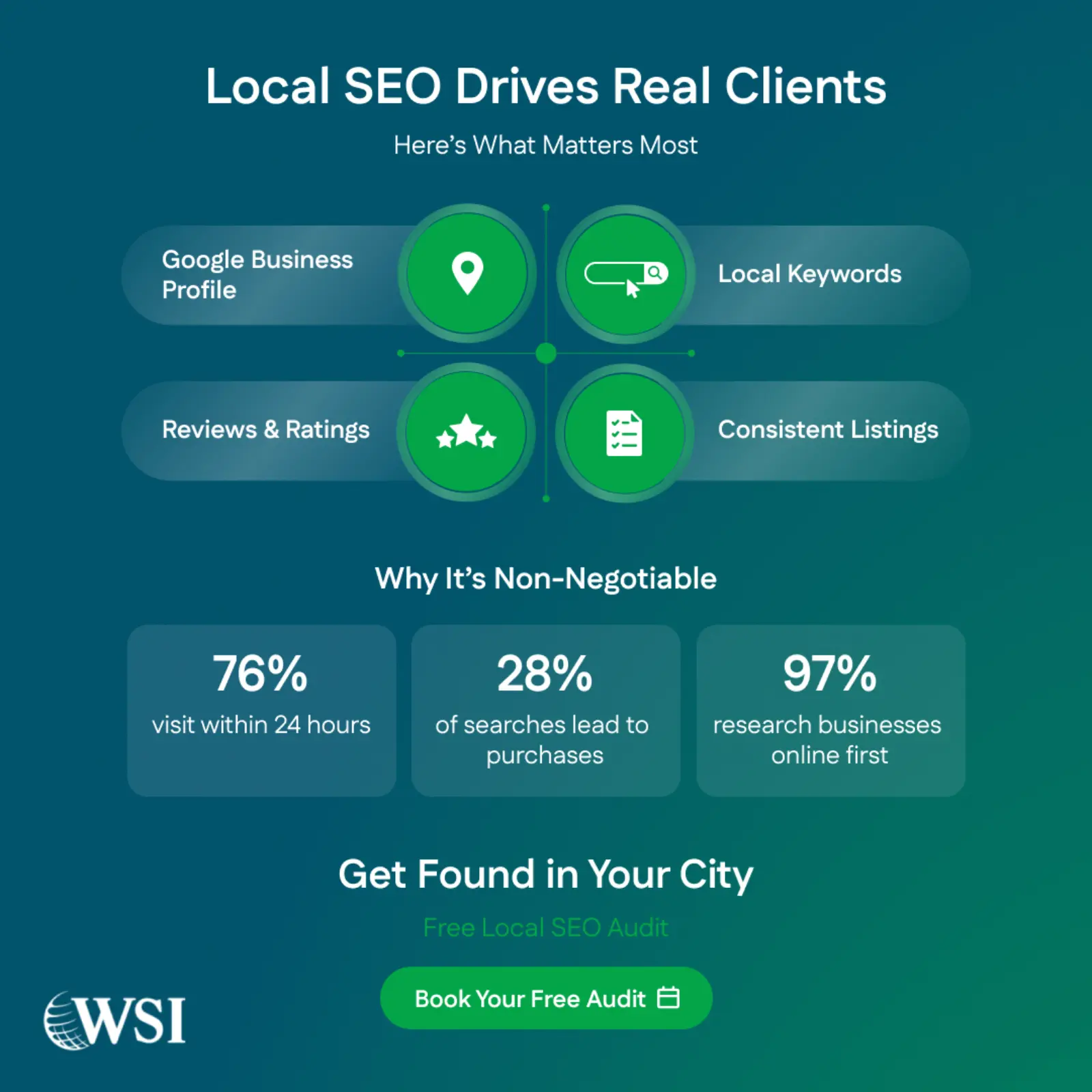
- Google Business Profile, local keywords, reviews, and consistent citations are the four pillars of local SEO: Each element contributes to how Google evaluates your relevance and credibility for location-based queries, and weakness in any one of them limits your overall visibility.
- Common mistakes actively suppress your local ranking: Generic SEO strategies applied without local relevance, unanswered reviews, missing service-area landing pages, and over-reliance on paid advertising each reduce your local search performance in specific, diagnosable ways.
Contents
- 1 What Local SEO Is and How It Differs from General SEO
- 2 The Search Queries That Drive Local Business
- 3 Why the Data on Local Search Makes This Non-Negotiable
- 4 The Key Elements of Local SEO and How Each One Works
- 5 How Local SEO Impact Differs Across Industries
- 5.1 Clinics and Healthcare Providers
- 5.2 Professional Service Firms
- 5.3 Education and Training Providers
- 5.4 Applying Generic SEO Without Local Relevance
- 5.5 Ignoring Google Reviews or Responding Inconsistently
- 5.6 Missing Service-Area Landing Pages
- 5.7 Over-Relying on Paid Advertising Without Building Organic Local Visibility
- 6 Frequently Asked Questions
- 7 Conclusion
What Local SEO Is and How It Differs from General SEO
General SEO is the practice of optimizing a website to rank well in organic search results for queries that are not tied to a specific geographic location. Local SEO is a more focused discipline that addresses a specific category of search behavior: queries where the searcher’s location is a primary factor in determining which results are relevant.
When Google processes a query like ‘physiotherapy clinic Toronto’ or ‘small business accountant Brampton,’ it does not simply return the websites with the most relevant content. It evaluates a combination of factors that are specific to local search: the proximity of the business to the searcher, the completeness and accuracy of the business’s Google Business Profile, the volume and recency of its reviews, the consistency of its contact information across the web, and the presence of location-specific content on its website. These factors collectively determine a business’s local search ranking, and they are largely separate from the factors that determine general organic rankings.
The practical distinction matters because businesses that invest in general SEO without specifically addressing local signals often find that they rank reasonably well for broad, non-geographic queries while remaining invisible in the local pack results that appear at the top of Google’s results page for location-based searches. Those local pack results, the map with three business listings that appears above organic results for most local queries, generate a disproportionate share of clicks for high-intent local searches. Being absent from that section means being absent from the most valuable real estate in local search.
The Search Queries That Drive Local Business
The queries that local SEO addresses are fundamentally different in character from informational search queries. A user searching ‘how does physiotherapy work’ is in a research mindset. A user searching ‘physiotherapy clinic Toronto’ or ‘physiotherapist near me’ has already completed their research and is now selecting a provider. That distinction in intent is what makes local search queries so valuable to location-dependent businesses.
The specific formats these queries take vary, but the intent structure is consistent:
Service plus city queries
Searches in the format ‘service type + city name’ are among the most common and highest-converting local queries. A business that ranks in the local pack for ‘chiropractor Mississauga’ or ‘corporate accountant Ottawa’ is visible to searchers who have already identified both their need and their preferred location.
Near me queries
Searches using the phrase ‘near me’ are handled by Google using the searcher’s device location and return results in proximity order. These searches are most common on mobile devices and often indicate immediate or same-day intent. A business that appears in ‘dentist near me’ results for its surrounding neighborhood is accessible to its highest-urgency prospective patients.
Best or top qualifier queries
Searches in the format ‘best physiotherapist in [city]’ or ‘top-rated accountant near me’ are high-intent queries where the searcher is actively evaluating quality rather than just availability. These searches strongly favor businesses with high review volumes and strong average ratings, making reputation management an essential component of ranking for this query type.
Why the Data on Local Search Makes This Non-Negotiable
The behavioral data on local search is consistent across multiple years of research and reflects a fundamental shift in how people find and choose local businesses. The statistics cited most frequently in local SEO discussions are not outliers or aspirational projections. They describe actual behavior patterns that are directly relevant to the revenue of any business that depends on local clientele.
Three figures in particular frame the stakes clearly. There are 76% of people who search for something nearby visit a business within 24 hours of conducting that search. And at least 28% of local searches result in a purchase. And 97% of people learn more about a local business online before visiting, calling, or booking. Taken together, these numbers describe a world in which local search is not a supplementary discovery channel. It is the primary mechanism through which a large proportion of high-intent local prospects make contact with businesses for the first time.
What the Numbers Mean for Clinics and Service Firms Specifically
For a healthcare clinic, the 76 percent same-day visit figure reflects a specific behavioral reality: patients searching for a clinic or specialist often have an immediate or urgent need. A person searching ‘walk-in clinic near me’ or ‘physiotherapist accepting new patients Toronto’ is not conducting preliminary research for a decision they plan to make in three months. They are actively seeking a provider, and the businesses that appear first in those results receive the calls.
For professional service firms, including accounting practices, law firms, financial advisors, and consultancies, the review and reputation data is particularly significant. A business accountant or legal advisor appearing in local map results with 80 verified reviews and a 4.8 average rating creates a fundamentally different first impression than an equally qualified competitor with 12 reviews and a 4.1 average. The local search results page is often the first substantive interaction a prospective client has with a business, and the visible signals on that page, review count, rating, hours, photos, and response patterns, shape an initial credibility judgment before any website visit occurs.
For education and training providers, localized search visibility addresses a specific trust dynamic. Even programs delivered primarily online benefit from local search visibility because a meaningful proportion of prospective students prefer or actively seek institutions with a local presence. Appearing in local search results with accurate location information and positive reviews signals the institutional stability and community embeddedness that online-only visibility cannot replicate.
The Key Elements of Local SEO and How Each One Works
Local SEO is not a single tactic. It is a system of interconnected optimization elements that collectively determine how prominently your business appears in location-based search results. Understanding each element individually, and how they interact, is what allows you to diagnose gaps in your current local presence and prioritize improvements by likely impact.
Google Business Profile Optimization
Your Google Business Profile is the single most important factor in your local search visibility. It is the data source Google uses to populate local pack results, Google Maps listings, and the knowledge panel that appears on the right side of desktop search results for branded queries. A profile that is incomplete, inaccurate, or poorly maintained directly suppresses your local ranking and undermines the first impression you make on prospective clients who encounter you through search.
The elements of a well-optimized Google Business Profile include:
- Claim and verify your profile: An unclaimed profile cannot be fully managed and is more vulnerable to incorrect information being suggested by third parties. Claiming and verifying through Google’s standard process gives you control over all profile elements and enables access to performance analytics that unclaimed profiles do not provide.
- Select accurate primary and secondary categories: Your primary category is one of the strongest signals Google uses to determine which local searches your profile is eligible to appear for. Selecting the most specific, accurate category available for your primary service, rather than a broad parent category, improves your relevance for the specific queries most likely to convert for your business.
- Complete every profile section with accurate, specific information: Business hours, service descriptions, website URL, phone number, and physical address should all be complete and consistent with the information on your website. Incomplete profiles appear less credible to both Google’s algorithm and to prospective clients evaluating options in local search results.
- Add photos and update them regularly: Businesses with photos on their Google Business Profile receive substantially more direction requests and website visits than those without. Photos of your clinic, office, staff, and work environment humanize your business and give prospective clients a realistic preview of what to expect, which reduces hesitation before making contact.
- Post regular updates and special offers: Google Business Profile posts function similarly to social media updates and appear directly in your profile in search results. Regular posts signal to Google that your profile is actively maintained, which is a positive factor in local ranking, and they give prospective clients current information about your services, hours, and any time-sensitive offers.
Local Keywords and Location-Specific Content
Your website needs to communicate clearly to search engines that your business serves specific geographic areas with specific services. This requires content that explicitly names your service categories alongside the locations you serve, structured in a way that reflects how your target audience searches rather than how your internal team describes your offerings.
The most effective approach to local keyword integration involves two interconnected content strategies:
- Service-area landing pages for each primary location: A single homepage with a mention of your city in the footer does not provide enough local signal for Google to rank your site prominently for city-specific queries. Creating dedicated landing pages for each primary service area, for example ‘Chiropractic Services in Mississauga’ or ‘Accounting Services for Small Businesses in Brampton,’ gives Google specific, indexable content for each geographic target and gives visitors a page that directly confirms you serve their area.
- Blog content addressing local context and community topics: Articles that address local events, regional regulations relevant to your industry, neighborhood-specific health topics for clinics, or local business conditions for professional service firms serve two functions simultaneously. They provide topical content that is specifically relevant to a local audience, and they generate long-tail local search traffic from queries that broader content cannot capture.
- Natural integration of location signals throughout existing pages: Beyond dedicated landing pages, your homepage, about page, and service pages should reference your primary service city and surrounding areas in ways that read naturally rather than as keyword stuffing. Structured data markup using the LocalBusiness schema provides an additional, machine-readable layer of location information that reinforces your geographic relevance to search engines.

Get Found Locally
See where your local SEO stands and what to fix first.
Reviews and Reputation Management
Online reviews are one of the most powerful local ranking signals available and one of the most consequential trust factors in local search. Google’s algorithm explicitly incorporates review volume, review recency, and average rating into local search ranking calculations. A business with 150 recent reviews and a 4.7 average rating will, all other factors being roughly equal, outrank a competitor with 25 reviews and a 4.4 average for the same local queries.
Beyond their ranking impact, reviews function as social proof at the exact moment a prospective client is evaluating their options. A local search result page displaying your rating alongside competitors creates an immediate comparative impression that influences which listing a searcher clicks on before they have visited any website. Managing your review profile is not just an SEO activity. It is a conversion activity with direct revenue implications.
Effective reputation management for local SEO involves a consistent set of practices:
- Build a systematic process for requesting reviews from satisfied clients: Reviews do not accumulate passively for most businesses. A deliberate, repeatable process for asking satisfied clients or patients to leave a Google review, timed appropriately after a positive experience, is what separates businesses with 200 reviews from those with 20. The request itself can be a brief follow-up message, an email with a direct link to your review page, or a prompt at the point of service checkout.
- Respond professionally and specifically to every review: Responding to positive reviews confirms that your business is attentive and client-focused, which is a positive impression for prospective clients reading reviews. Responding to negative reviews demonstrates that your business takes feedback seriously and handles concerns constructively. Unanswered negative reviews, left sitting without response, create the impression that the criticism is accurate and that the business does not care.
- Monitor reviews across multiple platforms: Google reviews carry the most weight for local search ranking, but reviews on Healthgrades, RateMDs, or Zocdoc for healthcare providers, and on Clutch or industry-specific directories for professional service firms, also contribute to your overall online reputation. Monitoring these platforms regularly and responding consistently across all of them reflects a thorough approach to reputation management that prospective clients notice.
Local Listings and Citation Consistency
A citation, in local SEO terms, is any online mention of your business name, address, and phone number. Citations appear in business directories, review platforms, industry association listings, local chamber of commerce sites, and dozens of other online databases. The consistency of this information across all platforms is a significant local ranking signal because Google cross-references citation data to verify that your business information is accurate and trustworthy.
Inconsistent citations, where your address appears with different formatting, your phone number has changed but old listings have not been updated, or your business name appears with different punctuation or abbreviation across platforms, create conflicting signals that reduce Google’s confidence in your business information. This directly affects your local search ranking and can also cause prospective clients who find your listing on a third-party directory to have incorrect contact information.
The key citation management practices that local SEO requires include:
- Establish a canonical NAP format and apply it consistently: Decide on the exact format for your business name, address, and phone number, including abbreviations, suite number formatting, and phone number punctuation, and use that exact format across every platform where your business is listed. Even minor formatting differences between listings can create citation inconsistency signals.
- Audit and correct existing citations on primary directories: Your business is likely already listed on Google, Yelp, Yellow Pages, Bing Places, Apple Maps, Facebook, and a range of industry-specific directories, many of which were created automatically from data aggregators rather than by your team. Auditing these listings for accuracy and correcting outdated or incorrect information removes citation inconsistency without requiring you to build new listings from scratch.
- Build citations on industry-specific directories relevant to your sector: Healthcare providers benefit from listings on Healthgrades, RateMDs, WebMD’s provider directory, and provincial or state health authority directories. Professional service firms benefit from listings on professional association websites, Clutch, and local chamber of commerce directories. Industry-specific citations carry additional relevance weight beyond general directories because they signal both geographic presence and sector credibility simultaneously.
On-Site SEO and Schema Markup for Local Businesses
Your website’s technical and content structure needs to reinforce the geographic relevance signals established through your Google Business Profile and citation network. On-site local SEO encompasses both the content elements visible to visitors and the structured data markup that communicates business information directly to search engines in a machine-readable format.
- Implement LocalBusiness schema markup: Schema markup using the LocalBusiness type, or a more specific subtype such as MedicalClinic, AccountingService, or LegalService, provides search engines with structured data about your business name, address, phone number, hours, service area, and other attributes. This markup reinforces your citation data, helps Google understand your business category, and can enable rich result features in search results for qualifying businesses.
- Embed a Google Maps instance on your contact page: An embedded map on your contact or location page provides a visual confirmation of your physical location for site visitors and adds a geographic data point that search engines can process. It also improves the practical usability of your contact page for prospective clients who are planning a visit and need directions.
- Optimize page titles and meta descriptions for local search: Page titles that include your primary service category and city name, for example ‘Physiotherapy Services in Toronto | Clinic Name,’ provide a clear local relevance signal in one of the most heavily weighted on-page SEO elements. Meta descriptions that include location references and a clear call to action also improve click-through rates from local search results pages where your listing appears alongside competitors.
How Local SEO Impact Differs Across Industries
The fundamental mechanics of local SEO are consistent across business types, but the specific opportunities, priorities, and competitive dynamics vary significantly by industry. Understanding the specific local search landscape in your sector allows you to direct optimization effort where it produces the greatest return rather than applying a generic approach across all elements equally.
Clinics and Healthcare Providers
Healthcare is one of the sectors where local search intent is most urgent and where the conversion from search to contact happens most rapidly. A patient searching for a clinic, specialist, or therapist often has an immediate need, a referred condition, or a scheduled follow-up that requires timely booking. The speed of that conversion from search to call or booking request means that visibility at the moment of search is more directly tied to appointment volume than in sectors with longer consideration cycles.
The specific local SEO priorities for healthcare providers reflect this urgency dynamic:
- Google Business Profile completeness and photo quality: Prospective patients evaluating clinic options in local search results make rapid assessments based on visible profile elements. A clinic with professional photos of the reception area, treatment rooms, and staff communicates a level of facility quality and patient care investment that influences click-through decisions before any website visit occurs.
- Review volume and recency in a trust-sensitive context: Healthcare decisions carry higher personal stakes than most service purchases. A clinic with 200 recent positive reviews and a 4.8 rating provides the kind of social proof that reduces the hesitation a new patient might feel about trusting their care to an unfamiliar provider. Review recency matters specifically because patients want confirmation that the positive experience others describe is representative of current practice, not historical performance.
- Condition and treatment-specific local content: Clinic websites that publish content addressing specific conditions, treatments, or health topics relevant to their patient population in conjunction with location references capture long-tail local search traffic from patients researching specific diagnoses. A physiotherapy clinic that publishes articles on ‘knee rehabilitation exercises after ACL surgery in Toronto’ serves both the informational search and the local provider search simultaneously with a single piece of well-structured content.
Professional Service Firms
For accounting practices, law firms, financial advisors, and business consultancies, local SEO operates in a context where trust and credibility are the primary decision factors. A prospective client evaluating professional service providers in local search results is not simply looking for the nearest available option. They are assessing competence, reputation, and fit before making a commitment that may involve significant financial, legal, or strategic stakes.
- Review content and specificity matter beyond volume: For professional services, the content of reviews carries as much weight as the count. Reviews that describe specific positive outcomes, professional responsiveness, and clear expertise in a relevant area are more persuasive than generic praise, even in large volumes. Encouraging clients to describe the specific situation in which they found the firm’s service valuable produces review content that functions as a targeted testimonial.
- Local map pack visibility signals established community presence: Appearing consistently in local map pack results for queries relevant to your practice area and city signals that your firm has an established, verifiable physical presence in the community. For professional service prospects conducting due diligence before making contact, that visibility is itself a credibility signal that distinguishes your firm from practitioners who exist only as website listings without corroborating local search presence.
- Service-area pages for each practice niche and location: A multi-service firm that optimizes separate landing pages for each primary service category, combined with each primary service area, creates a large matrix of locally targeted pages that capture specific queries across the full range of the firm’s expertise. An accounting practice serving multiple cities can create pages targeting ‘small business accounting in Brampton,’ ‘corporate tax services in Mississauga,’ and ‘bookkeeping services in Hamilton’ that each rank independently for their specific queries.
Education and Training Providers
For education institutions and training providers, local SEO addresses a trust and familiarity dynamic that operates even for programs delivered primarily online. Research consistently shows that a meaningful segment of prospective students prefers institutions with a recognizable local presence, particularly for programs involving significant tuition investment or credential stakes. A local search presence that confirms physical existence, community integration, and regional reputation provides reassurance that a purely digital presence cannot replicate.
- Localized content that references regional career outcomes: Educational content that connects program completion to employment outcomes in the local job market, specific regional employers, or local industry sectors makes the value proposition concrete for prospective students evaluating programs from the perspective of their own geographic context. ‘Graduates from our Toronto-based program have been placed with these regional employers’ is more persuasive to a local prospect than a generalized outcome statement.
- Local partnerships and community involvement as citation sources: Education providers that partner with local employers, participate in community events, or collaborate with regional industry associations generate natural citation opportunities through press mentions, partner websites, and event listings. These citations carry additional relevance weight because they reflect genuine community integration rather than directory submissions, and they also build the reputation signals that prospective students use to evaluate institutional quality.
Common Local SEO Mistakes That Suppress Your Ranking
Understanding what effective local SEO looks like is most useful when paired with an understanding of what commonly goes wrong. The mistakes that suppress local search performance are consistent across industries and business sizes, and many of them are made by businesses that have invested in general digital marketing without specifically accounting for the local search context.
Applying Generic SEO Without Local Relevance
General SEO strategy and local SEO strategy overlap in some areas but diverge significantly in others. A business that implements solid general on-page optimization, builds links from authoritative sites, and produces high-quality content may still underperform in local search if none of that activity addresses the specific factors that determine local ranking: Google Business Profile quality, citation consistency, review signals, and location-specific content.
- Keyword research that ignores geographic modifiers: General keyword research tools identify high-volume search terms without filtering for local intent. An SEO program built around non-local keyword targets may generate informational traffic from across the country while missing the high-converting local queries that represent the most valuable traffic for a location-dependent business. Local keyword research requires specifically identifying the city-plus-service and near-me variants that your target audience uses.
- Link building that does not prioritize local authority sources: General SEO link building focuses on domain authority without regard for geographic relevance. Local SEO benefits most from links from local news sites, regional business directories, community organizations, and local industry associations because these links carry geographic relevance signals in addition to general authority. A link from a local Chamber of Commerce or a regional industry publication provides both an authority signal and a geographic relevance signal that a link from a national publication cannot replicate.
- Content production that lacks location specificity: Blog content and service descriptions written for a general audience without geographic reference do not contribute to local search visibility. Every piece of content produced for a location-dependent business should include explicit geographic references, local context, and location-specific keyword integration to generate local search traffic rather than general informational traffic that rarely converts into local appointments or inquiries.
Ignoring Google Reviews or Responding Inconsistently
Review management is one of the most directly impactful local SEO activities available, and it is one of the most commonly neglected. Businesses that do not actively solicit reviews from satisfied clients accumulate reviews slowly and often disproportionately from dissatisfied clients, who are statistically more likely to leave unsolicited reviews than satisfied ones. The result is a review profile that underrepresents actual client satisfaction and underperforms in local ranking.
- Not asking satisfied clients for reviews: A clinic or professional service firm that sees hundreds of satisfied clients per month but has 30 Google reviews is leaving significant local ranking potential unrealized. A systematic, consistently applied review request process, delivered through a follow-up email, a text message, or a verbal prompt at the point of service, is the most reliable way to build review volume at a rate that reflects actual client satisfaction.
- Leaving negative reviews unanswered: An unanswered negative review tells every prospective client who reads it that the business did not consider the complaint worth addressing. A professional, specific, non-defensive response that acknowledges the concern and describes the steps taken to address it turns a negative review into a demonstration of client care that can actually strengthen trust with readers who observe how the business handles criticism.
Missing Service-Area Landing Pages
One of the most common structural gaps in local SEO for multi-location or multi-area businesses is the absence of dedicated landing pages for each primary service area. A single homepage or a single service page that mentions multiple cities in passing does not provide the specific, indexed content that Google needs to rank your business for city-specific queries in each of those areas.
- Relying on a single page to rank for multiple geographic targets: A page titled ‘Physiotherapy Services’ that mentions Toronto, Mississauga, and Brampton in its footer provides insufficient geographic specificity to rank competitively for physiotherapy queries in any of those cities. Separate pages optimized specifically for each city, with unique content addressing the local context and local client profile for that area, give Google distinct pages to index for distinct geographic queries.
- Creating thin service-area pages with duplicate content: The solution to the single-page problem is not to create multiple service-area pages that contain identical content with only the city name changed. Google identifies and discounts thin duplicate content, and pages that are structurally identical aside from a city name substitution do not rank well and can actually create a negative signal for the domain overall. Each service-area page needs genuinely unique content that addresses the specific characteristics of that location and its client population.
Over-Relying on Paid Advertising Without Building Organic Local Visibility
Paid local advertising, including Google Local Services Ads and geotargeted search campaigns, produces immediate visibility for businesses that have not yet built an organic local presence. But paid advertising is a rental arrangement: the visibility exists only for as long as the budget continues. Businesses that invest exclusively in paid local advertising without building a parallel organic local SEO infrastructure are permanently dependent on ongoing ad spend for any local search visibility at all.
- Paid ads do not improve organic local ranking: Running Google Local Services Ads or geotargeted search campaigns does not contribute to your Google Business Profile ranking, does not build citation signals, and does not improve the review volume that affects organic local placement. Paid and organic local search operate on separate tracks, and investment in one does not substitute for investment in the other.
- Organic local visibility compounds while paid visibility does not: A Google Business Profile with 300 reviews, a consistent citation network, and optimized service-area landing pages continues generating local search visibility and leads indefinitely without ongoing incremental investment. Paid campaigns cease generating leads the moment the budget is paused. Building organic local presence in parallel with paid advertising creates a foundation that reduces paid dependency over time as organic visibility grows.
Frequently Asked Questions
How long does it take to see results from local SEO improvements?
Local SEO results appear on different timelines depending on the specific element being improved. Service-area landing pages typically take three to six months to rank competitively for their target queries as Google indexes them and evaluates their relevance against established competitors. A complete local SEO program that addresses all four pillars simultaneously will typically produce meaningful, measurable improvement in local search visibility within three to six months and continue improving over the following year.
Does local SEO work for businesses that serve clients at their location rather than having a physical office?
Yes. Google Business Profile supports a service-area business designation for businesses that travel to client locations rather than receiving clients at a fixed address. This designation allows you to specify your service area by city, region, or radius without displaying a physical address that clients are not meant to visit. Service-area businesses can rank in local search results for their specified areas and appear in Google Maps results, though the ranking factors and competitive dynamics differ slightly from businesses with a fixed storefront address.
How many Google reviews does a business need to rank competitively in local search?
There is no universal minimum review count that guarantees local pack ranking. The relevant comparison is to your direct local competitors. If the businesses appearing in the local pack for your primary service queries have between 50 and 150 reviews, that range represents your competitive benchmark. If the local pack is dominated by businesses with 300 or more reviews, your target is higher. Review recency matters alongside volume: a business with 200 reviews accumulated over five years is generally less competitive than one with 150 reviews accumulated over two years, because recent reviews signal current client satisfaction more directly than historical ones.
Can a business with multiple locations manage local SEO effectively?
Yes, but multi-location local SEO requires additional structure compared to single-location optimization. Each physical location should have its own Google Business Profile, verified independently, with location-specific content and photos. Each location should have a dedicated page on the website with unique, location-specific content rather than a single locations page listing all addresses. Citation management becomes more complex with multiple locations because each must maintain its own consistent NAP across directories, and review management must be tracked and actioned separately for each profile. Businesses with four or more locations typically benefit from location management software that centralizes profile updates, citation monitoring, and review tracking across all locations simultaneously.
Is local SEO still necessary if a business already runs paid local advertising?
Paid local advertising and organic local SEO serve different functions and produce different types of value. Paid local ads, including Google Local Services Ads and geotargeted search campaigns, produce immediate visibility for specific queries but require ongoing budget to maintain that visibility and do not contribute to organic ranking. Organic local SEO builds cumulative visibility that does not require per-click expenditure and continues producing results without ongoing ad investment. Businesses that rely exclusively on paid local advertising are permanently dependent on ad spend for local search presence. Building organic local SEO alongside paid campaigns creates a parallel visibility channel that reduces long-term cost per lead as organic rankings mature.
What is the most important single action a business can take to improve local SEO immediately?
If your Google Business Profile is unclaimed, claiming and verifying it is the highest-priority single action available because it gives you control over the data source that most directly determines your local search visibility. If your profile is already claimed and verified, the highest-impact immediate action is typically to audit your primary and secondary category selections for accuracy and specificity, because category assignment is one of the most heavily weighted ranking factors in local search and is frequently set incorrectly or suboptimally. After those two elements are addressed, a systematic review request process implemented consistently over the following months will produce the most sustained ranking improvement of any ongoing local SEO activity.
Conclusion
Local SEO is not a technical specialty reserved for businesses with large marketing budgets or dedicated digital teams. It is a structured, prioritized process of optimizing the specific signals that Google uses to evaluate local search relevance, and those signals are accessible to any business willing to invest consistent effort in managing them. The Google Business Profile, citation network, review volume, and location-specific content that determine local ranking are all within the direct control of any business that commits to maintaining them.
For clinics, professional service firms, and education providers, the stakes of local search visibility are direct and measurable. The 76 percent of local searchers who visit a business within 24 hours of their search represent a category of prospect that no other channel reliably captures at the same moment of intent. Those prospects are searching right now. They are making decisions based on what they find. And the businesses that have invested in the optimization elements described in this article are the ones that appear when those decisions are being made.
The path forward starts with an honest assessment of your current local search presence. Search for your primary service category combined with your city name and evaluate what you find. If your business does not appear in the local pack, or if it appears with an incomplete profile, low review count, or outdated information, you have a specific, addressable gap in your local search visibility. Start with your Google Business Profile, build your review volume systematically, audit your citations for consistency, and develop the location-specific content that signals your geographic relevance to search engines and your actual clients alike.

Rank in Your City
Build a local SEO strategy that drives real appointments.