


Most enrollment campaigns spend the budget but miss the application. They reach students who were never seriously considering applying. A well-structured enrollment campaign is specific about who it targets, what it says, and where it sends people. Getting those three things right is what separates campaigns that produce applications from those that only produce impressions.
Contents
- 1 Key Takeaways
- 2 Why Most Enrollment Campaigns Underperform
- 3 Structuring High-Impact Enrollment Campaign Strategies
- 4 Targeting High-Intent Student Segments
- 5 Messaging That Converts Interest into Applications
- 6 Analyzing Campaign Performance and ROI
- 7 Frequently Asked Questions
- 8 Building Campaigns That Consistently Drive Applications
Key Takeaways
- Schools using digital marketing see measurable inquiry gains: According to Sixth City Marketing’s higher ed statistics report, schools using higher education digital marketing strategies experience up to a 50% increase in student inquiries. Conversion rates also improve by up to 30%.
- Organic search drives the largest share of higher ed traffic: Organic search generated 46% of total traffic to higher education websites between July 2023 and June 2024, per Carnegie Higher Ed’s 2024 SEO Benchmarks report. That share of traffic carries no per-click cost.
- Enrollment campaign ROI depends on targeting accuracy: A campaign pointed at the wrong audience produces traffic without applications. Better targeting and stronger messaging together produce more qualified applicants.
Why Most Enrollment Campaigns Underperform
Most enrollment campaigns underperform because they treat awareness as the goal. Impressions and clicks are not applications. A campaign that generates 10,000 impressions from the wrong audience produces nothing. The schools that consistently increase student enrollment are the ones that treat the campaign as a funnel, not a broadcast.
Misaligned Channel Selection
Channel selection is where most enrollment campaigns go wrong first. Running display ads on platforms where prospective students do not research programs wastes money. Students researching programs start on search engines, not social feeds. Over 90% of online experiences begin with a search engine. An enrollment campaign that does not include a search component is missing the highest-intent audience. Paid and organic search together form the strongest entry point into the student recruitment funnel.
Generic Messaging That Does Not Convert
Enrollment campaign messaging fails when it describes the school, not the student’s outcome. Prospective students are not looking for a brand story. They want to know what the program will do for their career. Ads and landing pages that lead with cost, career outcomes, and time-to-completion convert better. Generic messaging about campus culture or institutional values rarely drives an application. Specificity at every stage of the campaign is what closes the gap between interest and enrollment.
No Connection Between Campaign and Conversion
A campaign that drives traffic to a weak program page fails at the last step. The ad message and the landing page must say the same thing. When they do not match, students leave without applying. This is one of the most common conversion losses in any student recruitment funnel. Every enrollment campaign should be audited from click to application, not just from spend to traffic.
Structuring High-Impact Enrollment Campaign Strategies
A high-impact enrollment campaign is built around a repeating cycle, not a one-time push. It starts with strategy, moves through execution, and returns to analysis and growth. Each stage feeds the next, which is what keeps results compounding over time.
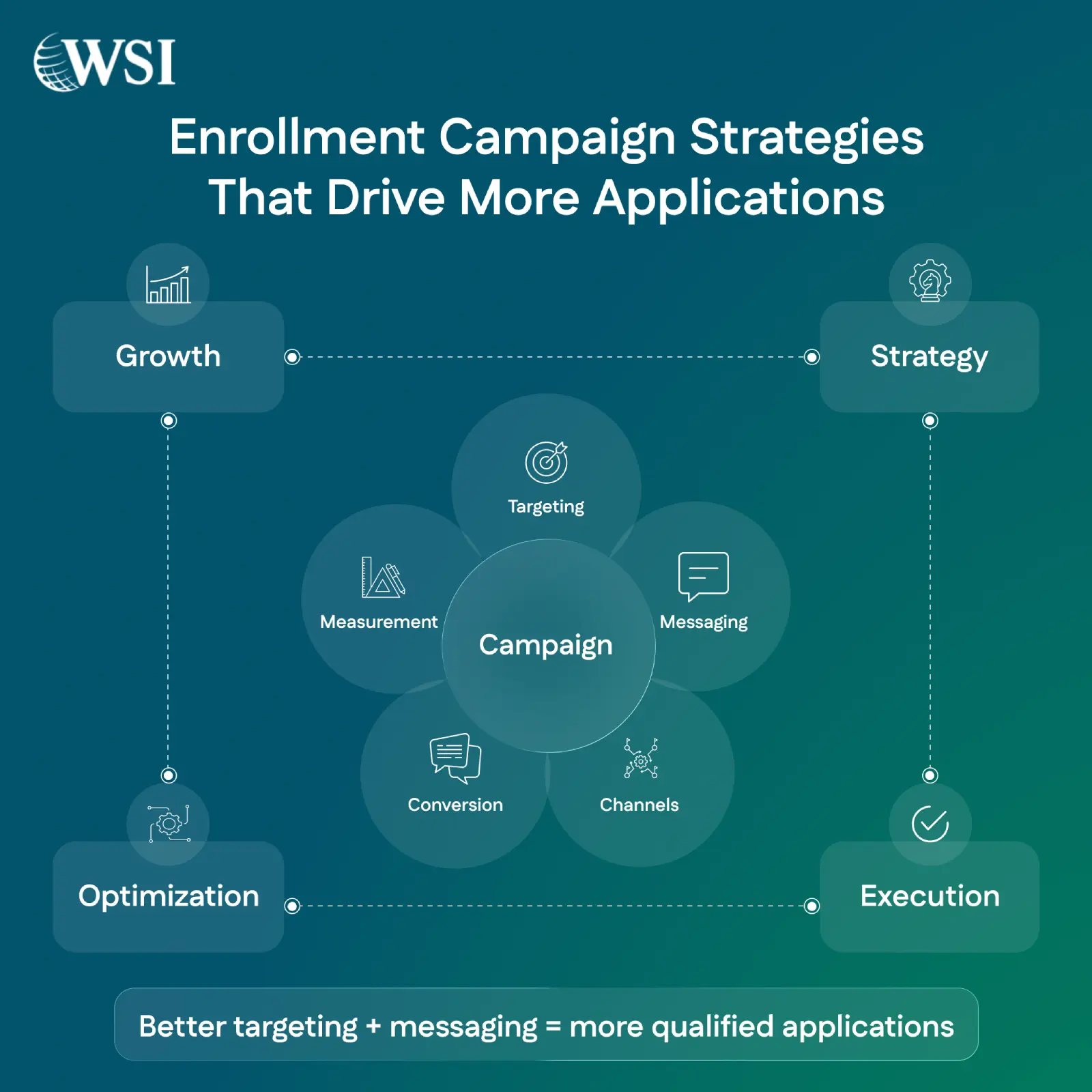
The Campaign Engine above shows how these components work together. Strategy sets the direction: which segments to target and what outcomes to prioritize. Channels determine where your campaign appears across search, social, and content platforms. Messaging converts channel exposure into interest. Conversion turns that interest into a completed application. Targeting keeps all of this focused on students most likely to enroll. Measurement tracks performance at every stage. When these six elements run as one system, the entire campaign improves continuously. This is the difference between a campaign and a campaign engine.
Phases That Drive Campaign Growth
Strategy, Execution, Optimization, and Growth form the outer ring of every enrollment campaign that works. These are not steps you complete once and move on from. They repeat, and each round improves on the last.
Strategy
Strategy decides where the budget goes before the campaign launches. It answers three questions: which programs to promote, which student segments to target, and which channels to prioritize. A campaign without clear answers here produces activity without results.
Execution
Execution puts the campaign live across the channels students actually use. Search, email, retargeting, and paid social each serve a different stage of the student recruitment funnel. Running them without a shared goal wastes time and confuses the audience.
Optimization
Optimization uses performance data to cut what is not working and scale what is. Most institutions skip this phase because they do not track conversion at each funnel stage. Those that do improve cost-per-application with every campaign cycle.
Growth
Growth is the compounding result of repeating the cycle with improvements from the previous round. It is not a separate effort. It is what happens when Strategy, Execution, and Optimization are running correctly.
Components Inside the Campaign Engine
These five components sit at the center of the cycle. Each one drives a specific outcome inside the enrollment campaign.
- Channels: Each channel should cover a specific funnel stage, not duplicate another.
- Messaging: Specific outcome-focused messaging converts more interest into applications than generic brand content.
- Conversion: Every campaign asset, ad, page, and email should pull toward one outcome: the completed application.
- Targeting: High-intent signals like specific search terms and return page visits identify the students most likely to enroll.
- Measurement: Tracking conversion at each funnel stage shows exactly where students are dropping off and what to fix next.
Targeting High-Intent Student Segments
Targeting high-intent students means reaching people already searching for what you offer. High intent is signaled by specific search terms, time spent on program pages, and return visits. An enrollment campaign built around these signals converts at higher rates for the same spend.
- Program-specific keywords: Students searching “online MBA in Ontario” are closer to applying than those searching “best universities.”
- Retargeted page visitors: Students who spent time on a program page are warm leads who left for a specific reason.
- Email list segments: Past inquiries who never applied represent a high-intent audience that did not require new acquisition spend.
- Geographic targeting: Local students searching for nearby programs convert at higher rates than broadly targeted audiences.
- Career-motivated adults: Working adults searching for programs with clear job outcomes are among the most likely to enroll quickly.
Messaging That Converts Interest into Applications
Enrollment campaign messaging converts when it answers what the student is actually asking. Students want to know if the program fits their situation, budget, and career direction. Messaging that addresses these three things directly produces more completed applications than messaging that does not.
Leading With Outcomes, Not Features
Students respond to career outcomes far more than program descriptions. “Graduate employment rate: 92% within six months” outperforms “comprehensive curriculum.” The program features belong on the course detail page. The enrollment campaign ad or email needs to answer: what happens after this program? Leading with outcomes gives prospective students a reason to click and a reason to apply.
Matching Message to Funnel Stage
A student who found you through a search ad needs different messaging than one who inquired last month. Awareness-stage messaging introduces the program and its outcomes. Consideration-stage messaging addresses cost, duration, and flexibility. Decision-stage messaging provides a clear next step and removes doubt. Sending the same message to students at different stages of the student recruitment funnel is the most common reason good leads do not convert.
Analyzing Campaign Performance and ROI
Enrollment campaign performance is analyzed at the application, not the click. Traffic and impressions tell you how visible the campaign is. Conversion data tells you how effective it actually is. These are different numbers, and only one of them predicts enrollment.
- Cost per inquiry: Track how much each new inquiry costs across paid search, organic, email, and social.
- Inquiry-to-application rate: This rate reveals if your follow-up process and program pages are doing their job.
- Application-to-enrollment rate: A low rate here signals a process problem between application submission and enrollment confirmation.
- Channel attribution: WSI’s lead generation services track which channels produce applications, not just traffic, so budget follows results.
- Time-to-decision tracking: Knowing how long students typically take to decide helps you time follow-up messages for maximum effect.

Build a Better Campaign
WSI builds enrollment campaigns that track results, not just traffic.
Frequently Asked Questions
How long does it take to see results from an enrollment campaign?
Paid campaigns can generate inquiries within days of launch. Organic content and SEO improvements typically take three to six months to produce consistent traffic growth. The fastest results come from combining both: paid for immediate coverage and organic for long-term inquiry volume that does not require ongoing ad spend.
What is the most important part of a student recruitment funnel?
The most important stage is where students are currently dropping off. For most institutions, that is somewhere between the inquiry and the application, not between search and the first click. Auditing your funnel from inquiry to enrollment, not just from ad to click, identifies the specific stage that is costing you the most applications.
Can a well-run enrollment campaign offset declining applicant numbers?
A campaign can recover significant ground from demographics or policy-driven application decline. Institutions with strong campaigns consistently outperform regional peers facing the same external pressures. Working with a team like WSI LeapDigital to audit and restructure your enrollment campaign is one of the most direct ways to recover applications that are currently being lost to competitors with stronger funnel execution.
Building Campaigns That Consistently Drive Applications
An enrollment campaign that consistently drives applications is not an accident. It is the product of aligned strategy, accurate targeting, specific messaging, and steady analysis across every stage of the student recruitment funnel. Schools that treat their enrollment campaign as a repeating cycle rather than a seasonal push are the ones that increase student enrollment year over year, regardless of what is happening in the broader market.

Fix Your Campaign Now
WSI audits and rebuilds enrollment campaigns for better results.