
Declining enrollment is no longer a future concern for most post-secondary institutions. Colleges across North America are already operating with fewer students than they had five years ago. The causes are layered, running from demographic shifts to policy changes to shifts in how students weigh the cost of a degree. Understanding what is driving the drop is the first step toward responding to it.
Key Takeaways
- The enrollment cliff is structural, not temporary: According to WICHE projections cited by the College Board, the high school graduate population peaked in 2025 and will decline by 13% through 2041. That translates to approximately 576,000 fewer students between 2025 and 2029.
- International student enrollment decline has accelerated sharply in Canada: New international student arrivals in Canada fell 61% in 2025 to just 115,470 students, per Academic Jobs’ 2025 enrollment report. Ontario institutions have been among the hardest hit, with over 600 programs suspended and thousands of jobs lost.
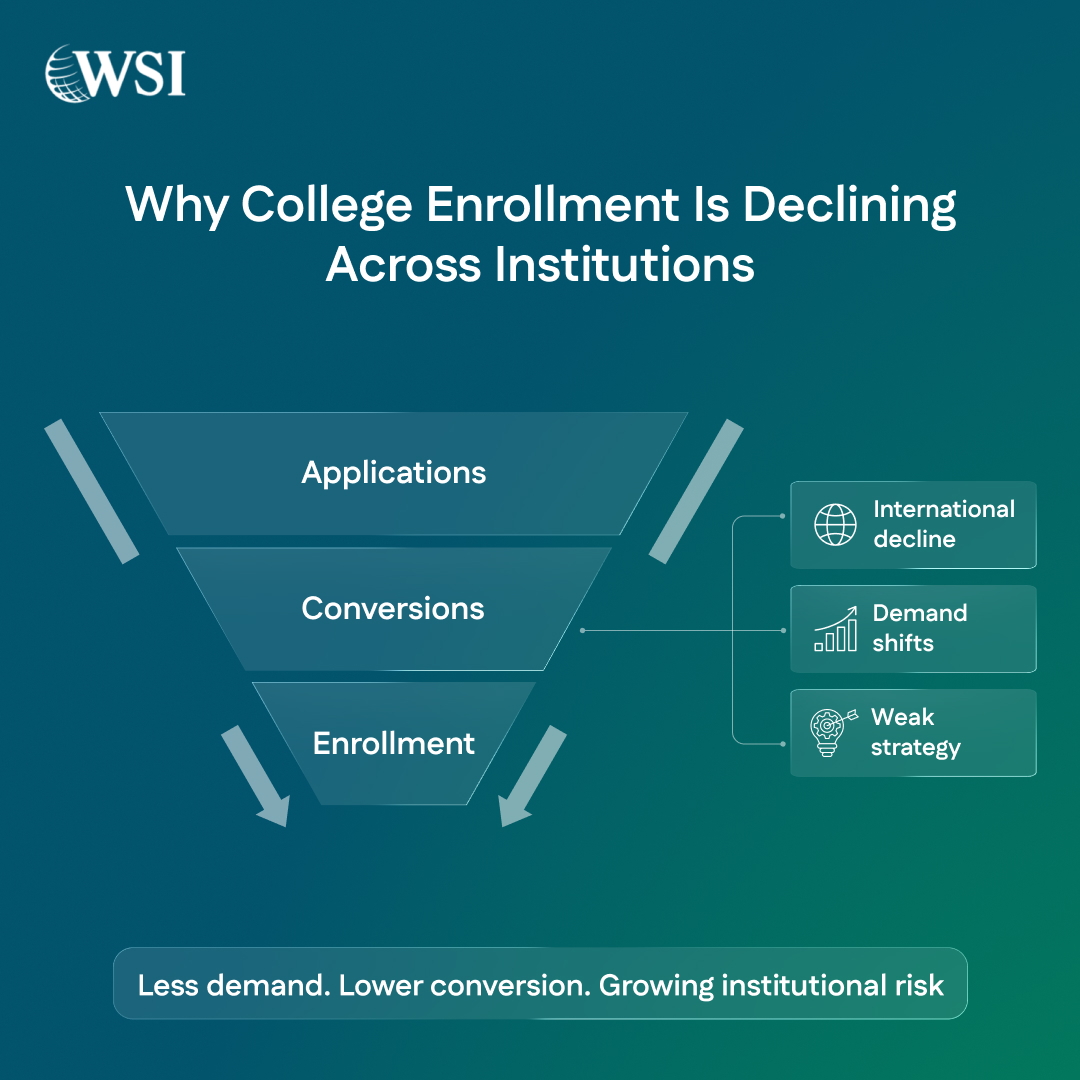
- Declining conversion is as damaging as declining applications: Many schools still receive adequate inquiry volume but lose students between the application and enrollment stages. Fixing conversion is often faster and cheaper than replacing lost demand.
Contents
- 1 What Is Driving Declining Enrollment Across Institutions
- 2 Impact of International Student Enrollment Decline
- 3 Application Drop-Off and Demand Shifts
- 4 Early Signals Colleges Often Ignore
- 5 Strategic Response to Reverse Declining Enrollment
- 6 Frequently Asked Questions
- 7 Addressing Enrollment Risk Before It Accelerates
What Is Driving Declining Enrollment Across Institutions
Declining enrollment has multiple causes that compound each other over time. No single factor explains the full picture at any institution. Demographic pressure, shifting student priorities, and policy decisions all play a role. Getting the diagnosis right is what allows schools to respond with something more than increased ad spend.
Demographic Pressure and the Enrollment Cliff
The enrollment cliff is a direct result of falling birth rates after 2007. Fewer children born during and after the Great Recession means fewer 18-year-olds today. This is not a temporary dip; it is a structural demographic change. WICHE projects the high school graduate pool will shrink through at least 2041. Schools in the Northeast and Midwest are already feeling this pressure acutely. Smaller cohorts entering the pipeline mean fewer applicants regardless of recruitment effort.
Shifting Perceptions of Degree Value
A growing number of prospective students are questioning if a degree is worth it. Tuition costs have outpaced wage growth for over two decades. Vocational training, boot camps, and certifications have become credible alternatives. When a student can enter the workforce faster and with less debt, they often do. This is not about apathy toward education; it is a cost-benefit calculation. Institutions that cannot articulate a specific career outcome are losing this argument.
Financial Aid Uncertainty and FAFSA Disruption
Financial aid delays have directly contributed to application decline in recent years. The FAFSA overhaul in 2024 created processing problems that left students without aid estimates. Students who could not confirm their cost of attendance often chose not to enroll. This added financial uncertainty on top of already rising tuition. Schools that relied on financial aid clarity as a conversion tool lost students at the final step. The problem was most severe at institutions where most students depend on aid.
Inadequate Digital Visibility
Many institutions with strong programs simply cannot be found online. Students research programs almost exclusively through search before they contact any school. A school that does not rank for relevant search terms will not receive those inquiries. This is a fixable problem, but it requires deliberate attention to content and search strategy. Declining enrollment at some institutions is partly a digital visibility problem, not a demand problem. WSI’s higher education SEO and enrollment strategy addresses this gap directly.
- Birth rate decline: Fewer children born after 2007 means fewer traditional-age students entering college from 2025 onward.
- Degree cost perception: Rising tuition without clear career outcomes is pushing students toward faster, cheaper alternatives.
- FAFSA disruption: Processing delays in 2024 left many students without aid clarity, causing some to withdraw entirely.
- Weak online presence: Institutions without strong search visibility lose prospective students before the first contact.
- Competition from alternatives: Vocational programs, bootcamps, and employer-sponsored training are absorbing students who once enrolled in college.
Impact of International Student Enrollment Decline
International student enrollment decline has become one of the sharpest financial risks. This is especially true in Canada, where policy changes took effect quickly and forcefully. Schools that built their operating budgets around international tuition revenue are now in deficit. The speed of the decline left little time for institutions to adapt.
How Canada’s Study Permit Cap Changed the Landscape
Canada introduced a study permit cap in 2024 that changed the market almost overnight. New international student arrivals dropped 48% in 2024 alone. By 2025, arrivals had fallen a further 61% to just 115,470 students. Ontario colleges, which had relied heavily on Indian and South Asian students, took the hardest hit. More than 600 programs have been suspended across Ontario’s publicly funded colleges. Between 8,000 and 10,000 positions have been cut as a direct consequence.
The Funding Gap Left Behind
International students typically pay three to four times the domestic tuition rate. When those students stop arriving, the revenue gap is immediate and significant. Domestic tuition in Ontario has been frozen since 2019 and does not offset the loss. Schools cannot simply raise domestic rates to compensate. The financial pressure forces program suspensions, staffing cuts, and in some cases, closure. This is the direct consequence of building operating models around a single volatile revenue source.
Why This Is Not Just a Canada Problem
International student enrollment decline is affecting institutions in the US, UK, and Australia. Policy changes, exchange rates, and post-study work restrictions are shifting student destinations. Students who once defaulted to Canada or the UK are now researching alternatives. Schools in every country that rely on international volume are facing the same math. Diversifying domestic recruitment and strengthening digital visibility are both part of the answer.
Application Drop-Off and Demand Shifts
Application decline signals a shift in how students weigh their options before deciding. In some cases, fewer applications reflect reduced population size in the applicant pool. In others, it reflects dissatisfaction with program clarity, value, or visibility. Both problems are addressable, but they require different solutions.
Where Applications Are Falling Most
Two-year colleges have experienced a sharper application decline than four-year institutions. Vocational programs tied to healthcare and trades have fared better than general arts. Programs that clearly connect to employment outcomes are losing fewer applicants. Programs that describe content without explaining career direction are losing more. This tells you something specific about what prospective students are looking for when they search. They want to know what the program will do for them, not just what it covers.
Search Behavior and the Discovery Gap
Most students start their search online before they ever visit a program page. If your programs are not visible for the terms they use, the application never comes. According toCarnegie Higher Ed’s 2024 SEO Benchmarks report, organic search generates 46% of total traffic across higher education websites. That share of traffic produces inquiries at a fraction of paid media cost. Schools with low organic visibility are missing a large portion of their potential applicant pool. Addressing this gap does not require more budget; it requires a focused SEO strategy.
When Applications Arrive, But Enrollment Does Not
Some schools receive inquiry volume that does not convert into applications or enrollment. This is a conversion problem, not a demand problem. Slow response times, unclear program pages, and friction in the application process all cause dropout. A student who submits an inquiry and receives no contact within 48 hours often moves on. Fixing conversion is frequently faster than building new awareness campaigns. Both WSI’s leads and sales services and content strategy address this specific dropout point.
- Program clarity gap: Applicants want to see employment outcomes before they apply, not after they graduate.
- Response time failure: Students who contact multiple schools enroll at the first one to follow up clearly.
- Mobile application friction: Application forms that do not work well on mobile devices lose submissions at the final step.
- Competitive visibility: Schools not appearing on page one for relevant searches are being filtered out before the process begins.
Early Signals Colleges Often Ignore
Declining enrollment does not arrive without warning. The signals appear in traffic data, inquiry volume, and conversion rates months before. Most institutions only act when the enrollment numbers confirm the problem. By then, an entire academic year has been lost.
1. Falling Website Traffic From Organic Search
A sustained drop in organic search traffic is one of the clearest early warnings. It means fewer prospective students are finding your programs before they consider applying. This kind of decline typically precedes inquiry and application drops by several months. Schools that monitor this data monthly can intervene before the enrollment gap opens. Those who review it annually see the problem only after it has already cost them a class.
2. Declining Inquiry-to-Application Rates
When inquiry volume holds steady but applications fall, conversion is the problem. This means interested students are starting the process and abandoning it partway through. Common causes include poor follow-up, unclear program information, and complicated application steps. Each of these can be addressed without spending more on lead generation. Tracking this metric monthly allows institutions to identify and fix the problem quickly.
3. Program Page Bounce Rates
A high bounce rate on a program page means visitors arrive and leave almost immediately. This typically signals a mismatch between what the search result promised and what the page delivers. It can also mean the page loads too slowly or does not function well on mobile. Either way, the student who bounced will not be coming back. Fixing these pages costs time but not additional ad spend. A well-structured program page directly supports both organic ranking and conversion.
4. Stagnant or Declining Social Engagement
Social media engagement is an early signal of brand relevance in the student market. When prospective students stop interacting with your content, they are losing interest. This may reflect content that no longer connects with how students research programs. WSI’s brand awareness services address this by aligning content with the platforms and formats students actually use. Monitoring engagement trends alongside traffic data gives a fuller picture of institutional visibility.
- Search ranking drops: Losing page one positions for key program terms reduces inquiry volume within weeks.
- Inquiry response lag: Teams that take more than 48 hours to follow up lose students to faster-responding competitors.
- Reduced referral traffic: Declining traffic from partner schools or education directories signals weakening pipeline relationships.
- Shorter session duration: Students who spend less time on program pages are not finding what they came for.
- Application abandonment rates: Tracking where students exit the application form identifies the exact friction point to fix.

Stop the Enrollment Drop
WSI works with institutions to fix funnel conversion and visibility.
Strategic Response to Reverse Declining Enrollment
Reversing declining enrollment requires a strategy, not just more advertising. The institutions gaining ground are those fixing their funnel alongside their visibility. Both sides of the problem need attention at the same time. The actions below address the specific stages where enrollment is most commonly lost.
Strengthening Organic Search Visibility
Search visibility is the foundation of sustainable enrollment growth. According to RNL’s enrollment marketing research, organic search converts at three times the rate of any other lead source. Schools that invest in SEO reduce their reliance on paid media while improving conversion quality. This starts with keyword research that reflects how prospective students actually search. It continues with content that answers the questions students ask before they apply. WSI’s search and enrollment strategy services build this kind of long-term visibility systematically.
Rebuilding Program Pages Around Student Outcomes
Program pages that describe curriculum instead of career outcomes do not convert. Students want to see what happens after graduation before they decide to apply. Employment rates, graduate salaries, and alumni paths are the most persuasive page elements. Placing this information near the call to action reduces doubt at the decision point. This is one of the lowest-cost, highest-impact changes an institution can make. It requires time and a content strategy, not a new budget.
Targeting Adult and Non-Traditional Learners
The traditional 18-year-old applicant pool is shrinking by demographic math. Adult learners and career-changers represent a growing and underserved enrollment source. These students search differently and need different content to convert. They want flexibility, clear time-to-completion, and specific career alignment. Programs that communicate these things clearly can access a segment largely ignored by competitors. This is not a new segment; it is simply one that many schools have not actively targeted.
Reducing Conversion Loss Between Inquiry and Application
Most declining enrollment conversations focus on attracting more applicants. Fewer focus on keeping the applicants who are already in the pipeline. Automated follow-up sequences, faster response standards, and simplified application forms all help. These improvements do not require more leads; they require better handling of existing ones. A 15% improvement in application completion rates is often worth more than a new ad campaign.
Frequently Asked Questions
Is declining enrollment happening everywhere or only at certain institutions?
Declining enrollment is widespread but not uniform across all schools. Two-year colleges and smaller, tuition-dependent institutions have felt it most severely. Schools with strong program-to-career alignment, robust SEO, and active conversion strategies have held enrollment more effectively, and some have grown while regional peers have declined.
Can a marketing strategy offset the demographic and policy factors driving the decline?
Marketing cannot replace students who were never born, but it can recover significant ground. Schools are losing students to competitors, not because demand is absent, but because those competitors are more visible and convert inquiries more effectively. A well-structured enrollment marketing strategy from a team likeWSI LeapDigital addresses both the visibility problem and the conversion problem simultaneously, which is where the recoverable enrollment actually lives.
What is the fastest way to start reversing application decline?
The fastest wins typically come from fixing existing assets rather than building new ones. Auditing program pages, improving response times to inquiries, and addressing technical SEO issues can produce measurable improvement within weeks. Longer-term recovery requires a sustained content and search visibility strategy, but starting with a funnel audit identifies the highest-impact fixes immediately.
Addressing Enrollment Risk Before It Accelerates
Declining enrollment is a structural problem that will not correct itself over time. Schools that respond early, by fixing visibility, improving program pages, and converting existing inquiries better, will hold ground while peers continue to slide. The institutions that wait for enrollment numbers to confirm the problem before acting are typically a full academic year behind the institutions that already fixed it.

Reverse Your Enrollment Trend
WSI builds enrollment strategies for colleges and universities.