


Higher education SEO is how prospective students find your programs before they find your competitors. Most students begin their research on a search engine, not on your homepage. If your programs are not appearing for the terms those students are using, the inquiry never comes. Getting this right does not require a bigger marketing budget; it requires a focused search strategy built around how students actually search.
Contents
- 1 Key Takeaways
- 2 Why Higher Education SEO Is Critical for Enrollment Growth
- 3 Search Behavior Trends Among Prospective Students
- 4 Higher Education SEO vs Traditional SEO Approaches
- 5 SEO for Universities vs Colleges: Key Differences
- 6 Building Visibility with SEO for Educational Institutions
- 7 Program-Level Strategy Using University Program Page SEO
- 8 Technical SEO Fixes for University Websites That Matter
- 9 Keyword Strategy Using College Keyword Research and Intent
- 10 When to Consider an SEO Agency for Higher Education
- 11 Measuring Impact Across Rankings, Traffic, and Applications
- 12 Frequently Asked Questions
- 13 Turning SEO into a Student Acquisition Engine
Key Takeaways
- Organic search is the top traffic source for higher education websites: According to Carnegie Higher Ed’s 2024 SEO Benchmarks report, organic search generated 46% of total traffic across higher education websites between July 2023 and June 2024. Organic sessions also had the highest engagement rate of any traffic source at 61%.
- Most higher ed institutions have no established SEO strategy: Per Sixth City Marketing’s higher ed marketing statistics, 84% of higher education marketing departments view SEO as a key enrollment strategy. Yet 51% of those same departments have no established SEO plan in place.
- Institutions with strong content see 60% more student inquiries: Research compiled by Sixth City Marketing found that institutions providing compelling content see up to a 60% increase in student inquiries. Content built around student questions consistently outperforms generic institutional publishing.
Why Higher Education SEO Is Critical for Enrollment Growth
Higher education SEO is the foundation of every enrollment strategy that does not rely entirely on paid media. Students search before they apply, and they search with specific intent. They want program details, career outcomes, costs, and timelines, not campus branding. Institutions that rank for those specific searches own the first conversation with the student.
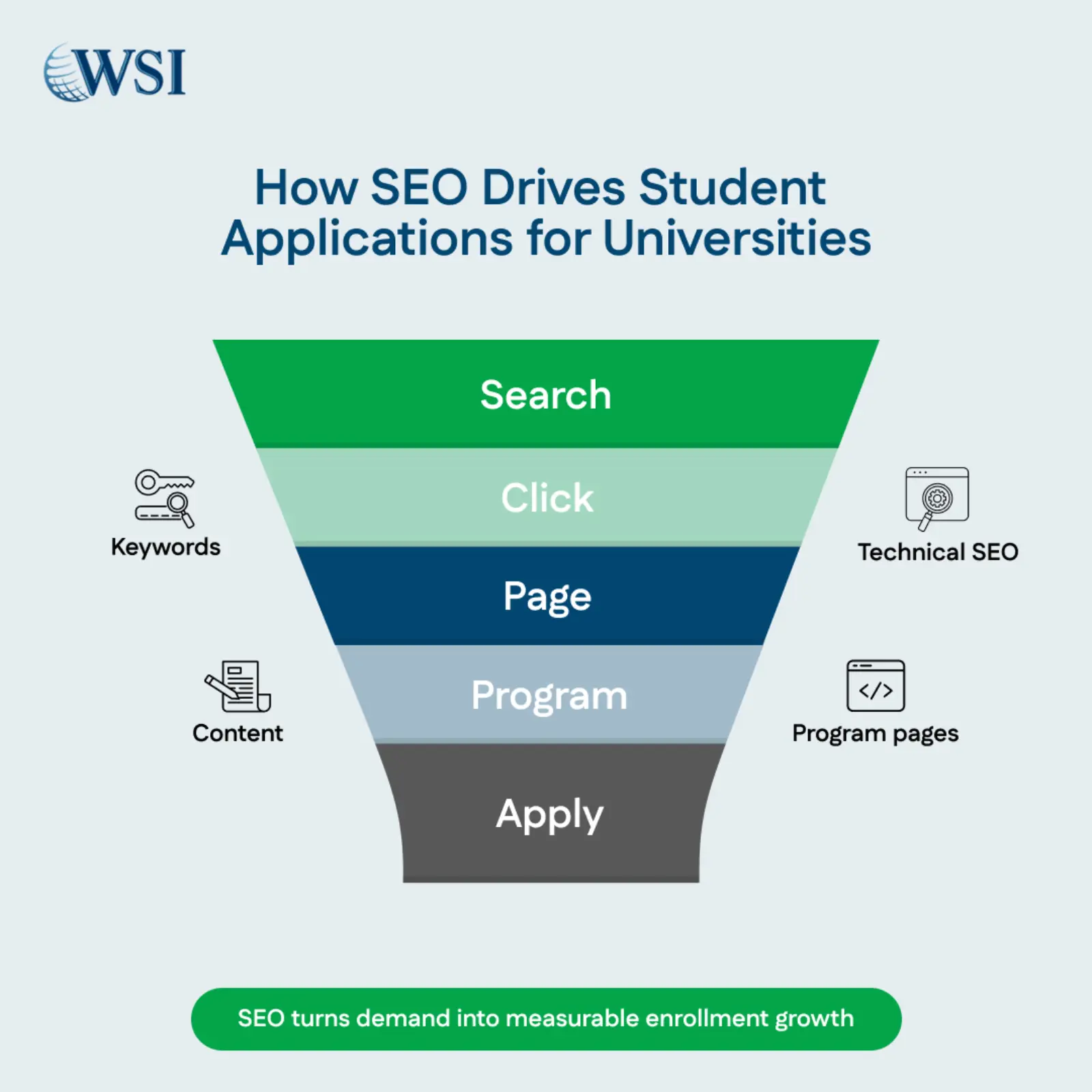
The funnel above shows how higher education SEO turns a search into a submitted application. At the top, a student types a query into a search engine. Keywords determine if your result appears; technical SEO determines if the page loads and ranks. Content is what keeps that student reading long enough to consider the program. Program pages are where the application decision forms are, so they carry the most conversion weight. The Apply stage at the bottom is the only one that matters for enrollment. Every layer of the funnel has to work for SEO to deliver applications, not just traffic.
What Students Actually Search For
Students rarely search for institution names when they start researching programs. They search for program types, locations, costs, and career paths. Terms like “online MBA Ontario” or “nursing degree Toronto” dominate non-branded searches. Non-branded keywords produce 87% of all search impressions in higher education. This means SEO for universities must target how students search, not how institutions describe themselves. Programs that rank for high-intent, non-branded terms receive inquiries from students already prepared to apply.
Why Paid Ads Alone Cannot Replace Organic Search
Paid search stops producing results the moment the budget stops. Organic rankings continue generating inquiries long after the content is published. Higher education SEO compounds over time; paid media resets with every campaign. Schools that build strong organic foundations reduce their cost-per-inquiry year over year. Those that rely entirely on paid media keep paying the same rate for the same students indefinitely. The smart approach combines both, with organic carrying the long-term load and paid filling specific gaps.
The Cost Argument for Higher Education SEO
Every organic click costs nothing beyond the investment in content and SEO infrastructure. A page that ranks for a program keyword can generate inquiries for years. A paid ad generates inquiries only while the campaign is funded. Schools that invest in higher education SEO are building an asset. Schools that invest only in paid media are renting attention they do not own.
Search Behavior Trends Among Prospective Students
Prospective students search with specific questions at every stage of their decision. Early searches are broad: they compare program types and explore career outcomes. Later searches get narrower: they compare specific schools and look for application deadlines. A higher education SEO strategy needs to show up at both stages to stay in the running.
How Search Intent Changes Across the Decision Process
A student who searches “what can I do with a business degree” is at the start. A student who searches “online MBA program fees Ontario” is close to applying. These two searches require different content to serve the student effectively. Awareness-stage content answers broad questions about programs, industries, and career paths. Decision-stage content answers specific questions about costs, timelines, and admission steps. Institutions that only publish one type miss a large share of their potential applicant pool.
Mobile Search and the Implications for SEO
Most program research now happens on a mobile device before it ever reaches a desktop. Students search on their phones during commutes, breaks, and evening hours. A program page that loads slowly or renders poorly on mobile loses that student. Mobile performance is not a technical nicety in higher education SEO; it is a direct enrollment factor. Pages that fail on mobile fail to rank as well, compounding the visibility loss.
- Long-tail queries dominate: Students searching “best online business degree Canada” are closer to applying than those searching “university programs.”
- Question-based searches grow: Searches phrased as questions signal students at the research stage who want specific answers before deciding.
- Local intent is strong: Students often add location terms to their searches, making regional SEO a separate and high-value priority.
- Career outcome searches increase: Queries like “what can I do with a healthcare management degree” are high-intent and underserved by most institutions.
- Voice search is expanding: Conversational search queries from voice assistants require content structured around natural language patterns.
Higher Education SEO vs Traditional SEO Approaches
Higher education SEO differs from standard SEO in both scope and stakes. A product page competing for a keyword has one goal: a purchase. A university program page competing for a keyword has to move a student through a months-long decision. The content depth, intent matching, and page structure all need to reflect that longer path.
Content Depth and Decision-Stage Mapping
Standard SEO content often aims for a quick answer and a fast conversion. SEO for higher education requires content that serves students at the awareness, consideration, and decision stages. A student comparing two programs needs different content than one ready to apply. Institutions that map content to these stages see higher inquiry-to-application rates. This approach requires more planning than a standard content calendar. The payoff is a consistent pipeline of students who are already informed and motivated when they make first contact.
Authority and Trust Signals in Academic SEO
University websites carry natural authority in search because of their age and backlink profiles. SEO for educational institutions builds on that foundation with content depth and internal linking. Faculty profiles, research pages, and accreditation information all support domain authority. These are signals that traditional commercial SEO rarely has available. Using them deliberately is one of the clearest advantages higher education SEO has over competing ad-based strategies. An institution with strong domain authority needs less time to rank new program pages than a newer or weaker domain.
The Long Content Advantage
Academic institutions have access to subject matter expertise that most commercial sites lack. Faculty research, student outcomes data, and program-specific knowledge are all SEO assets. Content written from genuine expertise ranks better and earns more backlinks than generic editorial. This is why higher education SEO, done well, tends to outperform pure content marketing over time. The institution already has the expertise; the SEO work is making it findable.

Rank Higher, Enroll More
WSI builds higher education SEO strategies that produce applications.
SEO for Universities vs Colleges: Key Differences
SEO for universities and SEO for colleges share the same technical foundations. Where they differ is in audience size, program volume, and search intent patterns. Understanding these differences directly affects how you structure your keyword strategy and content priorities.
Scale and Subdomain Complexity at Universities
Large universities often manage hundreds of program pages across multiple subdomains. Search engines treat subdomains as separate websites in many cases. This means SEO work on one subdomain does not automatically benefit another. A coordinated higher education SEO strategy maps the full domain structure before setting priorities. Without that map, SEO investment gets fragmented across properties that do not reinforce each other.
Local SEO Priorities for Colleges
Colleges typically draw from a regional catchment area rather than a national pool. Local SEO tactics carry more weight here than they do for national university campaigns. Ranking for “college near me” or “business program in [city name]” drives direct enrollment. Google Business Profile optimization, local citations, and location-specific landing pages all contribute. These are low-cost, high-return activities that many colleges underuse significantly.
- Program volume: Universities manage far more program pages, requiring a more systematic approach to page audits and content.
- Search intent differences: College searchers often want faster pathways; university searchers research longer-term career and academic outcomes.
- Subdomain complexity: Larger institutions need coordinated SEO across multiple subdomains that search engines treat independently.
- Local vs national reach: Colleges prioritize regional search visibility while universities balance local and national program terms.
- Backlink profiles: Universities benefit from decades of academic backlinks; colleges often need to build link authority more deliberately.
Building Visibility with SEO for Educational Institutions
SEO for educational institutions starts with identifying which pages drive the most application decisions. Program pages, admission pages, and career outcome pages carry the most conversion weight. These are the pages where higher education SEO investment produces the clearest and fastest return.
Mapping Your Site to the Student Decision Journey
Not every page on a university website plays the same role in recruitment. Homepage content should rank for branded and broad institutional terms. Program pages should rank for program-specific and outcome-specific searches. Blog and resource content should rank for the comparison and research questions students ask early on. Each page type serves a different student at a different stage. Treating all pages as equally important is one of the most common higher education SEO mistakes.
Building Topical Authority Across a Program Area
Topical authority means your site is recognized as a reliable source on a specific subject. For a business school, this means covering business careers, MBA comparisons, and admission guidance in depth. For a nursing program, it means answering questions about licensing, career paths, and program types. Search engines reward sites that cover a topic comprehensively and consistently. This is not about publishing more content; it is about publishing content that answers the full range of student questions in one place.
- Homepage visibility: The homepage should rank for your institution name and key branded terms, not program-level queries.
- Program page depth: Each program page should answer outcomes, costs, duration, and admission requirements without requiring a separate search.
- Blog and resource content: Content answering career and program comparison questions attracts students at the research stage.
- Faculty and research pages: These pages build domain authority and attract links from academic and industry sources naturally.
- Location and campus pages: For institutions with multiple campuses, location-specific pages improve local search performance significantly.
Program-Level Strategy Using University Program Page SEO
University program page SEO is where higher education SEO produces the most direct enrollment impact. These pages sit at the bottom of the search funnel. Students arriving from program-specific searches are closer to applying than any other organic audience. Getting these pages right converts organic traffic into completed applications.
What a High-Converting Program Page Includes
A program page that converts starts with graduate employment data, not course descriptions. Students want to know what happens after graduation before they decide to apply. Career paths, salary ranges, and employer partnerships are the most persuasive page elements. Application steps, deadlines, and next-action buttons reduce friction at the decision point. Pages that bury this information below long curriculum descriptions lose students at the scroll. Short, scannable sections with clear headers also support SEO by matching how search engines read structured content.
Internal Linking Between Program and Supporting Content
Program pages rank better when supported by content that answers related student questions. A blog post comparing two degree paths can link directly to both program pages. A career guide for healthcare graduates can link to the healthcare management program page. This builds topical authority and keeps students in the funnel while they are still deciding. WSI’s higher education SEO services include program page audits and internal link structure as part of every engagement.
Keeping Program Pages Fresh
Search engines favor pages that are regularly updated with accurate, current information. Program pages that show outdated statistics or old admission details lose both rankings and student trust. Updating salary data, employment rates, and program changes on a regular schedule protects rankings. A simple quarterly review process prevents pages from going stale without requiring major rewrites. Freshness signals from updated content contribute to how search engines assess page quality and relevance.
Technical SEO Fixes for University Websites That Matter
Technical SEO for university websites addresses the issues that suppress organic rankings. These problems are invisible to students but are read by search engines on every crawl. Fixing them produces ranking improvements faster than any new content will.
Page Speed and Core Web Vitals
Google uses Core Web Vitals as a ranking factor for all pages. These measure how fast a page loads, how stable the layout is, and how quickly it responds to interaction. University websites often carry years of accumulated code, large image files, and outdated plugins. Each of these slows load times and reduces both rankings and student patience. A technical audit identifies which pages fail Core Web Vitals thresholds and in what order to fix them.
Duplicate Content Across Program Pages
Large university websites frequently have near-identical pages for related programs. Two program pages with the same content compete against each other in search results. Neither page ranks as well as a single, authoritative page would. Canonical tags and content differentiation resolve this without deleting useful information. Identifying and fixing duplicate content is one of the highest-return technical SEO activities available to any higher education institution.
- Missing meta descriptions: Program pages without meta descriptions get auto-generated snippets that rarely match what students search for.
- Broken internal links: Orphaned pages and broken links reduce crawl efficiency and hide content from search indexing.
- Mobile performance: Program pages that render poorly on mobile lose a significant share of prospective student traffic before any content is seen.
- Sitemap accuracy: An outdated XML sitemap causes search engines to crawl old or deleted pages while missing new and updated ones.
- HTTPS and security: Pages flagged as insecure by browsers are penalized in rankings and lose student trust at first glance.
Keyword Strategy Using College Keyword Research and Intent
College keyword research starts with how students describe programs, not how institutions name them. Students search for outcomes and formats, not academic department names. A keyword strategy built around student language outperforms one built around institutional language every time.
Mapping Keywords to Funnel Stages
Awareness keywords attract students who are still exploring their options. These are broad terms like “best healthcare programs in Canada.” Consideration keywords draw students to compare specific program types or institutions. Decision keywords signal students who are ready to apply and are looking for final details. Content built around all three stages supports students at every point in the process. An institution that only targets decision-stage keywords wins at the end but loses students to competitors earlier in the research phase.
Non-Branded vs Branded Keyword Balance
Branded terms are important, but they only reach students who already know your institution. Non-branded terms introduce your programs to students who have never heard of you. Carnegie’s data shows non-branded keywords generate 87% of all higher education search impressions. This means most of your potential applicant pool will find you through program and outcome terms, not your name. A higher education SEO strategy that focuses only on branded terms captures only a small fraction of available demand.
Using Competitor Keyword Gaps
Competitor keyword analysis identifies which searches your rivals rank for that you do not. These gaps represent students actively researching programs you offer but cannot currently find you. Building content that targets those terms directly is one of the fastest ways to capture new inquiry volume. SEO tools like Semrush and Ahrefs map these gaps at the program and category level. This type of analysis removes guesswork from content planning and directs effort toward terms with proven demand.
When to Consider an SEO Agency for Higher Education
An SEO agency for higher education makes sense when internal capacity cannot keep pace with the work. Higher education SEO involves technical audits, content strategy, program page optimization, and ongoing monitoring. Most institutions do not have the staff to execute all of these consistently alongside other marketing priorities.
Signs Your Current SEO Approach Is Not Working
Organic traffic that has been flat or declining for more than three months is a clear signal. A high bounce rate on program pages means students are arriving and leaving without engaging. Competitor institutions consistently outranking you for program-level terms is a direct enrollment risk. Running paid campaigns to compensate for poor organic performance is expensive and unsustainable. Any of these patterns indicates the current strategy needs an external audit and a fresh approach.
What a Good Higher Education SEO Partner Delivers
A strong SEO partner for higher education starts with data, not assumptions. They audit your existing technical setup, content quality, and keyword coverage before recommending anything. They connect SEO activity to enrollment metrics, not just traffic numbers. They track which organic sessions result in inquiries and which inquiries convert to applications. WSI’s enrollment-focused SEO approach is built specifically for higher education institutions managing these exact challenges.
- Enrollment is declining: WSI’s enrollment strategy services audit the full funnel to find if visibility, conversion, or both are contributing to the drop.
- Organic traffic is falling: A sustained drop in organic search traffic typically precedes inquiry and application declines by several months.
- Paid media is primary: If paid media is generating most inquiries, the organic channel is underperforming and needs a structural fix.
- No keyword tracking exists: Without keyword rank monitoring, it is impossible to tell if the SEO is improving or sliding between campaigns.
- Content is not converting: High traffic with low inquiry volume means the content is attracting visits but not qualifying students to act.
Measuring Impact Across Rankings, Traffic, and Applications
Measuring higher education SEO requires tracking more than keyword positions. Rankings tell you where you appear; traffic tells you who is clicking. Applications tell you which of those clicks were actually worth having. All three metrics together give a complete picture of SEO performance for any institution.
Setting Up Meaningful SEO Reporting
Most higher education SEO reports show total organic traffic and top keywords. These numbers are useful, but they do not connect SEO directly to enrollment outcomes. Reporting at the program page level shows which specific pages are generating inquiries. Tagging organic traffic in your CRM allows direct attribution between SEO and applications. This level of reporting takes more setup, but it is the only way to demonstrate real SEO value to institutional leadership.
How Often to Review and Adjust
Technical SEO issues should be reviewed quarterly at a minimum. Keyword rankings for key program terms should be monitored monthly. Content performance should be assessed every six months against inquiry and engagement benchmarks. Annual full audits allow institutions to reset priorities based on what changed in the prior year. The schools that improve their higher education SEO fastest are those that review performance on a schedule, not only when something visibly breaks.
- Organic traffic by program: Track monthly organic sessions to each program page separately, not just site-wide totals.
- Keyword rank movement: Monitor the specific terms each program page is ranking for and how positions shift month over month.
- Engagement rate by page: Pages with high traffic but low engagement signal a mismatch between search intent and page content.
- Inquiry attribution: Tag organic traffic specifically in your CRM to trace how many inquiries came directly from search.
- Application conversion rate: Measuring organic visitors who submit applications is the clearest indicator of SEO content quality.
Frequently Asked Questions
How long does higher education SEO take to produce results?
Technical fixes and content improvements can produce ranking changes within four to eight weeks. Sustained organic traffic growth typically develops over three to six months. Unlike paid campaigns, the results from SEO for higher education compound over time, meaning the inquiry volume generated in month six is usually significantly larger than in month one without any additional budget required.
What is the difference between SEO for universities and SEO for colleges?
The technical foundations are the same for both. The differences lie in program volume, audience geography, and search intent patterns. Colleges often benefit more from local SEO investment and regional keyword targeting, while universities need a broader strategy that covers national and international program-level searches across a much larger and more complex content portfolio.
Where should a university start with SEO if nothing has been done before?
Start with a technical audit to identify the most urgent ranking suppressors on key program pages. Then, audit those program pages to assess if the content matches how students actually search. These two steps alone typically surface enough high-impact fixes to produce ranking improvements within the first two months, before any new content is written or any additional budget is spent.
Turning SEO into a Student Acquisition Engine
Higher education SEO works when it runs as a system, not a one-off project. Technical health, program page quality, keyword alignment, and content depth each support the others, and weakness in any one area reduces the impact of the rest. Institutions that treat SEO for higher education as an ongoing discipline rather than a seasonal task consistently outperform peers in organic visibility, inquiry volume, and cost-per-application.

Build Your SEO Strategy
WSI turns higher education SEO into consistent student applications.