


Search traffic is dropping, and leaders across industries are feeling the impact. A 25% decline sounds like a demand problem, yet the reality is more complex. AI-driven results and zero-click searches are changing how users interact with Google, compressing traffic while concentrating intent. Fewer sessions do not mean fewer prospects. They mean a smaller, more serious group of visitors who arrive ready to act. This article breaks down what the drop really represents, how it affects your pipeline, and the steps businesses are using to protect and grow leads in an AI-shaped search environment.
Key Takeaways
- A 25% drop in search traffic does not equal a 25% drop in demand; AI-driven zero-click results are filtering out low-intent visitors while concentrating high-intent users.
- Businesses protecting their pipeline focus on conversion uplift, compressed funnel pages, and AI-supported experiences to get more value from fewer visits.
- Leaders who track intent signals in GA/GSC and diversify channels while adapting content for AI summaries are outperforming those who chase raw volume.
Contents
- 1 The Stat in Plain English (Why “Volume” ≠ “Demand”)
- 2 Owner Math: 3 Scenarios with Conversion Uplift
- 3 Where You’ll See It in GA and GSC
- 4 Compressed Funnel Pages; A Quick Checklist
- 5 30-Day Triage Plan for Business Owners and CMOs
- 6 How Search Traffic Decline Affects Lead Generation
- 7 The Role of AI and Zero-Click Searches in Traffic Drops
- 8 Strategies Businesses Are Using to Adapt
- 9 FAQ
- 10 Optimizing Your Path Through AI-Driven Disruption
The Stat in Plain English (Why “Volume” ≠ “Demand”)
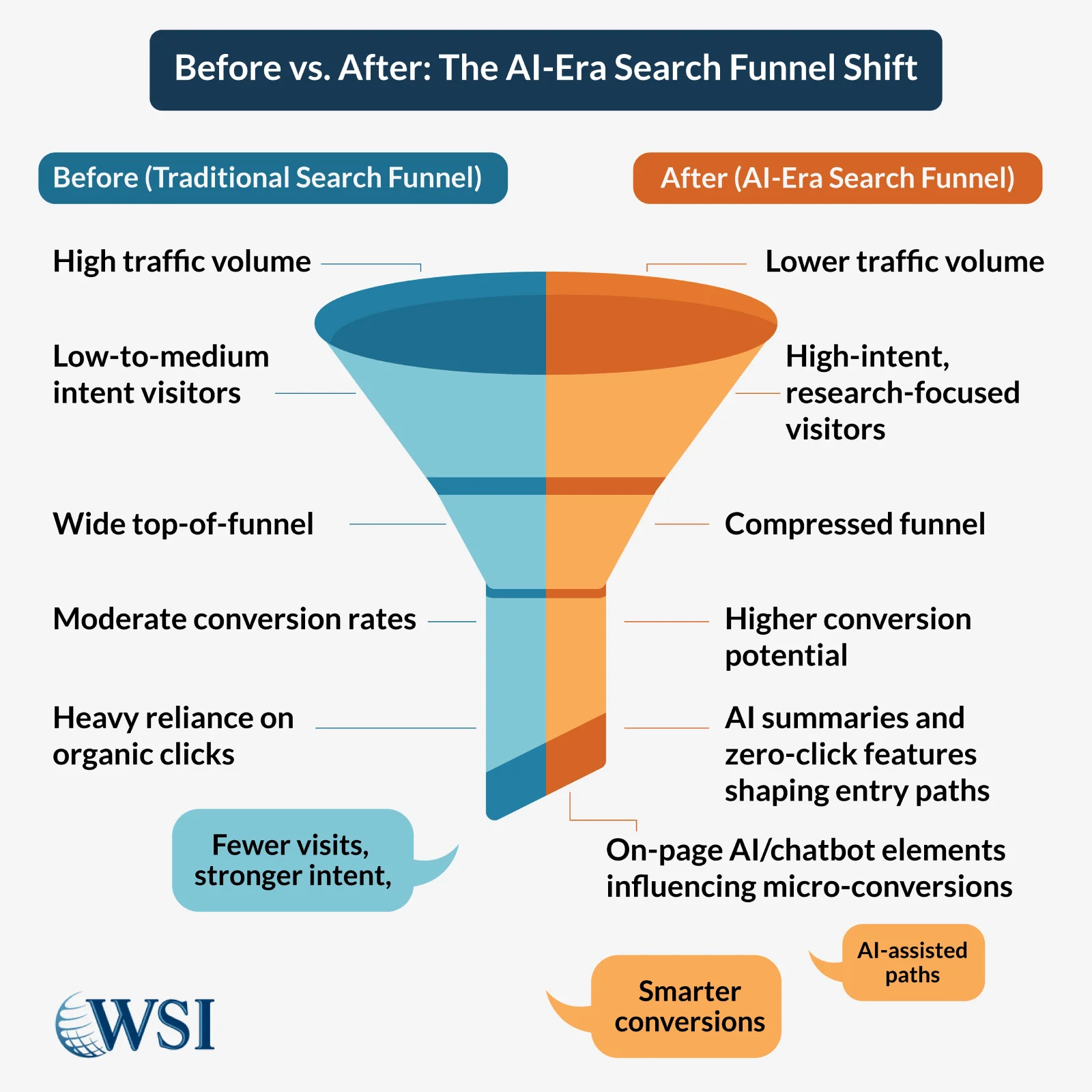
In 2025, a 25% drop in search sessions often alarms business owners and CMOs alike. However, this drop in volume is not a straightforward signal of diminished market demand. Instead, it reflects a changing search landscape heavily shaped by AI-driven responses embedded directly in search engine results pages (SERPs). With approximately 60% of all search queries now resulting in zero clicks, this means users get answers without visiting websites, traffic volume no longer directly correlates to consumer interest or demand.
For businesses, this means fewer site visits but not necessarily fewer purchase-ready or research-intense prospects. The intent behind search queries is concentrating, creating a smaller but hotter pool of visitors who are further down the funnel and more likely to convert. Recognizing that “volume” has decoupled from “demand” is the foundational mindset for adapting effectively to the 25% search drop.
Owner Math: 3 Scenarios with Conversion Uplift
Business leaders must translate session data into meaningful pipeline metrics. Owner math connects sessions to potential leads, emphasizing the importance of conversion rate uplift in offsetting traffic declines:
- No Conversion Change: A pure 25% session loss results in a 25% lead loss; a clear pipeline threat.
- Incremental Conversion Gains (~33% uplift): This stabilizes leads despite fewer visitors, highlighting that working smarter on existing traffic prevents pipeline erosion.
- Significant Conversion Increases (~50% uplift or more): Combined with AI-powered personalized content and compressed funnel designs, this boosts pipeline volume even as visitor numbers fall, capitalizing on higher intent visitors.
The math confirms that companies winning post-drop optimize conversion aggressively, converting a reduced but warmer traffic segment into leads effectively. This shifts focus from chasing raw volume to maximizing value per visitor through refined pages and AI integration.
Where You’ll See It in GA and GSC
Analytics platforms illustrate these trends in clear ways. Google Analytics (GA) and Google Search Console (GSC) reveal:
- Changing Traffic Mix: Organic non-branded sessions decline, while branded search share grows as the audience narrows to intent-driven users familiar with your brand.
- CTR Fluctuations: Overall organic CTR may drop because of AI-powered zero-click answers, though CTR on transactional or branded queries tends to rise.
- Branded Lift: As generic informational queries lose prominence, brand-focused searches reflect stronger user familiarity and purchase intent.
Business owners should analyze these metrics together to untangle session drops from demand signals and recalibrate marketing and budget strategies accordingly.
Compressed Funnel Pages; A Quick Checklist
With session volume down, each visitor’s experience must count more. Compressed funnel pages are optimized to convert intent-rich but fewer visitors:
- Include clear, high-impact calls-to-action (CTAs) removing decision friction.
- Deploy AI-powered personalized content and chatbot support that matches visitor intent in real time.
- Design pages with minimal distractions; fewer navigation choices and fast loading speeds.
- Add social proof elements like testimonials or client logos for immediate trust.
- Keep content concise yet comprehensive, precisely addressing the visitor’s question or challenge.
- Ensure mobile responsiveness and easy access to key conversion paths.
- Continuously test and iterate based on behavior analytics and conversion feedback.
This checklist helps maximize the pipeline from shrinking but more purchase-focused traffic, turning volume loss into a lead generation opportunity.
30-Day Triage Plan for Business Owners and CMOs
A focused adaptation plan is critical to navigate shrinking search traffic without sacrificing leads:
- Audit Key Metrics: Deep dive into GA and GSC data to quantify session declines, CTR shifts, and branded share increases.
- Prioritize Conversion Focus: Identify and optimize top funnel and critical buyer journey pages using the compressed funnel checklist.
- Implement Quick Wins: Enhance page speed, strengthen CTAs, introduce AI chatbots, and revise content for focused intent matching.
- Leverage AI for Content Visibility: Develop content that works for AI summary snippets and virtual assistant integrations.
- Rebalance Marketing Mix: Shift spend toward paid social, video, and niche marketplaces to diversify lead sources.
- Rapid Testing and Iteration: Measure improvements in conversion and lead metrics weekly; experiment with messaging, CTAs, and page layouts.
- Stakeholder Alignment: Keep leadership informed to support investments in new tools and tactics that reflect the AI-driven search reality.
By following this triage guide, businesses can stabilize and grow lead pipelines despite a 25% drop in search-driven sessions and maintain a competitive advantage in a fundamentally altered search ecosystem.

Recover lost traffic and protect your pipeline with a tailored roadmap built for the AI-era search landscape.
This plan gives you clear priorities, channel diversification strategies, and conversion upgrades designed for business owners and CMOs.
How Search Traffic Decline Affects Lead Generation
A decline in search traffic primarily affects lead generation in two dimensions: quantity and quality. Fewer organic sessions mean fewer raw leads entering the funnel, impacting overall lead volume. However, as AI-driven search results filter out less-relevant traffic, the remaining visitors often display higher purchase intent, which can improve lead quality.
Businesses that fail to optimize for this intent shift risk losing pipeline volume and may face declining revenue forecasts. Conversely, businesses that embrace intent-oriented strategies and AI integration can extract more value per visitor, creating a leaner but more effective lead funnel.
The Role of AI and Zero-Click Searches in Traffic Drops
AI-powered search features and zero-click results are major drivers behind the session decline. Instead of linking users to third-party websites, search engines now provide comprehensive answers directly on the SERP with AI summaries, knowledge panels, and chatbot-like features. This reduces organic click-throughs drastically for informational queries and shifts user behavior toward immediate answers. Although this enhances user experience, it challenges traditional SEO and inbound marketing strategies. Businesses must evolve content strategies to gain AI endorsement within SERPs and implement conversational AI on their own sites to capture intent proactively.
Strategies Businesses Are Using to Adapt
Leading businesses are adopting multi-faceted strategies to survive and thrive amid search volume contraction:
- Diversifying Channels: Expanding investment in paid social, video marketing, and e-commerce SEO to complement shrinking organic search leads.
- Optimizing Conversion Paths: Reengineering landing pages for conversion efficiency with compressed funnels guided by AI insights.
- Embracing AI Tools: Using AI-generated insights for content creation, personalization, and real-time visitor engagement.
- Focusing on Brand Strength: Boosting efforts to increase branded search share through PR, retargeting, and impactful customer experiences.
- Data-Driven Decisions: Leveraging deep analytics to track intent signals, attribute lead sources accurately, and optimize spend dynamically.
These adaptations form a coherent response to the new “less is more” lead generation landscape shaped by AI-driven search and zero-click trends.
FAQ
Does a 25% drop in sessions mean my leads will fall by 25%?
No. A traffic drop reflects how AI and zero-click features change user behaviour, not demand. If you improve conversion rates and focus on intent-rich visitors, you can maintain or even grow leads despite fewer sessions.
What should I look for in GA and GSC to understand the real impact?
Watch branded search share, CTR shifts on transactional queries, and changes in traffic mix. These metrics reveal intent trends and help separate volume decline from demand decline.
How can businesses adapt quickly to lower organic traffic?
Simplify funnel paths, strengthen CTAs, optimize for AI summaries, introduce conversational AI on key pages, and diversify channels through paid social and video. These steps help stabilize pipeline performance even as search volume contracts.
Optimizing Your Path Through AI-Driven Disruption
This comprehensive article addresses why a 25% drop in search sessions does not equate to an equivalent drop in demand, explains owner math scenarios that highlight the crucial role of conversion uplift, and deep dives into analytics signals business leaders should watch. It elaborates on the critical influence of AI and zero-click searches in reshaping website traffic and lead strategies, and it outlines actionable optimization checklists and a 30-day triage plan customized for business owners and CMOs. The article concludes with how businesses are strategically adapting through channel diversification, AI integration, and conversion focus to maintain pipeline growth despite volume declines. This reflects the realities and opportunities of the AI-era search landscape.
Strengthen your lead pipeline with a fast, targeted review of how AI and zero-click search are shaping your traffic.
Get a practical 10-day action plan that identifies missed conversion opportunities, fixes funnel gaps, and aligns your site with the new AI-driven search environment.