
Many businesses fall into a dangerous pattern, putting all of their marketing efforts into one channel. It feels efficient at first: familiar tools, measurable results, and less complexity to manage. Yet over time, this narrow focus becomes a liability. When the platform you depend on changes the rules or stops performing, your growth slows to a crawl.
Think of it this way: relying on a single tactic is like trying to run a company with only one type of customer. It may work for a short period, but it will never sustain growth in today’s competitive environment.
Key Takeaways:
- Customers interact with brands across multiple touchpoints, limiting your strategy to one channel makes you invisible elsewhere.
- Overdependence on a single platform leaves your business vulnerable to sudden algorithm or policy changes.
- Integrated marketing spreads risk, lowers acquisition costs, and builds long-term brand trust.
Contents
Why Businesses Stick to One Channel
For many organizations, especially in education, B2B services, and private healthcare, the issue isn’t strategy, it’s simplicity. One channel feels manageable. It shows clear metrics. It requires less learning and fewer resources.
The problem is that customers don’t act in single-channel patterns anymore:
- 95% of consumers use more than one channel before making a purchase decision.
- 89% of B2B buyers expect brands to appear across multiple touchpoints before they feel confident enough to act.
If you’re only present in one place, you’re absent everywhere else.

Is your marketing strategy leaving gaps?
Learn how single-channel reliance hurts long-term growth and what to do about it.
The Real Risks of a Single-Channel Strategy
At first glance, relying on a single marketing channel feels efficient. It’s easier to track, requires fewer resources, and creates the illusion of stability. Yet beneath that simplicity lies fragility. When all of your lead generation depends on one platform or tactic, your business is exposed to risks you can’t control.
Customer behaviour has changed; buyers interact with multiple touchpoints before making a decision, and algorithms shift faster than most companies can adapt. What looks like a reliable channel today can turn into a bottleneck tomorrow. Without diversification, you’re not just limiting growth, you’re leaving your business vulnerable to disruption, higher costs, and weaker brand trust.
Vulnerability to Platform Changes
When your pipeline relies on one channel, you’re at the mercy of external forces. A Facebook Ads policy change or account suspension can instantly dry up leads. Google algorithm updates can erase months of SEO progress in a single night. With no backup channel, recovery becomes costly and slow.
Limited Audience Reach
Your ideal customers are spread out. Some research extensively on Google. Others look to LinkedIn for professional validation. Some rely heavily on peer reviews or niche forums. Focusing on only one channel ignores entire groups of prospects who may be searching for you elsewhere.
Higher Customer Acquisition Costs (CAC)
Paid ads without supporting organic content mean you’re paying every time someone notices you. Without SEO, blogs, or reviews feeding brand recognition, your cost-per-lead climbs steadily, making growth harder to sustain.
Weaker Trust and Brand Presence
Trust is built over repeated interactions. Prospects want to see your company on search engines, in social feeds, on review platforms, and across industry resources. A single-channel presence makes your business appear less established, limiting conversions.

Want to reduce customer acquisition costs?
Discover how blending SEO, content, and paid ads strengthens performance and lowers spend.
Real-World Examples
The risks of single-channel marketing are easier to grasp when you see how they play out in practice. On paper, relying on one tactic might look efficient, less to manage, fewer moving parts, and clear results to track. In reality, it creates blind spots that only become obvious when growth stalls or customer trust fails to build.
Across industries, businesses that depend too heavily on a single channel often run into the same issues: clicks without conversions, visibility without trust, and traffic without long-term pipeline growth. The following examples show how different organizations, despite strong intentions and initial success, found themselves stuck because their strategies weren’t integrated.
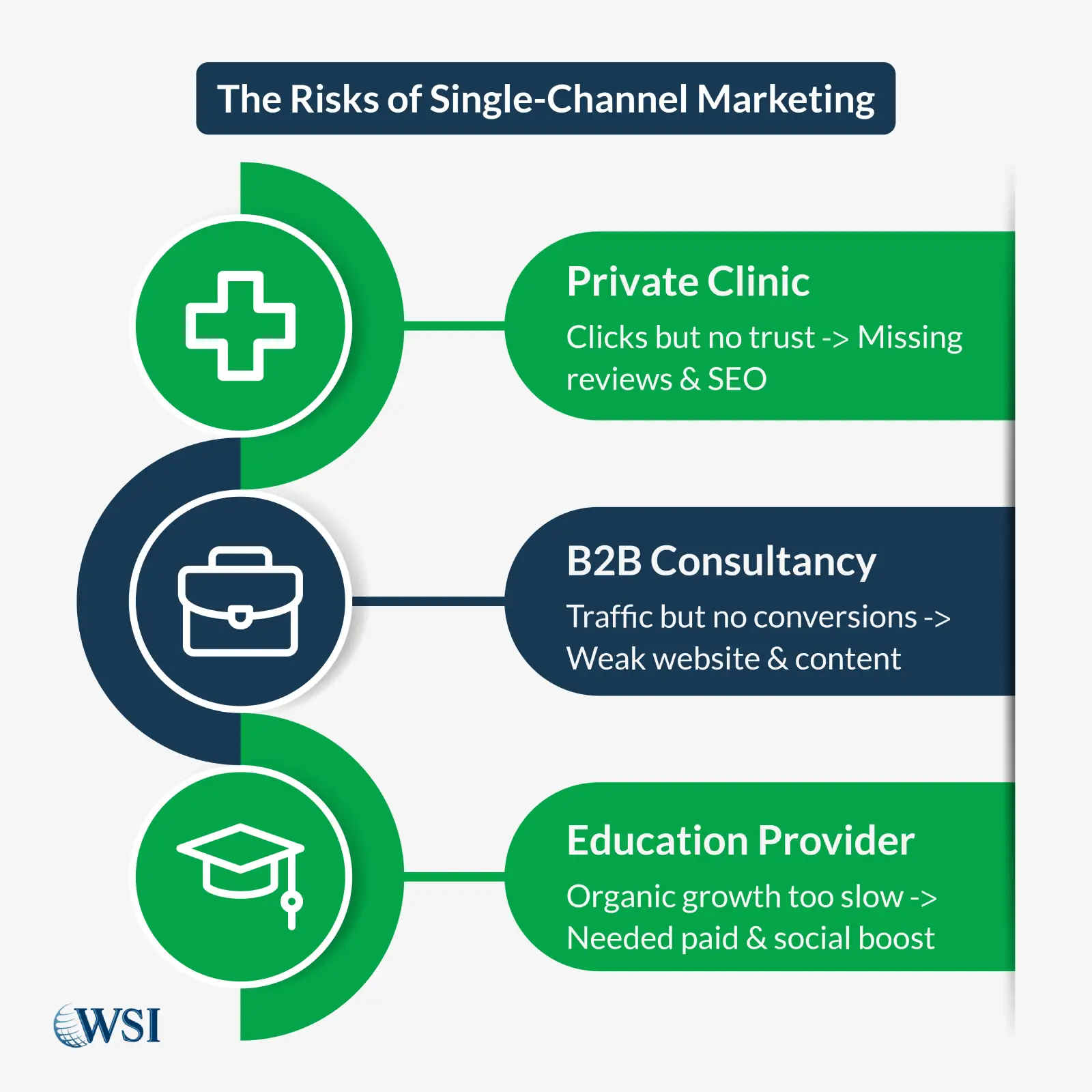
- Private clinic: Relied solely on Google Ads. Ads produced clicks, but bookings stayed low because the clinic lacked local SEO, patient reviews, and educational content that builds trust.
- B2B consultancy: Invested heavily in LinkedIn ads. The campaigns generated traffic, but their website wasn’t designed for conversion, and no content existed to nurture leads.
- Education provider: Strong in organic SEO, yet growth stalled. They needed paid ads and social campaigns to balance slow-moving organic traffic with immediate lead flow.
These examples highlight how single-channel reliance creates bottlenecks instead of sustainable pipelines.
A Better Way: Integrated Marketing
Integrated marketing doesn’t mean doing everything at once. It means building a connected system where each channel supports the others.
- Use SEO to improve PPC Quality Scores and reduce ad spend.
- Let content marketing fuel both organic traffic and social campaigns.
- Track analytics across touchpoints (SEO → Blog → Retargeting Ad → Form Fill) to see the full customer path.
The strength comes from synergy. One channel generates awareness, another builds trust, and another captures the conversion. This approach spreads risk, improves efficiency, and scales more reliably than any single tactic on its own.

Ready to future-proof your marketing?
Build a system where every channel strengthens the next.
Auditing Your Marketing Mix Today to Improve Results
Auditing your marketing mix today can set the foundation for stronger results. If you’re leaning too heavily on one channel, take action by reviewing your pipeline and pinpointing where you might be over-reliant. Identify the gaps in your digital presence and explore how your existing strengths can extend into new channels. By diversifying, you reduce risk, strengthen trust with your audience, and create more consistent outcomes. The businesses winning right now aren’t relying on a single tactic, they’re building integrated systems that stay flexible as the market shifts.