

AI-powered platforms are reshaping how audiences find and interact with content. Unlike traditional search or social channels, AI-driven surfaces prioritize relevance, context, and verifiability over simple popularity metrics. For channel strategists, success is not just about producing high-quality content, it’s about understanding where that content will perform best first. Each platform has its own behavior patterns: some favor concise, citation-backed answers, while others reward creative or multimodal responses combining text, visuals, or video.
Audiences also vary in intent, some are seeking quick solutions, others want step-by-step guidance, and some explore concepts conversationally. Recognizing these nuances allows strategists to place content strategically, ensuring it reaches the right users at the right moment. Doing so prevents wasted effort, maximizes engagement, and provides a foundation for repurposing content across multiple AI-driven surfaces efficiently.
Key takeaways:
- Audience behavior and content type should determine your platform priority.
- Reuse and repackage content smartly across AI surfaces for broader visibility.
- Structured approaches like collections, transcripts, and citations improve discovery.
Contents
Content Types That Perform
Different content formats resonate differently depending on the platform and audience intent. Understanding these patterns helps strategists prioritize effort, create content that gains traction, and simplify repurposing across multiple surfaces.
- Short answers: Platforms like Perplexity and ChatGPT prioritize concise, direct responses with supporting citations. Users often seek immediate, actionable insights, so answers that are clear, well-structured, and include references to credible sources tend to perform best. Numbered lists, bullet points, or brief stepwise responses improve scanability and increase the likelihood of AI surfacing your content.
- How-tos: Step-by-step instructions work well on Copilot and ChatGPT, especially when paired with annotated screenshots, example workflows, or mini-tutorials. Content that anticipates user questions, provides troubleshooting tips, or demonstrates alternatives adds additional value. These guides not only satisfy user intent but also increase engagement and repeat interactions.
- Statistics and reports: Gemini and Perplexity favor data-driven content presented in structured formats. Tables, charts, graphs, and visual diagrams improve comprehension and AI discoverability. Explicitly citing studies, reports, or internal metrics strengthens authority, while contextual analysis, such as comparing trends over time or across segments, enhances relevance for both human readers and AI systems.
- Strategic alignment: Matching content type to platform ensures higher engagement and faster discoverability. For instance, a long-form tutorial can be converted into short-answer snippets for Perplexity, workflow examples for Copilot, and charts or visual summaries for Gemini. This approach preserves content consistency, maximizes reach, and reduces friction when repurposing across multiple AI surfaces.
Platform Landscape & Strengths
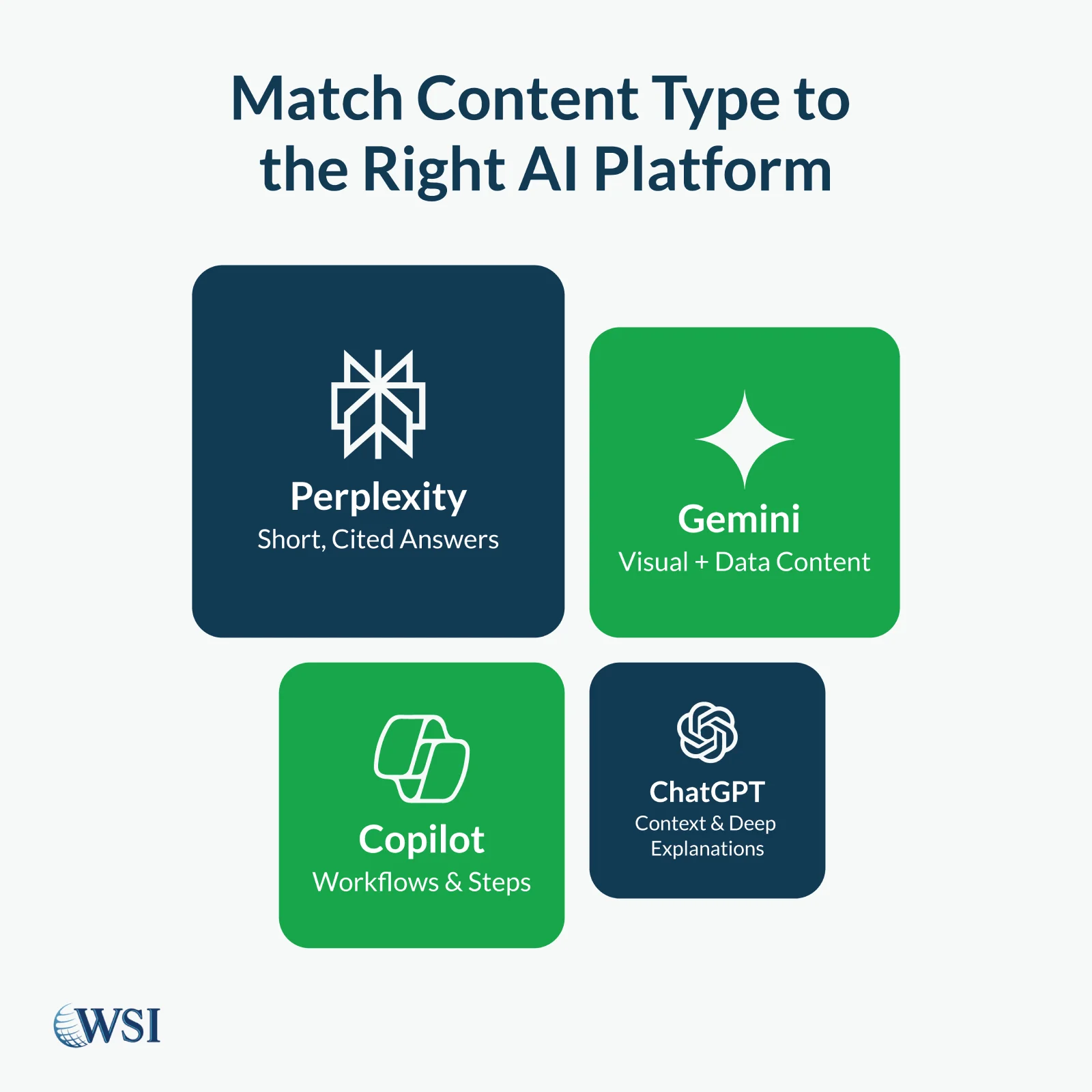
Each AI platform has its own set of signals and behaviors that determine how content is surfaced and engaged with. Perplexity prioritizes accuracy and verifiability, so content that includes credible citations, references to authoritative sources, and clear summaries tends to rank higher. Users here are often looking for precise answers quickly, which means content must be structured and easy to scan.
ChatGPT, by contrast, favors context-rich, well-framed prompts. The platform thrives on conversational queries, so content that anticipates user intent, provides nuanced explanations, or presents multiple perspectives tends to perform well. Long-form content, scenario-based examples, and stepwise instructions are highly effective when paired with clear context.
Gemini excels with multimodal content, blending text, images, and even data visualizations. Strategists can leverage this by combining written explanations with visuals, diagrams, or annotated screenshots, making content more digestible and memorable for users. This platform is especially useful for educational content, tutorials, or any material that benefits from a visual component.
Copilot focuses on task execution and technical problem-solving. Content that is structured around workflows, code examples, or step-by-step instructions performs best here. Users expect actionable, reliable guidance, so content clarity and practical applicability are critical.
Understanding these nuances allows strategists to tailor content for each platform’s strengths. By matching content type with platform behavior, teams can improve discoverability, engagement, and the efficiency of repurposing content across multiple surfaces.
| Platform | Primary Strength | Audience Behavior | Quick Win |
| Perplexity | Answer aggregation with citations | Users seek concise, verifiable info | Build structured collections with topic clustering |
| Gemini | Multimodal reasoning | Visual + text queries | Combine text explanations with relevant visuals |
| Copilot | Code and task assistance | Professional and technical queries | Include clear examples and stepwise instructions |
| ChatGPT | General Q&A and creative content | Exploratory, conversational queries | Optimize for prompts with clear intent and supporting context |

Take control of your content placement strategy before publishing.
Discover which platforms your audience prefers and create a step-by-step approach to maximize reach.
Building Perplexity Collections & Profiles
Perplexity enables users to organize content into topic-focused collections, which surface high-value information quickly and improve discoverability. For channel strategists, these collections are not just organizational tools, they become strategic assets for content amplification and AI visibility.
- Identify core themes: Start by clustering content around audience questions, pain points, or trending topics. Collections should reflect the way users search and interact with information. By grouping related content, AI can better understand context, making it easier to surface your material in response to relevant queries. Strategically defined themes also allow teams to scale content production without losing focus.
- Use structured citations: Linking authoritative sources within collections signals credibility to both users and AI systems. Citations can include studies, industry reports, or internal data that reinforce the content’s accuracy. Structured references make it easier for AI platforms like Perplexity to verify and rank content, which improves visibility and trustworthiness.
- Maintain profiles: Consistent activity through well-maintained profiles establishes your content as coming from a reliable contributor. Profiles serve as a signal to the algorithm that your content is authoritative, current, and relevant. Regular updates, engagement with other collections, and consistent content curation reinforce this effect.
Organizing content into collections and maintaining profiles creates a reusable library of assets that can be repurposed across multiple AI platforms. Collections function as both a reference hub and a mechanism to increase broader AI discovery, enabling teams to efficiently distribute content while maintaining authority and context.

Get your AI profiles working harder for your brand.
Collections and structured citations improve discoverability, trust, and engagement on key platforms.
YouTube Chapters/Transcripts for AI Discovery
YouTube content has the potential to reach far beyond traditional viewers when it is structured with AI discovery in mind. By leveraging chapters, transcripts, and precise metadata, content becomes machine-readable, allowing platforms like Gemini, ChatGPT, and Perplexity to parse and surface it in relevant queries. This increases the likelihood that content appears in AI-generated answers, search snippets, or recommendation systems.
- Chapters: Dividing videos into clearly labeled segments allows AI systems to identify distinct topics or subtopics within a single video. This segmentation makes it easier for algorithms to extract and surface specific answers to user queries. Chapters also improve user experience, letting viewers navigate directly to the sections most relevant to their interests, which can increase engagement metrics that further boost AI visibility.
- Transcripts: Providing full, accurate transcripts transforms spoken content into structured text that can be indexed and analyzed by AI. Platforms can extract key points, highlight Q&A-style content, or pull snippets to answer queries directly. Transcripts also create opportunities for text-based repurposing, such as blog posts, social snippets, or AI Q&A cards, which further amplify content reach.
- Metadata: Well-crafted metadata, including titles, descriptions, and timestamps, helps AI platforms contextualize content. Descriptive, keyword-rich titles paired with detailed descriptions provide signals about content relevance, while accurate timestamps allow AI to pinpoint answers within specific sections of a video. Proper metadata ensures that content is discoverable both on YouTube itself and when surfaced by AI across other platforms.
Structuring YouTube content in this way not only improves discoverability but also creates a foundation for repurposing. Long-form videos can be broken into micro-content for AI-friendly formats, such as short snippets for Gemini or Q&A-ready text for ChatGPT and Perplexity. This approach maximizes the utility of each asset, making content work harder across multiple AI surfaces.
Repurpose Engine (long → shorts → Q&A)
A well-designed repurposing engine ensures that every piece of content reaches the right audience in the format they are most likely to engage with. This approach maximizes visibility, extends the lifespan of assets, and allows teams to create more touchpoints without producing entirely new content.
- Long-form content: Full articles, webinars, or video tutorials serve as the foundation of your content ecosystem. These assets typically contain rich context, detailed explanations, and multiple insights, making them ideal for extracting smaller pieces of value. Long-form content is also critical for establishing authority and providing referenceable material that can be cited or linked across platforms.
- Shorts and micro-content: Condensing long-form content into bite-sized snippets allows it to perform effectively on platforms like Gemini and ChatGPT, where users often seek quick, digestible answers. Micro-content can include key takeaways, step-by-step instructions, or visually summarized points. Properly crafted micro-content maintains context while increasing discoverability and engagement, particularly on AI-driven recommendation engines or feeds optimized for skimmable content.
- Q&A extraction: Converting insights from long-form content into question-and-answer pairs enables AI platforms like Perplexity and ChatGPT to surface content directly in response to user queries. This involves identifying the most relevant questions your audience might ask, aligning answers with verified sources, and structuring responses for clarity. Q&A formats are especially effective for building collections, enhancing profile authority, and driving searchability across multiple AI surfaces.
Repurposing effectively requires an understanding of audience consumption habits on each platform. For instance, a 10-minute tutorial can generate multiple short clips, text-based highlights, infographics, and a set of FAQs that correspond to user intent. Each microformat should retain the original content’s authority and context to prevent fragmentation and preserve trust.
Data cues for repurposing are essential. Tracking collections, citations, transcript highlights, and metadata ensures each derivative piece remains connected to the original asset. Structured repurposing also allows teams to identify which content segments perform best on which platform, creating a feedback loop that informs future content creation and distribution strategies. By implementing a systematic repurpose engine, content can achieve broader reach, higher engagement, and improved discoverability across Perplexity, Gemini, Copilot, ChatGPT, and other AI surfaces.
FAQs
How do I decide which AI platform to publish on first?
Choosing the right platform starts with understanding the intent behind how your audience searches. Perplexity users often want fast, authoritative, citation-backed explanations, while ChatGPT users prefer context-rich, conversational answers they can explore further. Gemini attracts people who learn visually and want explanations supported by diagrams, screenshots, or layered media. Copilot, on the other hand, is ideal for those seeking precise, task-driven workflows. When you map your content format to these intent patterns, you can prioritize where each asset will have the most immediate impact.
How can one content asset be repurposed effectively across Perplexity, Gemini, Copilot, and ChatGPT?
The key is extracting multiple “entry points” from one long-form source so each platform receives the version it handles best. A single article or video can be broken into short answers for Perplexity, workflow snippets for Copilot, visual summaries for Gemini, and scenario-based explanations for ChatGPT. Each derivative piece should retain enough context so the core message stays intact, even as the format shifts. By treating long-form content as your foundation and creating structured micro-content outputs, you can scale visibility without recreating assets from scratch.
Why do collections, transcripts, and citations matter so much for AI discovery?
AI systems rely on structure to understand what your content is about and when to surface it. Collections give context and clustering signals, helping platforms recognize relationships between your ideas. Transcripts turn audio and video into machine-readable text, dramatically increasing how many snippets AI can extract and reuse. Citations provide verifiability, which platforms like Perplexity heavily reward. Together, these elements form a connective layer that makes your content easier for AI to validate, reference, and distribute across multiple surfaces.
Structuring Content for AI-Driven Discovery
Optimizing how and where content appears across AI platforms is now a core part of modern channel strategy. These platforms act as primary discovery points for audiences in nearly every niche, and the order in which your content is deployed directly affects reach, visibility, and long-term traction. Prioritizing placement based on audience intent and content format prevents wasted effort and keeps your team focused on high-impact surfaces.
Collections, transcripts, and citations create continuity across platforms, giving AI systems the structure they need to understand, reference, and resurface your content accurately. When these elements are built into your workflow, they act as a distribution layer, helping your material travel from long-form assets to microformats without losing clarity or authority.
Strategic repurposing turns one asset into a full set of discovery-ready formats, creating multiple entry points for users across Perplexity, Gemini, Copilot, and ChatGPT. When teams build with this in mind, they ensure their work appears early, appears often, and appears in the exact format each platform prefers. This approach sharpens distribution, reduces production pressure, and positions your content to show up first where attention is closest.

Ready to map out the best channels for your content?
Get a detailed plan showing where to focus efforts for maximum reach and efficiency across AI surfaces.