


AI is reshaping how people search. Instead of short, broad phrases, users now type full questions, explain their situation, and expect tailored answers. If you want to get in front of them, your SEO strategy has to evolve. Long-tail SEO isn’t just useful anymore, it’s the core of how you reach high-intent traffic in an AI-powered search landscape.
This guide shows you how to turn long-tail queries into a steady stream of qualified B2B leads. You’ll learn why these searches matter, how to find them, and how to build content that ranks, even if you’re not on page one.
Key Takeaways:
- Long-tail queries fuel AI Overviews and attract ready-to-convert traffic
- You don’t need top rankings, just clear, structured answers
- Specificity beats volume in today’s AI-first SEO landscape
Contents
- 1 Why Long-Tail Queries Matter More in the AI Era
- 2 What Is a Long-Tail Keyword?
- 3 Benefits of Long-Tail SEO for B2B
- 4 How to Find High-Intent Long-Tail Queries
- 5 Creating Content for Long-Tail SEO
- 6 Ideal Formats for Long-Tail Content
- 7 How AI Search Handles Long-Tail Queries
- 8 Winning Long-Tail SEO in the AI Era
- 9 5 Step Action Plan for Long Tail SEO Implementation
- 9.1 1. Audit Top Content for Unanswered Long-Tail Variations
- 9.2 2. Interview Sales and Support to Extract Real Questions
- 9.3 3. Build a 10-Topic Content Cluster Around One High-Intent Theme
- 9.4 4. Write Using Question-Based H2s and Direct-Answer Openings
- 9.5 5. Monitor Google Search Console Weekly for New Query Matches
- 10 Showing Up Where AI Sends Traffic
Why Long-Tail Queries Matter More in the AI Era
AI is trained to understand context, not just keywords. That means content that answers specific questions gets rewarded, even if it’s buried deep in search results.
Short keywords like “CRM software” are too vague for AI to serve the right answer. On the other hand, something like “best CRM for Canadian SaaS startups” signals clear intent, audience, and purpose. It’s these long-tail queries that feed Google’s AI Overviews and drive higher engagement.
Instead of chasing top-volume head terms, smart marketers are now targeting detailed questions. Not only are they easier to rank for, they also connect you with users who are ready to act.
- AI prioritizes answers, not pages, long-tail questions perform better
- Long-tail keywords are less competitive and more aligned with buyer intent
- AI Overviews often source content from highly specific, helpful responses
What Is a Long-Tail Keyword?
Most long-tail keywords are 4 words or more, and they usually show up in natural-sounding questions. Each one may only get a handful of searches per month, but they add up, especially if you publish regularly.
They also reveal a deeper level of intent. Someone searching “cybersecurity” is just browsing. Someone searching “cybersecurity audit checklist for SMBs” probably needs help right now.
Think of long-tail SEO as conversation-based SEO. Your goal is to mirror the way people actually ask questions in real life.
Examples of high-intent long-tail keywords:
- “Best CRM for Canadian SaaS startups”
- “How to create a stakeholder map for nonprofit grant writing”
- “Lead scoring models for financial services firms”
- “Cloud hosting vs on-premise for legal tech companies”
Benefits of Long-Tail SEO for B2B
Long-tail content works especially well for B2B, where buyer journeys are longer and more research-heavy. You’re not chasing viral traffic. You’re meeting buyers at the point of real need.
By focusing on specifics, you attract the right prospects and push them further down the funnel.
More Conversions, Less Friction
People searching specific terms already know what they want. All they need is confirmation, and your solution.
Faster Rankings with Lower Competition
Long-tail queries aren’t saturated. You don’t need thousands of backlinks or a 90+ domain authority to show up.
Better Fit for Voice and AI-Powered Search
Voice assistants and AI features favour full sentences and specific questions. That’s exactly what long-tail SEO targets.
Natural Match with Funnel-Based Content Marketing
Long-tail queries align with awareness, consideration, and decision content. You can meet buyers at every stage without guessing.

Struggling to Rank? Let Strategy Do the Heavy Lifting.
Leap Digital helps B2B brands attract high-intent traffic through long-tail SEO, smart content clusters, and AI-ready page structures.
How to Find High-Intent Long-Tail Queries
You don’t need a massive keyword research budget to uncover winning long-tail opportunities. You just need to listen more closely, to your users, your data, and the search engines themselves.
Start with these four methods and look for patterns that repeat across your audience journey.
Use SERP Features
Start by using Google itself. The search engine reveals what users are actively looking for through features built right into the results page. These clues can point you toward untapped long-tail content ideas.
- People Also Ask questions are goldmines for blog titles
- Google Autocomplete reveals how users naturally finish their search
- Related Searches show semantically linked long-tails you can target
Use Keyword Tools
Once you’ve explored what Google suggests, expand your list with dedicated tools. These platforms help uncover related variations, intent markers, and phrasing patterns that align with your buyers’ search behaviour.
- Use SEMrush, Ahrefs, or Ubersuggest to filter by question-based terms
- Look for modifiers like “for,” “with,” “vs,” “near me,” and “best”
- Explore question formats (“how to,” “why does,” “what is”)
Analyze Search Console
Google Search Console is packed with hidden long-tail opportunities. You just need to look at the right signals. Focus on terms that have traction but haven’t yet broken through, that’s where your next content win lives.
- Flag low-impression queries with high CTR, these signal long-tail wins
- Review pages ranking on page 2 or 3 for niche terms and refine them
- Check clicks from unusual or “unexpected” search terms
Use Customer Data
Your best long-tail keywords may not come from a tool, they come from your customers. Every interaction is a source of organic phrasing and insight into the problems they’re trying to solve.
- Talk to sales, what do prospects always ask first?
- Mine support tickets for recurring “how do I…” phrases
- Review chat logs or call transcripts for exact wording
Creating Content for Long-Tail SEO
Once you’ve found the right query, the job isn’t to write about the keyword, it’s to answer it. Quickly, clearly, and in the same way a human would.
You want to make Google’s AI say, “This is the answer the user wants.” That means structure, clarity, and plain language.
Use the Question as the Title or H2
To get long-tail content to rank, start with the question itself. Using it directly as your H2 or title not only reinforces relevance for search engines but also matches the natural structure AI looks for when generating overviews.
- “How do managed IT services help mid-sized law firms?”
- “What is the best CRM for B2B manufacturing companies?”
Answer the Question Immediately
Once the question is presented, your next move is to answer it directly. AI and users both want the takeaway upfront, no need to warm up.
- Open with 1–2 sentences that give a direct, confident answer
- Avoid long intros, definitions, or background fluff
Build Context Around It
After the initial answer, offer the reasoning. Explain the logic, give supporting examples, and frame the nuance so readers understand the bigger picture.
- Break down the reasoning: Why does it matter? What’s the nuance?
- Include secondary insights that support your answer
- Link to related tools, resources, or guides
Use Natural Language
AI doesn’t respond well to robotic phrasing. Neither do people. Match your audience’s tone and pace to improve clarity and engagement.
- Write how your customers talk, not how SEO tools sound
- Think of each article like a helpful LinkedIn post with more depth
Use Internal Linking
Your long-tail strategy works best when connected. Guide users deeper through related content and solutions that match their next question.
- Connect related queries into clusters or content hubs
- Guide users to service pages, calculators, or case studies
Ideal Formats for Long-Tail Content
Not every page needs to rank for 10,000 monthly searches. What matters is matching intent. The right format helps surface your answer, even for rare queries.
These formats help your long-tail strategy stick, and stay evergreen.
Blog Posts and Knowledge Base Articles
These formats are great for targeting informational and awareness-stage long-tail queries. Blog posts offer flexibility to address very specific pain points, while knowledge base articles provide structured help content that often aligns with support-related searches.
- Handle individual questions in a clear, SEO-friendly layout
- Support bottom-of-funnel and post-sale needs through evergreen help content
- Enable easy AI scanning with structured answers, headers, and internal links
Comparison Pages (“X vs Y”)
Comparison pages speak directly to buyers in the decision stage of the funnel. These are high-converting because they validate purchase decisions and often get featured in AI Overviews due to their structured, side-by-side analysis.
- Ideal for buyers weighing two similar tools or approaches
- Target long-tail terms like “HubSpot vs Salesforce for financial advisors”
- Provide summary boxes, checklists, or tables that AI can pull directly
Use Case Pages (“CRM for franchise businesses”)
Use case pages showcase how your solution fits a very specific need or business model. These are long-tail gold, especially when you highlight industry language and job-specific pain points.
- Show real-world applications that match niche industries or segments
- Include testimonials, mini case studies, and ROI language
- Optimize for queries like “CRM for multi-location retail businesses”
Solution Pages with Tailored Benefits
These pages blend product messaging with keyword-targeted SEO. They’re essential for ranking in AI-informed searches where users are looking for tailored functionality within a broad category.
- Position your product with vertical-specific messaging and examples
- Structure pages with FAQs, benefits sections, and scenario-based subheadings
- Use schema markup to improve eligibility for AI result inclusion

Leap Ahead with Long-Tail SEO That Converts
We don’t just get you rankings; we get you revenue. Leap Digital creates SEO campaigns that answer exactly what your customers are searching for.
How AI Search Handles Long-Tail Queries
Google’s AI Overviews don’t just summarize top-ranking pages. They source from any site that answers a question clearly and with depth, even if you’re not on page one.
That’s your opportunity. Structured, helpful content has a real shot at showing up in AI summaries, side panels, or even voice results.
To get selected, your content needs to help the AI “think.” Break up your insights, use short summaries, and structure your content for fast parsing.
Structured Content Performs Better
The way you format content plays a big role in how AI and users consume it. AI models prioritize readability, structure, and clarity. That means bullet points, subheadings, and logical formatting all increase your chances of showing up in AI Overviews.
- Use bullets, H3s, and lists to make it scannable
- Start with direct answers and follow with details
AI Picks Answers, Not Pages
AI-powered search doesn’t care if your site ranks #1, it cares if your content solves the question well. This is your chance to win featured spots based on usefulness, not authority.
- Even obscure queries can trigger your content if it fits perfectly
- You don’t need top DA or 500 backlinks, you need clarity
Obscure Queries = High Conversion
The most specific questions often come from buyers who are deep in the funnel. That’s why targeting long-tail, low-volume queries can bring in better-fit traffic that converts at higher rates.
- Niche pages that match ultra-specific needs often convert 2–3x better
- These queries may never reach AI Overviews, but they dominate long-tail SERPs
Winning Long-Tail SEO in the AI Era
Google’s shift toward AI-powered search is actually good news for B2B brands. You don’t need to be the biggest. You just need to be the most helpful, and the most specific. When your content speaks to clear, niche problems, it stands a real chance of surfacing in AI-powered features even without top-tier domain authority or backlinks.
Long-tail SEO gives you that advantage. It helps you get found by buyers with urgent needs, builds trust through practical and solution-driven content, and lets you outrank bigger players by answering overlooked questions. It’s not just theory, this is the real direction of modern SEO.
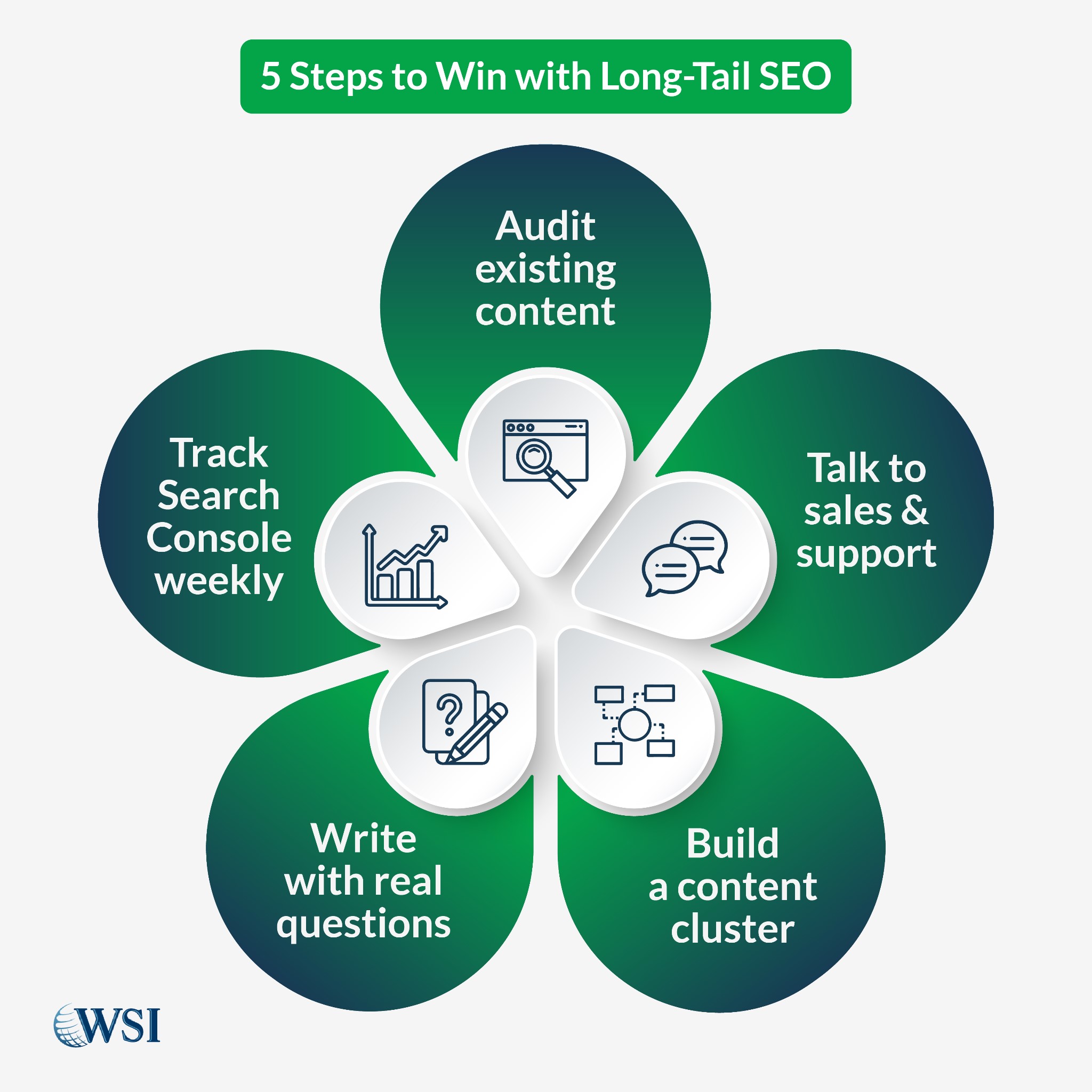
5 Step Action Plan for Long Tail SEO Implementation
Most B2B marketers churn out blog posts that check boxes but don’t get clicked. Why? Because the content isn’t anchored in real buyer questions. It skims the surface, ignores intent, and fails to match how search engines, and users, actually behave in 2025.
Today, AI search systems prioritize specificity, context, and direct value. If your content doesn’t reflect the way people speak, search, or solve problems, you’ll keep losing visibility to more strategic competitors.
You want more than impressions. You want leads, links, and lasting authority. That means shifting from volume-driven blogging to a structured, long-tail content engine. Before you write another post, run this playbook:
1. Audit Top Content for Unanswered Long-Tail Variations
Start with what’s already working. Use Google Search Console, Ahrefs, or Semrush to pull your top 10 traffic pages. Look under the hood for long-tail queries that triggered impressions but not clicks, these are your missed opportunities.
Then check:
- Are those queries answered in your post?
- Are they buried in a paragraph instead of an H2?
- Do they deserve a dedicated section or even a new page?
Flag every pattern where users want more detail than you’re giving. That’s your signal to expand or cluster.
2. Interview Sales and Support to Extract Real Questions
AI-generated prompts won’t cut it. If you want the kinds of questions buyers actually ask, talk to your frontline team.
Sales hears the objections.
Support hears the confusion.
Prospects voice problems in messy, imperfect language, that’s gold.
Ask them:
- What are the top 10 questions people ask before buying?
- What issues slow down onboarding?
- What answers close deals faster?
Record these word-for-word. Don’t sanitize them. The more natural the phrasing, the more likely your content aligns with voice search and AI results.
3. Build a 10-Topic Content Cluster Around One High-Intent Theme
Instead of chasing random blog ideas, map your next quarter of content around one business-critical theme.
Pick a high-intent topic that signals readiness to act, like “cost of [solution],” “best tools for [pain point],” or “how to switch from [competitor].”
Then outline:
- 1 pillar (2,000+ words)
- 9 supporting posts (600–1,200 words)
Each supporting post should link to the pillar and vice versa.
Use internal linking deliberately to funnel authority, improve dwell time, and signal topical relevance.
Clusters outperform standalone posts every time, especially when AI models look for context-rich domains.
4. Write Using Question-Based H2s and Direct-Answer Openings
Long-tail SEO is a game of clarity. Structure your content so Google knows exactly what you’re answering.
- Turn each H2 into a full question: What are the benefits of long-tail SEO for B2B companies?
- Answer immediately in the next 1–2 sentences.
- Expand after that with examples, comparisons, or quotes.
Use formatting that encourages skimming: bolded phrases, numbered steps, scannable bullets. Google favours pages that help users find answers fast, and so do real humans.
5. Monitor Google Search Console Weekly for New Query Matches
Once the content’s live, the real work begins. Long-tail queries often show up after publishing as Google experiments with how to rank your page.
In GSC:
- Set up filters by page
- Sort by queries with the most impressions and lowest CTR
- Look for emerging patterns or exact-match phrases you’re missing
Then either revise your post to include those terms or spin off a new piece of content targeting them directly. Over time, this turns a single post into a lead magnet powered by real-time query data.
Showing Up Where AI Sends Traffic
Dominating AI search doesn’t require a massive budget or a household name. It starts with showing up in the right place, at the right time, with the right answer. Long-tail SEO is your ticket to visibility, not through brute force, but through clarity, structure, and strategic specificity.
If your content doesn’t answer the question, AI won’t surface it, plain and simple. You don’t need to win the whole internet. You just need to solve the right problem for the right person.
Start small. Pick one clear question your audience is asking. Write a straight answer. Add context. Link it. Then repeat.
That’s long-tail SEO in the AI era. And it’s how smart B2B marketers win.

Your Next Lead Starts with a Better Answer
Let’s create search-driven content that actually speaks to your customer, and shows up where AI delivers answers.