

Artificial Intelligence (AI) is everywhere in the conversation right now, often framed as world-changing, job-destroying, human-like, or even dangerous. That constant noise can make AI feel confusing, technical, and distant, especially for people who did not grow up surrounded by digital technology. The reality is far simpler. AI is not magic, not alive, and not capable of thinking, feeling, judging, or making moral decisions.
It is a tool, similar in impact and evolution to electricity, telephones, calculators, search engines, and the internet. Like every major tool before it, AI is misunderstood at first, questioned over time, and eventually shaped by how people choose to use it. This article explains what AI actually is, what it clearly is not, where it already fits into everyday life, where its limits remain, and why human experience, judgment, and values matter more than ever.
Contents
- 1 What Artificial Intelligence Actually Does
- 2 AI Is Already Part of Your Daily Life
- 3 What AI Is Not: Separating Reality From Assumptions
- 4 Understanding Chatbots and AI Writing Tools
- 5 Where AI Falls Short and Always Will
- 6 Jobs, Change, and a Pattern Worth Remembering
- 7 Why Older Generations Matter More, Not Less
- 8 How to Think About AI Going Forward
- 9 How Leap Digital Helps You Use AI the Right Way
Key Takeaways
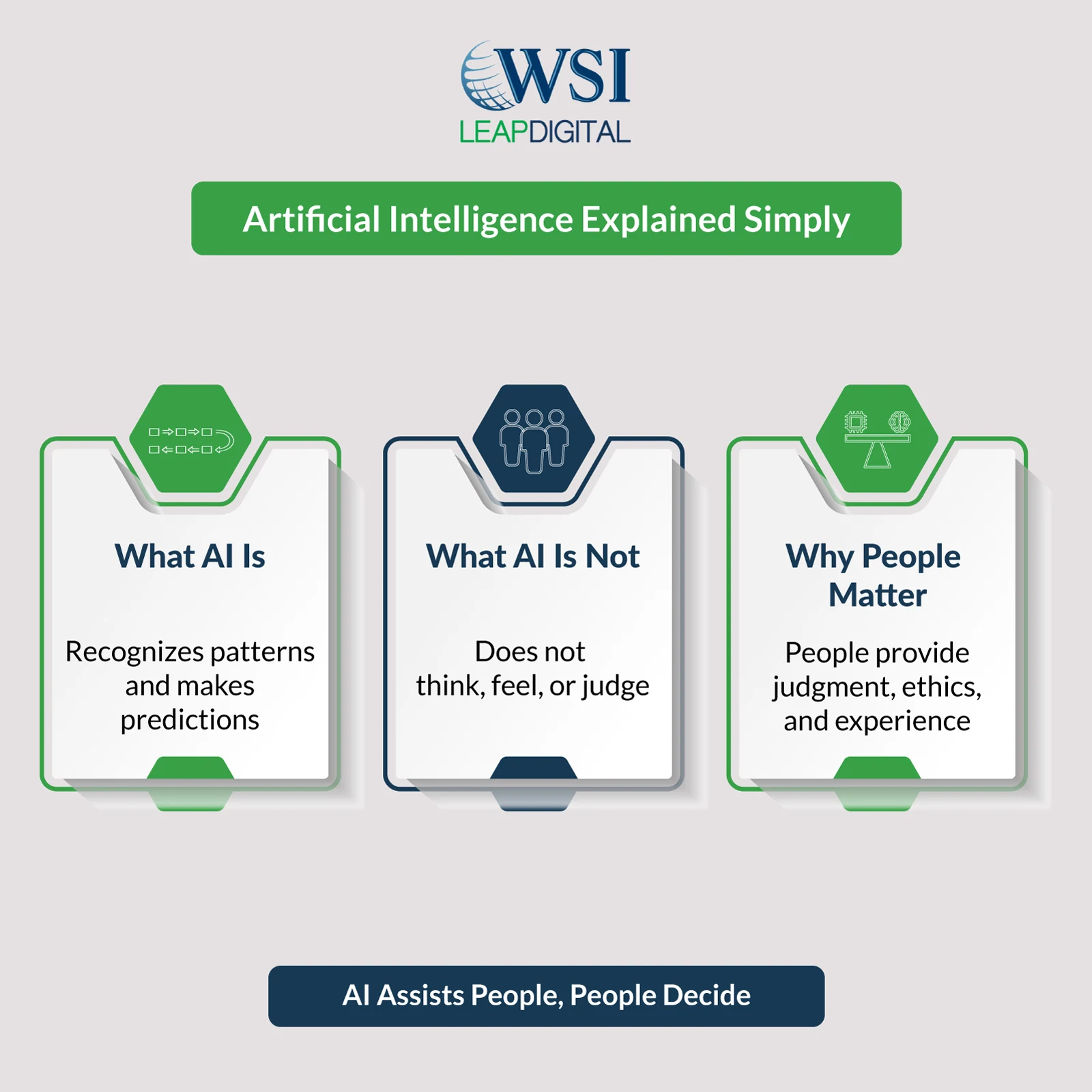
- Artificial Intelligence recognizes patterns and makes predictions based on data, without understanding meaning, emotion, ethics, or context, the way people do.
- AI supports daily life through healthcare, communication, accessibility, and convenience, while remaining dependent on human oversight and decision-making.
- Human judgment, life experience, ethics, and long-term thinking remain irreplaceable, making people, not technology, the final authority in how AI is used.
What Artificial Intelligence Actually Does
To understand Artificial Intelligence, you do not need a technical background. You only need one clear idea. AI does not think, reason, or understand the world. It performs a specific task extremely well: recognizing patterns in large amounts of information and using those patterns to make predictions. Once that idea is clear, most confusion around AI disappears. This section explains what AI does, how it works at a basic level, and why its capabilities are powerful yet limited.
AI Recognizes Patterns, Not Meaning
Artificial Intelligence is a computer program designed to study large volumes of information and detect patterns within that information. Based on those patterns, it can sort data, make predictions, or suggest outcomes.
At its core, AI follows a simple process:
- It reviews many examples
- It identifies recurring patterns across those examples
- It applies those patterns when presented with new information
That is the full scope of its function. AI calculates likelihood based on prior data. It does not interpret meaning or understand context the way people do.
What AI Can Do Well
AI excels at tasks that involve repetition, volume, and consistency. It can process more examples than any person could in a lifetime and apply patterns at high speed.
This allows AI to:
- Identify similarities across massive datasets
- Classify information quickly
- Detect trends that may be difficult for people to spot
These strengths make AI useful in narrow, well-defined tasks where speed and scale matter.
What AI Cannot Do
AI has clear limits that no amount of data can remove.
AI does not:
- Think independently
- Feel emotions
- Understand meaning
- Know right from wrong
- Form intentions
- Make value-based decisions
It does not understand the world as people do. It does not experience consequences. It does not hold beliefs or ethics. Everything it produces is based on probability, not understanding.
A Simple Analogy: Learning Through Examples
A helpful way to understand AI is to compare it to teaching a child through repetition.
Imagine showing a child many photos. Some photos show cats. Some show dogs. Each time, you label them clearly. Over time, the child notices patterns, such as ear shape, snout length, or body size. Eventually, the child makes an educated guess when shown a new photo.
AI learns in a similar way. It studies examples, detects patterns, and applies those patterns to new inputs. The difference is scale and speed.
How AI Learning Differs From Human Learning
AI operates very differently from people, even when the results appear similar.
AI:
- Uses millions of examples
- Works extremely fast
- Never becomes tired
- Does not understand what an animal is
- Does not know what a cat represents
- Does not recognize meaning, emotion, or significance
It produces a result based on pattern probability. Even when the answer is accurate, it remains a guess.
A fast guess.
A consistent guess.
Still a guess.
This distinction explains both the power and the limits of Artificial Intelligence.
AI Is Already Part of Your Daily Life
Artificial Intelligence often feels new because it is discussed more openly today, yet it has been part of everyday technology for many years. Long before recent headlines, AI was quietly built into tools designed to solve small, practical problems. These systems were not framed as Artificial Intelligence because they did not feel intimidating. They simply worked. Understanding where AI already exists helps remove fear and shows that its most effective role has always been supportive, not disruptive.
AI Has Been Working Behind the Scenes for Decades
AI did not suddenly appear in recent years. It has evolved gradually, becoming more capable as computing power and data increased. In many cases, it was introduced to improve speed, accuracy, or convenience in tasks people already performed.
Because these systems focused on narrow functions, they blended into daily routines without drawing attention to themselves.
Everyday Tools That Use AI
Many commonly used tools rely on AI, even if the word is rarely mentioned.
Examples include:
- Email spam filters that separate junk messages from important ones
- GPS navigation systems that adjust routes based on traffic
- Phone autocorrect that predicts intended words
- Streaming platforms that suggest videos or shows
- Voice assistants that respond to spoken requests
- Banking systems that flag unusual transactions
- Photo applications that group similar faces
These tools feel ordinary because they solve clear problems efficiently.
Why These AI Tools Feel Comfortable
These AI systems rarely cause concern because they follow three important principles:
- They perform specific tasks
- They reduce effort and friction
- They operate in the background
They assist without making decisions. They support without demanding attention. This quiet usefulness is why AI has been accepted in daily life for so long.
Where AI Delivers the Most Value
AI works best when its role is limited and clearly defined. When it focuses on helping people complete tasks faster, safer, or with less effort, it becomes a practical extension of existing tools rather than a replacement for human judgment.
What AI Is Not: Separating Reality From Assumptions
Much of the fear surrounding Artificial Intelligence does not come from what AI actually does. It comes from what people assume it does. Popular language often describes AI in human terms, which creates the impression that it thinks, understands, or makes decisions the way people do. Clearing up these assumptions is essential because misunderstanding AI leads to unrealistic expectations on one side and unnecessary fear on the other. The following points address the most common myths directly.
AI Does Not Think or Understand
AI does not think in any meaningful sense. It does not reason, reflect, or understand ideas. It processes information.
When an AI produces a poem about love, it is not expressing emotion. When it writes about grief, it is not experiencing sadness. When it offers advice, it does not grasp the consequences of that advice.
What it is doing is identifying patterns in language that humans have used before and assembling words in a way that statistically resembles similar writing. The result may sound thoughtful, persuasive, or empathetic. The process behind it remains mechanical.
There is no awareness behind the output. There is no intention behind the response.
AI Has No Consciousness or Awareness
AI has no sense of self and no awareness of the world around it.
It does not know:
- That it exists
- Who you are
- Why is it responding
- What its responses mean
AI does not observe, reflect, or remember experiences. It does not think between prompts. It does not continue processing unless it is actively instructed to do so.
When the prompt ends, the activity stops. There is no internal state, curiosity, motivation, or consciousness continuing in the background.
AI Cannot Replace Human Wisdom
Wisdom comes from living through experiences, making choices, facing consequences, and learning over time. AI has none of these foundations.
AI has no childhood, no family, no relationships, no memories, no failures, and no losses. It has never faced uncertainty, risk, regret, or responsibility.
Because of this, AI cannot:
- Weigh ethical trade-offs
- Understand context beyond data patterns
- Judge long-term consequences
- Apply moral reasoning
It can reflect patterns of human wisdom that appear in text. It cannot generate wisdom of its own.
Human judgment, shaped by experience and values, remains essential and irreplaceable.
How AI Supports Independence, Health, and Daily Living
Much of the public discussion around Artificial Intelligence focuses on risk, disruption, or long-term consequences. Far less attention is given to how AI already improves daily life in quiet, practical ways. For many people, especially older adults, AI is not something abstract or experimental. It is already present in tools that support health, reduce daily effort, and make staying connected easier. These uses are not about replacing people. They are about providing assistance where it matters most.
AI in Healthcare: Supporting Care Without Replacing Doctors
In healthcare, AI functions as a support system rather than a decision-maker. Its role is to help medical professionals work more efficiently and identify potential issues earlier.
AI assists doctors by:
- Reviewing medical images such as X-rays, MRIs, and scans more quickly
- Identifying patterns across large volumes of test results
- Flagging early signs that may require closer attention
These systems do not make diagnoses or treatment decisions. Doctors remain fully responsible. AI simply provides an additional layer of analysis that helps reduce oversight and improve consistency.
For patients, AI-powered tools support day-to-day health management:
- Medication reminders that reduce missed doses
- Monitoring heart rate, blood pressure, and blood sugar
- Virtual medical appointments that reduce travel and waiting
- Hearing aids that automatically adjust to different environments
- Fall detection systems that alert caregivers when help may be needed
Together, these tools help people maintain independence while increasing safety and peace of mind.
Everyday Convenience That Reduces Effort
Beyond healthcare, AI helps simplify everyday tasks that can become physically or mentally tiring over time. These tools are designed to reduce friction rather than introduce complexity.
Common examples include:
- Converting spoken words into text when typing is difficult
- Reading text aloud for those with vision or reading challenges
- Automatically adjusting screen brightness and text size
- Answering basic questions quickly without searching through menus
Many people rely on these features daily without thinking of them as AI. They are simply helpful tools that make technology easier to use.
Staying Connected With Less Frustration
Staying connected with family and friends becomes more important as distances grow and mobility changes. AI plays a key role in making communication clearer and more accessible.
AI supports connection by:
- Translating languages during conversations or messages
- Improving video call clarity
- Reducing background noise during calls
- Enhancing photos to preserve and share memories
These improvements reduce effort and frustration, making communication feel more natural and less demanding.
Understanding Chatbots and AI Writing Tools
The most visible form of Artificial Intelligence today is conversational AI. These are the systems people interact with directly through text or voice. Because they respond in full sentences and appear to “hold a conversation,” they feel more human than earlier technologies. This visibility often leads to confusion about their capabilities. These tools are powerful assistants for working with language, yet they remain limited by how they are designed and trained.
What These AI Tools Are Built to Handle
Chatbots and AI writing tools focus on tasks that involve reading, summarizing, organizing, and generating text. Their strength lies in handling large amounts of written information quickly.
Common uses include:
- Answering general questions
- Drafting emails, messages, or outlines
- Summarizing articles, reports, or documents
- Explaining topics in simpler language
- Helping structure plans, lists, or ideas
They are especially useful for reducing the time it takes to move from a blank page to a first draft.
How Chatbots Generate Responses
These systems are trained on large collections of human-written text. From this training, they learn how words, sentences, and ideas are commonly arranged. When a question is asked, the system predicts what a likely response would look like based on patterns it has seen before.
Important distinctions:
- They do not search the internet in real time
- They do not check sources for accuracy
- They do not confirm facts before responding
- They do not understand meaning or intent
They generate language that sounds plausible, not language that is guaranteed to be correct.
Why the Responses Often Sound Confident
One of the most misleading aspects of these tools is their tone. The responses are usually clear, well-structured, and confident. This happens because the system is trained on polished writing from many sources.
Clarity should not be confused with certainty.
Confidence should not be confused with correctness.
A response can sound authoritative while still containing gaps, assumptions, or errors.
Where People Commonly Misjudge These Tools
Problems arise when chatbots are treated as experts rather than assistants. Because the language feels natural, people may assume understanding where none exists.
Common misunderstandings include assuming that the system:
- Knows current events
- Understands personal circumstances
- Grasps ethical or emotional nuance
- Can replace professional judgment
These assumptions can lead to misplaced trust.
Practical Ways These Tools Add Value
When used correctly, chatbots and writing tools offer real benefits. They work best as support systems that help people think, organize, and communicate more efficiently.
Effective uses include:
- Generating first drafts that a person edits
- Summarizing long material for quick review
- Rewriting information in clearer language
- Organizing ideas before decision-making
Human review remains essential.
The Right Mental Model
The safest way to think about these AI tools is as assistants that have read a very large library but have no personal experience, judgment, or responsibility.
- They help speed up work.
- They do not replace understanding.
- They assist with expression.
- They do not make decisions.
Used with clear boundaries, these tools can be valuable additions to everyday tasks without creating dependence or confusion.

Turn AI Into a Practical Business Advantage
AI delivers value when it supports strategy, decision-making, and people. Leap Digital helps you apply AI thoughtfully across your business, without confusion, risk, or unnecessary complexity.
Where AI Falls Short and Always Will
Artificial Intelligence can process information at scale, yet certain human abilities remain outside its reach. These limits are not temporary gaps waiting for improvement. They exist because of how AI is built and what it lacks.
AI struggles in areas that depend on lived understanding rather than data patterns. These include:
- Common sense shaped by real-world experience
- Emotional understanding rooted in empathy
- Moral reasoning that weighs consequences and values
- Cultural nuance that varies across communities and generations
- Humor that depends on shared experience and timing
Because AI does not live in the world, it cannot fully grasp how people behave in everyday situations. It may offer a response that seems logical while missing factors that feel obvious to someone with real-life experience.
AI also lacks the personal history that forms judgment. It has never experienced:
- Raising children while balancing responsibility and uncertainty
- Caring for aging parents with emotional and practical challenges
- Making sacrifices that shape priorities
- Facing regret and learning from it
- Growing through hardship, failure, or resilience
These experiences are central to decision-making and wisdom. They cannot be learned from text alone.
AI can reflect patterns of human thought. It cannot replace human understanding.
Jobs, Change, and a Pattern Worth Remembering
Fear around job loss appears whenever new technology emerges. This pattern repeats because change feels uncertain, especially when tools evolve faster than people expect.
History shows a consistent cycle:
- New technology disrupts existing tasks
- Some roles change or disappear
- New roles emerge
- Human skills adapt and shift in value
AI follows this same path. It is most effective at handling work that is repetitive, predictable, and structured. In practical terms, AI tends to:
- Automate routine tasks
- Support professionals with analysis and organization
- Increase efficiency in information-heavy work
At the same time, AI does not replace roles that depend on human presence, judgment, and responsibility. These include:
- Care that requires trust and emotional awareness
- Teaching that adapts to how people learn
- Leadership that involves accountability and values
- Ethical decision-making
- Relationship-building and communication
As routine tasks become automated, human-centered skills grow in importance. Work increasingly rewards judgment, empathy, critical thinking, and ethical reasoning.
Understanding this shift helps replace fear with perspective. AI does not remove the need for people. It reshapes how people contribute, placing greater value on what only humans can provide.
Why Older Generations Matter More, Not Less
The role of older generations in the age of Artificial Intelligence is often underestimated. In reality, it is becoming more important. AI systems reflect the information and decisions shaped by people. Without thoughtful guidance, they amplify existing flaws rather than correct them. This is where experience and perspective play a critical role.
AI Reflects Human Bias and Assumptions
AI does not form its own worldview. It mirrors the information it is trained on, including human biases and assumptions. If the data contains narrow viewpoints, oversights, or unbalanced perspectives, those patterns are repeated at scale. Without human intervention, AI does not recognize these distortions or correct them on its own.
Older generations help identify these blind spots because they have lived through social, economic, and cultural shifts. This awareness allows them to question assumptions that may appear normal in modern data yet have long-term consequences.
Long-Term Thinking Counters Short-Term Outputs
AI systems tend to prioritize efficiency and immediacy. They generate responses based on what is most likely or most common, which often favors short-term thinking. This approach can overlook long-term impact, sustainability, and unintended consequences.
Older generations bring a long-term perspective shaped by experience. Having seen trends rise and fall, they understand the value of patience, caution, and delayed gratification. This perspective helps guide AI use toward outcomes that benefit people over time rather than simply producing fast results.
Historical Memory Provides Context
AI has no memory of history beyond what appears in data. It does not understand why certain decisions failed in the past or why specific safeguards exist today. It lacks awareness of lessons learned through real-world consequences.
Older generations carry historical memory that adds essential context. They remember past technological shifts, policy mistakes, and social changes. This context helps guarantee that AI is guided with awareness rather than repeating avoidable errors.
Ethical Grounding Comes From Lived Experience
Ethics are not abstract concepts. They develop through lived experience, accountability, and reflection. AI cannot judge what is fair, responsible, or humane without human guidance.
Older generations contribute ethical grounding shaped by responsibility, caregiving, leadership, and consequence. These values help define boundaries for how AI should be applied, ensuring technology serves people rather than undermines trust or dignity.
Patience Strengthens Responsible Decision-Making
AI operates instantly. People do not always benefit from instant answers. Thoughtful decisions often require time, reflection, and restraint.
Patience, developed through life experience, acts as a stabilizing force. It helps prevent overreliance on automated outputs and encourages careful evaluation before action is taken.
Why Your Voice Matters
AI requires human values to function responsibly. Without guidance rooted in experience, perspective, and ethics, technology reflects only patterns, not wisdom. The voices of older generations help shape how AI is used, questioned, and governed.
Your insight provides balance.
Your experience provides direction.
Your voice helps guarantee technology serves people, not the other way around.
How to Think About AI Going Forward
Instead of seeing AI as something to trust or distrust, it is more productive to focus on how it should be used. AI is most effective when it operates under clear human oversight and responsibility.
AI Assists, People Decide
AI can provide suggestions, summaries, and analysis. It should never be the final authority. Decisions that affect people require human judgment, accountability, and context. Relying solely on automated outputs removes responsibility from the decision-maker. People must remain accountable for outcomes, especially when choices carry long-term impact.
AI Supports, People Judge
AI outputs must be evaluated. People remain responsible for determining accuracy, relevance, and appropriateness. Systems can produce confident-sounding responses that still miss important details. Human judgment guarantees that decisions are grounded in reality rather than probability.
AI Speeds Tasks, People Define Values
AI can increase efficiency and reduce workload. It cannot define priorities or values. Efficiency without direction leads to misplaced outcomes. People must decide what goals matter and guarantee that speed does not override responsibility.
AI Should Be Questioned
Blind acceptance creates risk. AI outputs should be examined, challenged, and refined. Questioning helps identify errors, gaps, and assumptions embedded in responses. This habit prevents overreliance and strengthens responsible use.
AI Requires Supervision
Technology works best when it is guided. Supervision guarantees that AI remains a tool rather than an authority. Oversight helps prevent misuse, drift, and unintended consequences. Human involvement provides stability and accountability over time.
Human Oversight Remains Essential
AI functions within boundaries set by people. When guided by experience, ethics, and responsibility, it can serve as a valuable support system. Without oversight, technology reflects patterns without understanding. Human leadership guarantees that AI serves real needs rather than abstract efficiency.
How Leap Digital Helps You Use AI the Right Way
Artificial Intelligence is not a being, a mind, or a replacement for people. It is a tool created by humans, trained on human information, and shaped by human decisions. Used thoughtfully, it can improve healthcare, support independence, reduce frustration, save time, and increase access to information, while careless use can spread errors, reinforce bias, and create unhealthy dependence. The difference is not the technology itself, it is how people choose to use it. This is where Leap Digital helps. Leap Digital supports individuals and organizations in approaching AI with clarity and responsibility, focusing on practical use, ethical boundaries, and real outcomes rather than hype or blind trust. By guiding the selection, integration, and oversight of AI tools, Leap Digital guarantees technology supports human judgment, values, and long-term goals, helping people use AI confidently as a tool that serves them rather than replaces them.

Get Clear, Human-Led AI Guidance
If you want to explore AI without hype or pressure, speak with an expert who focuses on responsible use, real outcomes, and long-term value tailored to your business.