

Modern analytics teams face increasing pressure to move past surface-level metrics like clicks and pageviews. These numbers show traffic, yet they don’t reveal how well content reaches the right audience, shapes perception, or drives qualified engagement. Organizations need KPIs that measure visibility and the quality of that reach. A multi-layered approach does this through inclusion rate (how widely content is referenced), citation quality (authority and contextual relevance), entity health (accuracy and trustworthiness of your digital presence), and AI-qualified conversion rate (the influence of AI touchpoints on user actions).
Together, these metrics give analytics and RevOps leaders a clearer view of performance, reveal gaps in reach or influence, and show how AI contributes to conversions. This framework helps teams focus on high-value sources, fix underperforming channels, and optimize for both human and AI-driven engagement, moving from vanity metrics to insights that actually guide strategy.
Key Takeaways:
- Measure inclusion to track content reach across sources, channels, and audience segments.
- Focus on citation quality and AI-qualified conversion rate to evaluate influence and effectiveness.
- Entity health metrics provide context for ongoing content authority and credibility.
Contents
- 1 KPI Definitions & Why They Matter
- 2 Building the Inclusion Tracker (Sampling SOP)
- 3 Entity Health Dashboard (Schema/GBP/Reviews/Authors)
- 3.1 Why Entity Health Matters
- 3.2 Core Components of an Entity Health Dashboard
- 3.3 1. Structured Data / Schema Implementation
- 3.4 2. Verified Profiles and Business Listings
- 3.5 3. Reviews and Reputation Signals
- 3.6 4. Authors and Contributor Tracking
- 3.7 5. Citation Quality Integration
- 3.8 Dashboard Design and Metrics
- 3.9 Best Practices
- 4 Quarterly Review Template (Green/Red Deltas)
- 5 FAQs
- 6 Measuring AI Inclusion and Entity Health for Deeper Content Insights
KPI Definitions & Why They Matter
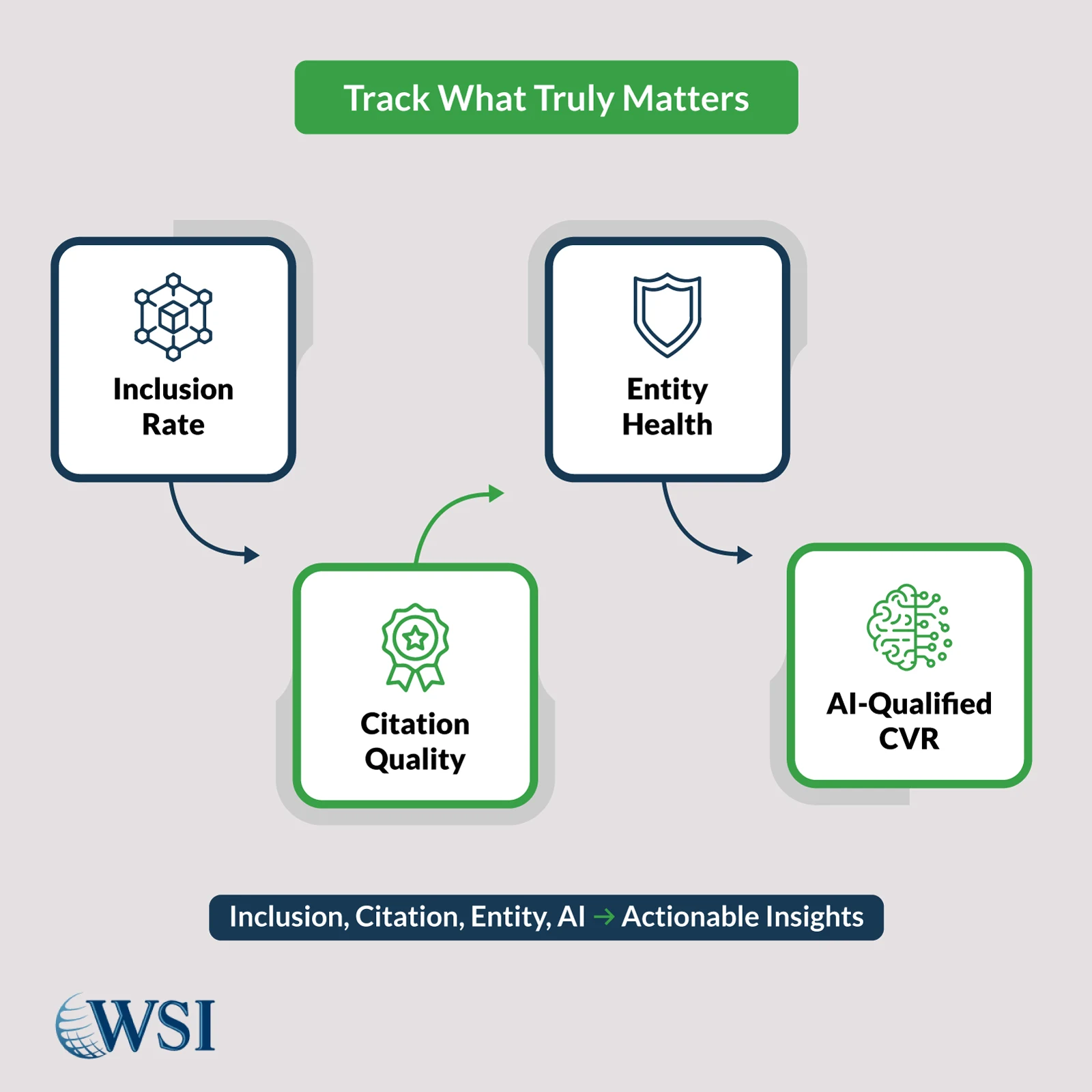
Before implementing a new measurement system, defining each KPI precisely is critical. Without clarity on what each metric represents, teams risk inconsistent tracking, misaligned reporting, and inaccurate decision-making. The framework we propose focuses on four interrelated pillars that together provide a holistic view of content performance and AI-influenced engagement.
Inclusion Rate
Inclusion rate measures the percentage of target sources or entities that reference your content or assets. This goes beyond raw traffic by assessing even if your content appears where it matters most in your ecosystem. Tracking inclusion helps teams identify gaps in reach and visibility.
Formula Example:
| Inclusion Rate | = |
|
× 100 |
Citation Quality
Not all citations are equal. Citation quality evaluates the authority and relevance of sources linking to your content. Weight citations based on metrics like domain authority, audience size, or topical relevance to identify high-value mentions.
Entity Health
Entity health tracks the integrity and completeness of your digital presence, including structured data, verified profiles, and review coverage. Healthy entities increase visibility in AI-powered platforms and improve trustworthiness for users and algorithms alike.
AI-Qualified Conversion Rate (CVR)
AI-qualified CVR measures conversions influenced by AI-driven signals such as chatbots, recommendation engines, or personalized LLM outputs. Unlike traditional CVR, this metric isolates AI contributions to conversion activity.
Building the Inclusion Tracker (Sampling SOP)
An effective inclusion tracker requires a structured approach to sampling, monitoring, and reporting. Without a methodical system, teams risk incomplete data, misrepresentative insights, or inconsistent benchmarking across periods. A good inclusion tracker will tell you not just if your material is being mentioned, but also where, by how many, and with what relative importance.
1. Define Your Universe of Sources
Start by identifying all relevant sources where your content or mentions could appear. These sources can include:
- Industry publications and blogs
- Forums, communities, and social platforms
- Partner websites and directories
- Internal references, such as knowledge bases or CRM-linked content
It’s critical to differentiate between high-value sources that significantly influence your audience or AI systems, and secondary sources that may be lower priority.
2. Determine Sampling Cadence
Sampling cadence balances precision with resource efficiency. A few approaches include:
- Weekly: Suitable for high-volume campaigns where rapid changes in coverage can occur.
- Monthly: Ideal for mid-tier programs or when monitoring smaller ecosystems.
- Quarterly: Appropriate for niche verticals or when tracking authority shifts over time.
Consistency in cadence allows for trend analysis and early identification of gaps in coverage.
3. Decide Sample Size and Weighting
- Sample Size: Randomly select a subset of your target sources to represent the full universe. Larger samples increase confidence in the results but require more resources.
- Weighting: Assign a higher weight to sources that are strategically important or have greater influence (e.g., top-tier industry publications, high-traffic websites). Weighting guarantees that a citation from a highly authoritative source has more impact on your inclusion rate metric than one from a minor site.
Example: If you monitor 50 sources, and 10 of them are high-impact, a mention in a high-impact source could count as 2-3 “points,” whereas a lower-impact site counts as 1.
4. Tracking and Monitoring Process
- Collection:
- Automated tools can scrape references from pre-defined domains or content feeds.
- Manual checks may be necessary for niche or non-indexed sources.
- Labeling:
- Categorize each reference by source type, priority, topic relevance, and weight.
- Track even if it’s a first-time inclusion or a repeat mention.
- Calculation:
- Compute the inclusion rate using the weighted formula:
| Weighted Inclusion Rate | = |
|
× 100 |
- Compare inclusion rates across segments (e.g., high vs low priority sources, regional vs global).
- Reporting:
- Visualize gaps in coverage and trends over time.
- Highlight missing references and areas where proactive outreach or content amplification is needed.
5. Best Practices for Accuracy
- Maintain a central repository of sources and categories to ensure consistency.
- Revisit your source universe periodically to add emerging channels or remove irrelevant ones.
- Integrate inclusion tracking with other KPIs like citation quality and entity health for a complete picture of content performance.
A structured inclusion tracker reveals where your content is underrepresented, enabling targeted interventions. By weighting and categorizing references, teams can focus efforts on high-value sources that influence both human audiences and AI-powered platforms. Properly implemented, inclusion tracking serves as a foundation for measuring citation quality, entity health, and AI-qualified CVR effectively.

Capture the full impact of AI-driven conversions with proper UTM and labeling strategies.
Our worksheet includes a guide for tagging AI referrals, ensuring accurate CVR measurement.
Entity Health Dashboard (Schema/GBP/Reviews/Authors)
Entity health measures the completeness, accuracy, and trustworthiness of your organization or content in digital ecosystems. In practical terms, it reflects how algorithms, AI systems, and users perceive your authority and credibility. A robust entity health dashboard consolidates multiple signals into a single view, enabling teams to track performance, identify gaps, and make data-driven decisions.
Why Entity Health Matters
- Algorithmic Recognition: Search engines and AI platforms use entity signals, like structured data, verified profiles, and author reputation, to assess content authority. A strong entity health profile increases the likelihood that your content will surface in AI-powered recommendations, search results, and knowledge panels.
- Trust and Credibility: Users often rely on external signals like reviews, citations, and verified profiles to judge credibility. Poor entity health can undermine conversion potential and reduce engagement.
- Cross-KPI Impact: Entity health directly affects other metrics such as inclusion rate, citation quality, and AI-qualified CVR. Healthy entities are more likely to attract high-quality citations and AI-driven conversions.
Core Components of an Entity Health Dashboard
1. Structured Data / Schema Implementation
- Implement schema markup for pages, products, services, and authors.
- See to it that all schemas are complete and accurate, including required fields and optional improvements (e.g., ratings, events, FAQs).
- Track errors or warnings via tools like Google Search Console to prevent AI misinterpretation.
2. Verified Profiles and Business Listings
- Maintain accurate profiles across Google Business Profile, LinkedIn, industry directories, and niche platforms.
- Track profile completeness, verification status, and updates.
- Ensure consistency of NAP (Name, Address, Phone) data across all listings to improve algorithmic trust.
3. Reviews and Reputation Signals
- Monitor review quantity, recency, and quality across platforms.
- Weight reviews by platform authority or relevance to your industry.
- Use sentiment analysis to identify recurring issues and improve customer experience.
4. Authors and Contributor Tracking
- Maintain consistent authorship across content pieces to establish topical authority.
- Track author profiles, publication history, and influence in relevant subject areas.
- Highlight high-performing contributors to optimize content strategy and AI recognition.
5. Citation Quality Integration
- Incorporate weighted citation metrics to understand which sources reinforce your entity.
- Track both the volume and quality of citations over time, visualizing shifts in authority and reach.
Dashboard Design and Metrics
A well-structured dashboard should provide clear, actionable insights:
- Scorecard Approach: Assign scores for each component (schema completeness, reviews, profile verification, author consistency).
- Color-Coded Health Indicators: Use green, yellow, and red to indicate status and focus areas.
- Trend Tracking: Monitor entity health over time to detect improvements or deteriorations.
- Segmented Views: Filter by region, content type, or source authority to identify granular performance trends.
Example Metrics to Include:
- Schema Coverage % (complete vs incomplete pages)
- Verified Profiles %
- Average Review Rating and Volume
- Author Consistency Index
- Citation Quality Score
Best Practices
- Centralize Data Sources: Pull signals from multiple platforms into one dashboard to reduce fragmentation.
- Automate Updates: Schedule regular data pulls to keep metrics current, especially for reviews, citations, and schema health.
- Correlate with Conversions: Align entity health metrics with AI-qualified CVR and inclusion rate to see how authority impacts results.
- Quarterly Audits: Conduct formal reviews to identify gaps, update schema, refresh profiles, and improve content for AI visibility.
A fully implemented entity health dashboard provides analytics and RevOps leaders with a clear view of organizational authority, AI recognition, and credibility. By systematically tracking these signals, teams can proactively optimize digital presence, improve AI-driven engagement, and strengthen the impact of content across channels.
Quarterly Review Template (Green/Red Deltas)
Quarterly reviews are a critical part of any KPI framework. They transform raw performance data into insights that guide strategy, operational adjustments, and resource allocation. Beyond simple reporting, a well-structured quarterly review allows teams to identify trends, diagnose issues, and highlight successes across multiple performance dimensions such as inclusion rate, citation quality, entity health, and AI-qualified CVR.
Why Quarterly Reviews Matter
- Trend Identification: Quarterly intervals provide enough data to observe meaningful patterns, seasonal variations, and long-term shifts.
- Cross-KPI Correlation: By reviewing multiple KPIs together, leaders can see how inclusion, citations, and entity health influence conversions and AI-driven outcomes.
- Action-Oriented Insights: Highlighting changes in performance with visual cues enables teams to prioritize high-impact actions.
Structuring the Review
- KPI Summary Section
- Include all core KPIs: inclusion rate, weighted citation quality, entity health score, and AI-qualified CVR.
- Present a baseline for each KPI, the current quarter’s performance, and delta changes from the previous quarter.
- Use weighted calculations for inclusion or citation quality to ensure high-value sources influence the overall metric accurately.
- Green/Red Delta Analysis
- Visual cues like green for improvements and red for declines quickly signal performance shifts.
- Include quantitative deltas, e.g.,
- Inclusion Rate: +12% from previous quarter (green)
- Citation Quality: -5% (red)
- AI-Qualified CVR: +3% (green)
- For more granular insight, add trend arrows or mini sparklines showing progression over multiple quarters.
- Segmented Views
- Break KPIs down by source, channel, or entity segment to identify specific areas driving gains or losses.
- Examples:
- Region: North America vs Europe
- Source Type: Industry publications vs forums
- Content Type: Blog posts vs AI-generated recommendations
- Action Items and Recommendations
- Clearly link each KPI delta to recommended actions. Examples:
- Negative delta in inclusion rate >> increase outreach to high-value sources.
- Decline in citation quality >> target authoritative publications or revise content for relevancy.
- Low AI-qualified CVR >> review tagging, prompts, or recommendation algorithms.
- Assign responsible team members and deadlines to guarantee accountability.
- Narrative Notes
- Include explanations for anomalies, e.g., why a sudden spike in citations occurred or why AI-qualified CVR dropped unexpectedly.
- Contextual insights help leadership interpret data beyond surface-level metrics.
Best Practices for Quarterly Reviews
- Consistency in Metrics: Ensure KPIs are measured and weighted the same way each quarter to maintain comparability.
- Visualization: Use dashboards or reports with clear visual cues. Heatmaps, red/green deltas, and trend graphs make insights digestible at a glance.
- Integration with Other KPIs: Combine quarterly review results with entity health and inclusion tracking to understand how changes in authority or coverage affect AI-driven conversions.
- Documentation: Archive each quarterly review to track long-term trends and inform future strategy.
Example Quarterly Review Dashboard Layout
| KPI | Previous Qtr | Current Qtr | Delta | Status | Notes / Action Item |
|---|---|---|---|---|---|
| Inclusion Rate | 65% | 72% | +7% | 🟢 Green | Continue outreach to top-tier sources |
| Weighted Citation Quality | 78 | 75 | -3 | 🔴 Red | Target authoritative publications |
| Entity Health Score | 88 | 90 | +2 | 🟢 Green | Maintain structured data consistency |
| AI-Qualified CVR | 4.2% | 4.5% | +0.3% | 🟢 Green | Optimize AI recommendations further |
This structured approach guarantees the quarterly review is not just a reporting exercise but a strategic tool that drives actionable improvements in coverage, authority, and AI-driven performance.
FAQs
How can I accurately measure the inclusion rate across multiple sources?
Measuring inclusion rate starts with defining the universe of sources where your content should appear, such as industry publications, forums, partner sites, and internal knowledge bases. Once the sources are defined, you can use a combination of automated scraping tools and manual checks to track mentions or references. Weighting high-value sources more heavily ensures the metric reflects meaningful reach rather than simply counting every mention equally.
Why is citation quality more important than total mentions?
Not all mentions carry the same value, and tracking citation quality helps you focus on authoritative and contextually relevant sources. By weighting citations based on metrics like domain authority, audience size, and topical alignment, you can distinguish high-impact references from low-value mentions. This approach ensures that your content’s perceived credibility and influence are evaluated more accurately than by raw counts alone.
How do AI-qualified conversions differ from traditional conversion metrics?
AI-qualified conversions specifically measure actions influenced by AI-driven interactions, such as chatbots, recommendation engines, or LLM-generated content. Unlike traditional conversion rates that aggregate all user actions, AI-qualified CVR isolates the impact of AI touchpoints, helping teams understand how AI contributes to engagement and revenue. This distinction allows organizations to optimize AI strategies, allocate resources effectively, and accurately attribute performance to both human and AI-driven efforts.
Measuring AI Inclusion and Entity Health for Deeper Content Insights
Tracking inclusion, citation quality, entity health, and AI-qualified conversions gives analytics and RevOps leaders a clearer understanding of how content performs and influences key audiences. Inclusion measures, even if your content is reaching the right sources, citation quality highlights the value of those mentions, entity health reflects credibility and trust, and AI-qualified CVR quantifies the impact of AI-driven interactions on conversions.
Implementing structured sampling, consistent tagging, and ongoing entity monitoring allows teams to spot gaps, prioritize high-value sources, and optimize AI-driven initiatives. This approach turns data into actionable insights, helping organizations make informed decisions, improve content authority, and strengthen engagement across both human and AI-powered channels.

Take control of your analytics with our comprehensive KPI worksheet, designed to unify inclusion, citations, entity health, and AI signals.
Start your structured measurement process today to improve visibility, influence, and AI-driven performance.