

You’ve made a change to your website. Maybe you’ve added new titles, cleaned up content, and improved your internal links. Then you wait.
Nothing happens.
A week goes by. Still nothing.
You start wondering: How long does SEO take? Is this working? Did I do something wrong?
Google’s Martin Splitt and John Mueller recently tackled this exact concern, and their answers offer more nuance than most of the SEO myths floating around.
Contents
- 1 Immediate vs. Strategic: The Spectrum of SEO Changes
- 2 How Long Does SEO Take for Google to Reflect Changes?
- 3 The Trap of Early Wins
- 4 Why Monitoring SEO Is More Than Just Rank Checking
- 5 The Value of Feedback Loops in SEO
- 6 SEO Gains Tend to Plateau, And That’s Okay
- 7 Your SEO Strategy Needs More Than Patience
- 8 FAQ
- 9 SEO Isn’t Magic, It’s Management
Key Takeaways:
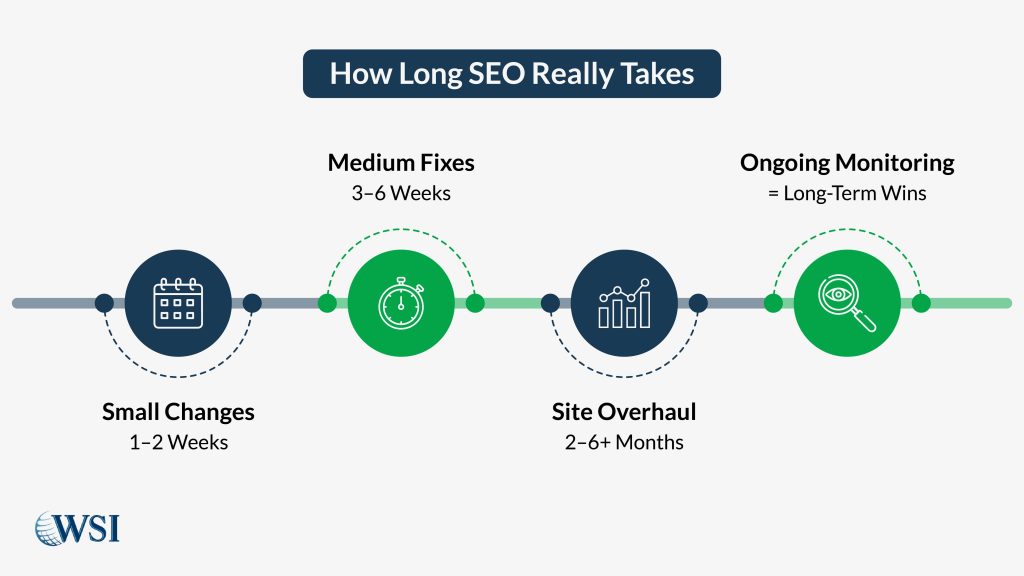
- Basic SEO edits like title tag updates or content tweaks can show results in one to two weeks.
- Structural overhauls, architecture changes, or full content rewrites may take several months to influence rankings.
- A successful SEO strategy involves continuous monitoring, feedback, and transparent reporting, not just one-time fixes.
Immediate vs. Strategic: The Spectrum of SEO Changes
Not all SEO changes are created equal. That’s the part most people overlook.
According to Mueller, if you’re working on a site that’s never been optimized, no meta tags, no structured layout, poor navigation, then you might see noticeable improvements within days or weeks just by fixing the basics. These are what we’d call low-hanging fruit:
- Clear page titles
- Proper headings
- Indexable navigation
- Descriptive alt text
These types of changes are easy for Google to crawl and reprocess. Mueller noted that even simple text edits can register quickly if the site is small and frequently crawled.
But once you get into broader changes, revamping site architecture, restructuring internal links, and rewriting entire sections of content, you’re looking at a longer game. The scale of the change determines how long SEO takes to show meaningful results, and that can range from a few weeks to several months.
Think of it this way: fixing a typo in your resume is different from switching industries. One takes minutes to notice, the other takes time to build momentum.
How Long Does SEO Take for Google to Reflect Changes?
Martin Splitt asked a fair question: If I change my homepage content and swap out images, how long does SEO take to reflect those changes?
Mueller’s answer: It depends on the size of your site and the scope of the change.
If you’re editing your homepage and a few top-level pages, you should see those changes show up in search within one to two weeks, especially if you search your site manually and monitor snippets, title tags, and meta descriptions.
You can literally search for your domain and see if the new title has been indexed. That’s your first clue.
However, that’s just the indexing part. Ranking shifts come later, and they’re not always linear.
The Trap of Early Wins
Here’s something Mueller didn’t elaborate on, but you need to know.
Sometimes, after an update, your site does jump in rankings. You get a surge in clicks, traffic spikes, and everything looks great.
Then, it fades.
Why? Because Google is constantly testing. It may boost your page briefly to see how users respond. If people bounce, don’t engage, or prefer another result, you’ll drop.
This is called query feedback, a concept tied closely to user signals like click-through rate, dwell time, and return visits. Studies by Moz and SEMRush have consistently shown that user behavior metrics correlate with long-term rankings.
So, it’s not just about what you change. It’s how users respond that matters.
Why Monitoring SEO Is More Than Just Rank Checking
Mueller was clear: a skilled SEO doesn’t just “set it and forget it.” They should be monitoring what’s happening every step of the way.
That means:
- Checking crawl logs
- Watching indexation trends
- Tracking SERP changes
- Analyzing which keywords are gaining traction
- Reviewing what didn’t move at all
If you hired someone who made a few changes and then disappears for six months, you’re not working with a real partner. A solid SEO should tell you what they’ve changed, when it should start having an impact, and how they’re measuring progress over time.
This transparency is critical. Without it, you’re flying blind.
The Value of Feedback Loops in SEO
One of the most underestimated levers in SEO success? Real-time user feedback.
While many obsess over algorithm updates, backlinks, or technical audits, what often gets ignored is how actual users engage with your content, and what they’re telling you (directly or indirectly) about what works and what doesn’t.
Google pays attention to these signals. Pages that satisfy search intent, based on engagement metrics like dwell time, click-through rates, and return visits, tend to sustain better rankings. User behavior is a proxy for trust.
So, how do you build those feedback loops into your SEO process? Start with frictionless, scalable tactics:
- Add thumbs-up/down ratings at the bottom of posts to gauge content helpfulness quickly
- Enable a moderated comment section to invite deeper input without spam risk
- Use heatmap (Hotjar, Microsoft Clarity) to visualize scroll depth, click activity, and content drop-off points
- Deploy lightweight tools like Qualaroo or Usabilla for contextual surveys, like “Was this page helpful?” prompts after 30 seconds of engagement
Want more tactical insights? Test scroll-triggered polls on long-form pages or auto-invite exit intent surveys. Some SaaS brands see up to a 20% feedback response rate using this strategy (source: CXL Institute).
Even just placing a contact or feedback button in your site’s sticky header can invite valuable suggestions, and that kind of qualitative data is gold. Not only can it improve SEO, but it also helps you tighten UX, identify knowledge gaps, and uncover new content opportunities.
Smart SEO isn’t just about publishing better, it’s about listening better.
SEO Gains Tend to Plateau, And That’s Okay
Mueller made another important point: the first wave of SEO wins usually comes quickly if your site was poorly optimized to begin with. You’ll see early gains, and then things slow down.
That’s normal.
How long does SEO take to plateau? Typically, a few months after your initial improvements.
SEO is a compounding asset. Just like a good investment portfolio, it grows slowly over time once the initial boost is baked in. This plateau doesn’t mean you’ve failed; it means you’re in the long game now.
What matters next is consistency:
- Continue publishing helpful, original content around your core topics
- Update underperforming pages with fresh data, visuals, and internal links
- Earn backlinks from niche-relevant sources and industry citations
Most plateaus are broken not by big shifts, but by small, consistent upgrades. For example, reworking a blog’s introduction to better align with user search intent can increase time-on-page by over 30% (source: Backlinko case studies).
The key is knowing what to watch for. Here’s a simplified roadmap for tracking post-optimization performance:
| Time Frame |
What to Look For |
| Week 1–2 | Indexation of new pages, updated titles/descriptions |
| Week 3–6 | Early ranking shifts, SERP appearance changes |
| Month 2–4 | Steady traffic changes, crawl frequency trends |
| Month 4–6+ | Engagement metrics, backlinks, and topic authority |
Your SEO Strategy Needs More Than Patience
Patience alone won’t get you far. You need data, context, and someone who can interpret the signals.
Mueller stressed the importance of working with SEOs who don’t just wait around. They’re proactive. They track Google bots’ activity. They explain what’s been done and what’s next.
They say:
- “Here’s the list of changes we’ve implemented.”
- “Here’s how often Google has crawled the site since then.”
- “Here’s when we expect ranking shifts based on crawl cycles and query behavior.”
Elite SEOs don’t just deliver reports, they deliver foresight. They connect ranking movement to user engagement. They align strategy with business outcomes. And they adjust the plan in real-time based on what the data tells them.
If you don’t have that level of clarity from your SEO team or partner, you’re not set up for long-term wins.
FAQ
How long does SEO take to show results from changes?
Most simple SEO changes, like updating page titles, improving meta descriptions, or fixing on-page content, can show results in one to two weeks, especially for smaller websites. However, more complex changes like restructuring your site, publishing new content at scale, or improving site speed and UX can take two to six months to impact rankings. The timeline depends on how quickly Google crawls your site and how competitive your keywords are.
Why do SEO rankings sometimes improve quickly and then drop off?
A quick boost in rankings can happen when Google tests your updated content to see how users respond. If engagement is low, like people bouncing back to search results or not spending time on your page, your rankings may drop again. This is part of Google’s quality assurance process. Sustainable rankings come from pages that consistently meet search intent and offer a good user experience.
What should I do while waiting for SEO changes to take effect?
While waiting, you should actively monitor your site’s performance. Use tools like Google Search Console to track indexing status, impressions, and clicks. Review user behavior through heatmap or analytics to see how people interact with your content. Keep improving other parts of your site, like internal links, loading speed, and content relevance. SEO isn’t a one-time fix; it’s an ongoing process of testing, measuring, and adjusting.
SEO Isn’t Magic, It’s Management
Too many people think SEO is a black box. It’s not. It’s a discipline grounded in process, feedback, and iteration.
Still wondering how long SEO takes? Simple changes can show results in days. Larger overhauls may take months. And some improvements may only bear fruit when paired with great content, technical health, and genuine user satisfaction.
If you treat SEO like a campaign instead of a project, one that requires consistent refinement, you’ll win in the long run.